







Question: Old MathJax webview Old MathJax webview 1.1 Do you believe that Blackberry neglected their design process Discuss Could Blackberry have used lean production to stay
Old MathJax webview
Old MathJax webview
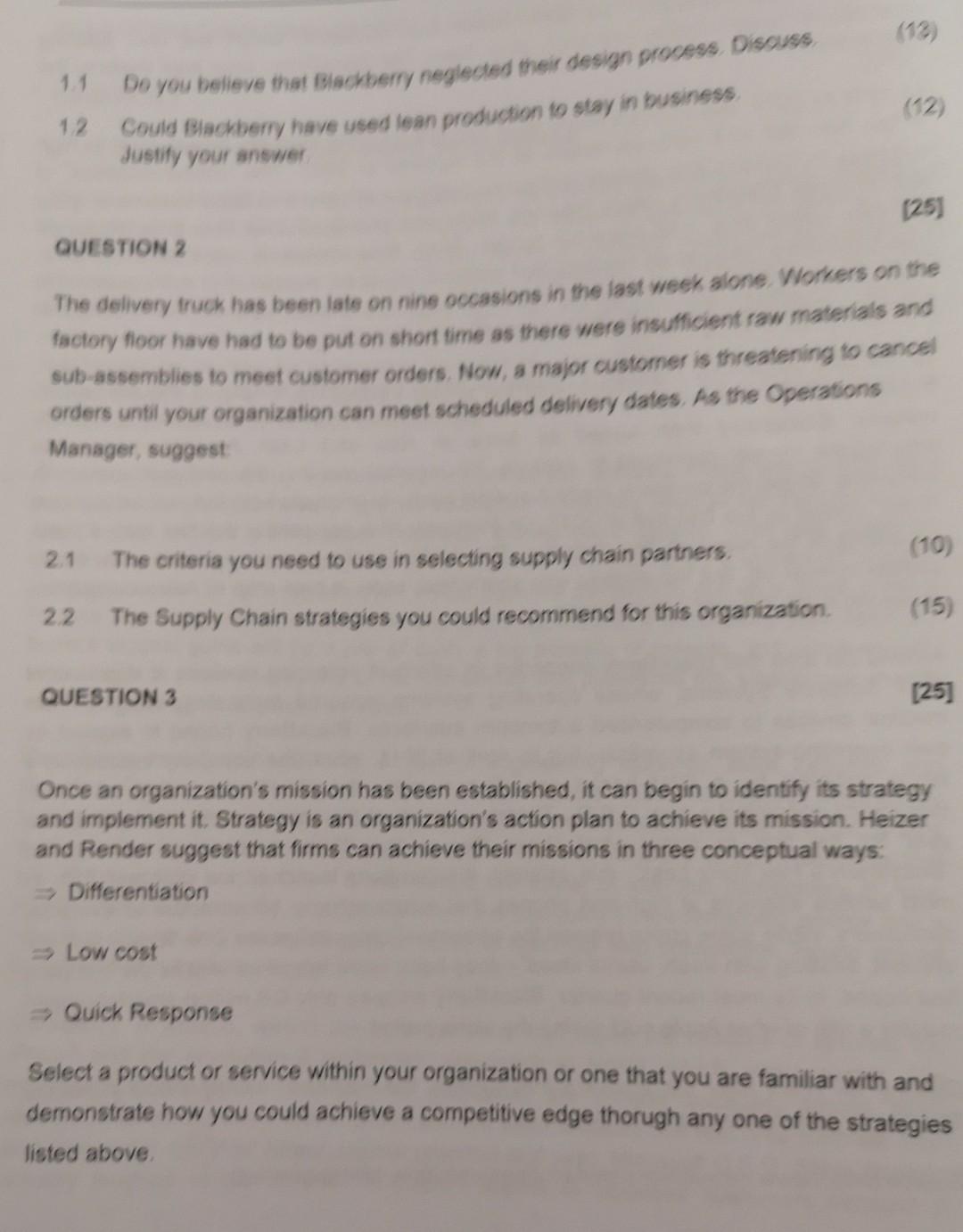
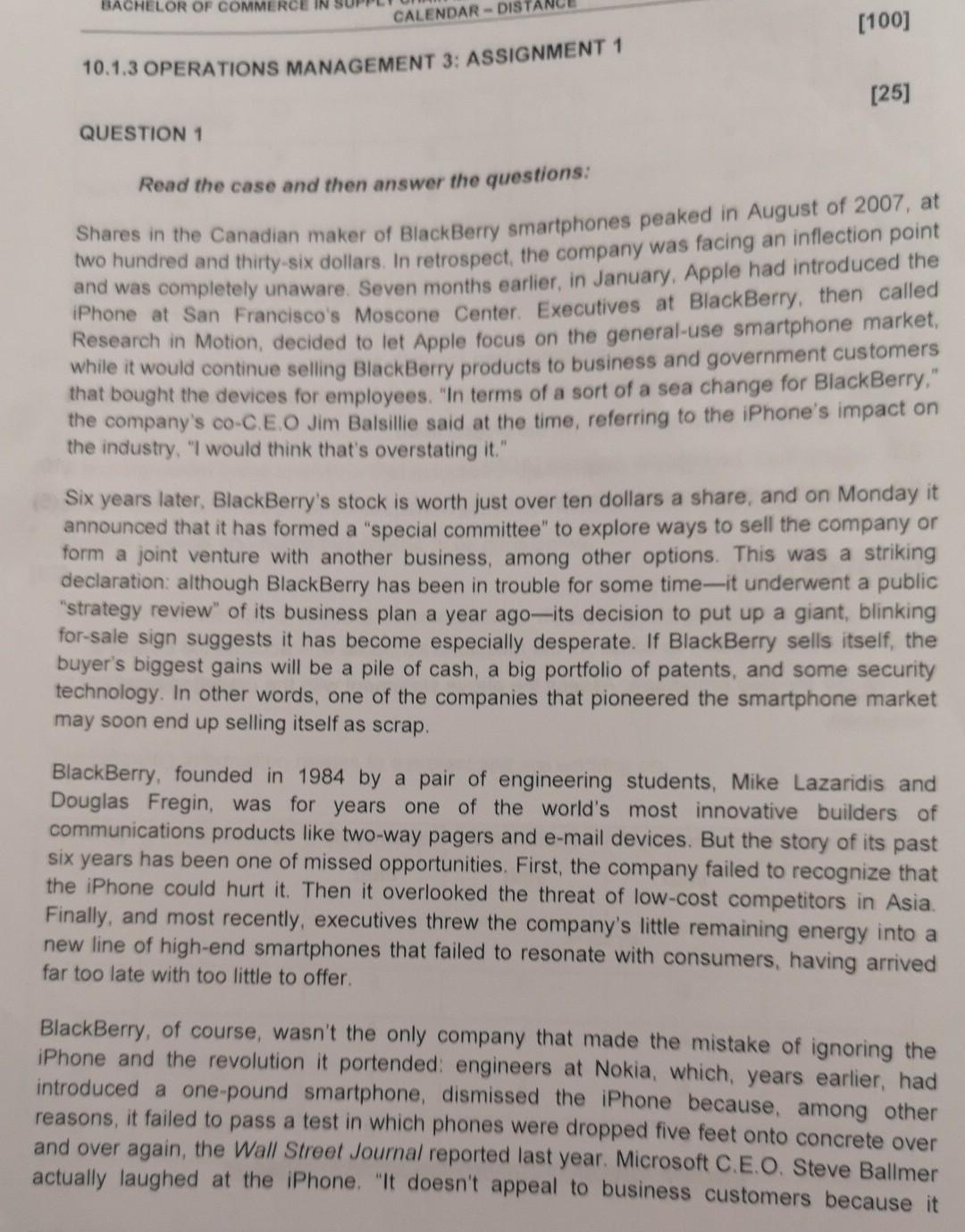
1.1 Do you believe that Blackberry neglected their design process Discuss Could Blackberry have used lean production to stay in business (12) 12 Justify your answer 125) QUESTION 2 The delivery truck has been late on nine occasions in the last week alone Worters on the factory foor have had to be put on short time as there were insuficient raw materials and sub-assemblies to meet customer orders. Now, a major customer is threatening to cancel orders until your organization can meet scheduled delivery dates. As the Operations Manager, suggest (10) 2.1 The criteria you need to use in selecting supply chain partners. 22 The Supply Chain strategies you could recommend for this organization (15) QUESTION 3 [25] Once an organization's mission has been established, it can begin to identify its strategy and implement it. Strategy is an organization's action plan to achieve its mission. Heizer and Render suggest that firms can achieve their missions in three conceptual ways: Differentiation - Low cost - Quick Response Select a product or service within your organization or one that you are familiar with and demonstrate how you could achieve a competitive edge thorugh any one of the strategies listed above BACHELOR OF COMMERCE IN CALENDAR - DIS [100] 10.1.3 OPERATIONS MANAGEMENT 3: ASSIGNMENT 1 [25] QUESTION 1 Read the case and then answer the questions: Shares in the Canadian maker of BlackBerry smartphones peaked in August of 2007, at two hundred and thirty-six dollars. In retrospect, the company was facing an inflection point and was completely unaware. Seven months earlier, in January, Apple had introduced the iPhone at San Francisco's Moscone Center. Executives at BlackBerry, then called Research in Motion, decided to let Apple focus on the general-use smartphone market, while it would continue selling BlackBerry products to business and government customers that bought the devices for employees. "In terms of a sort of a sea change for BlackBerry," the company's co-C.E.O Jim Balsillie said at the time, referring to the iPhone's impact on the industry. "I would think that's overstating it." Six years later, BlackBerry's stock is worth just over ten dollars a share, and on Monday it announced that it has formed a "special committee" to explore ways to sell the company or form a joint venture with another business, among other options. This was a striking declaration: although BlackBerry has been in trouble for some time--it underwent a public "strategy review of its business plan a year ago-its decision to put up a giant, blinking for-sale sign suggests it has become especially desperate. If BlackBerry sells itself, the buyer's biggest gains will be a pile of cash, a big portfolio of patents, and some security technology. In other words, one of the companies that pioneered the smartphone market may soon end up selling itself as scrap. BlackBerry, founded in 1984 by a pair of engineering students, Mike Lazaridis and Douglas Fregin, was for years one of the world's most innovative builders of communications products like two-way pagers and e-mail devices. But the story of its past six years has been one of missed opportunities. First, the company failed to recognize that the iPhone could hurt it. Then it overlooked the threat of low-cost competitors in Asia. Finally, and most recently, executives threw the company's little remaining energy into a new line of high-end smartphones that failed to resonate with consumers, having arrived far too late with too little to offer. BlackBerry, of course, wasn't the only company that made the mistake of ignoring the iPhone and the revolution it portended: engineers at Nokia, which, years earlier, had introduced a one-pound smartphone, dismissed the iPhone because, among other reasons, it failed to pass a test in which phones were dropped five feet onto concrete over and over again, the Wall Street Journal reported last year. Microsoft C.E.O. Steve Ballmer actually laughed at the iPhone. "It doesn't appeal to business customers because it
Step by Step Solution
There are 3 Steps involved in it
1 Expert Approved Answer
Step: 1 Unlock

Question Has Been Solved by an Expert!
Get step-by-step solutions from verified subject matter experts
Step: 2 Unlock
Step: 3 Unlock
 Study Help