







Question: omplete the steps below using cell references to given data or previous calculations. In some cases, a simple cell reference is all you need. To
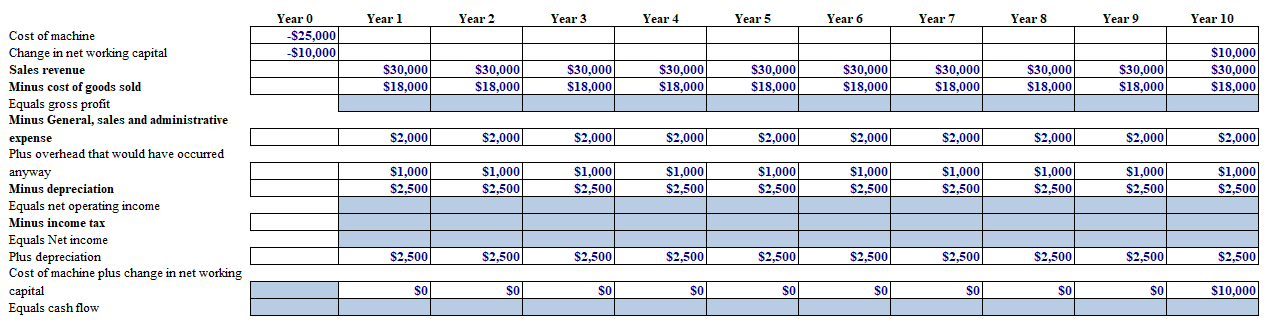
omplete the steps below using cell references to given data or previous calculations. In some cases, a simple cell reference is all you need. To copy/paste a formula across a row or down a column, an absolute cell reference or a mixed cell reference may be preferred. If a specific Excel function is to be used, the directions will specify the use of that function. Do not type in numerical data into a cell or function. Instead, make a reference to the cell in which the data is found. Make your computations only in the blue cells highlighted below. In all cases, unless otherwise directed, use the earliest appearance of the data in your formulas.
You are a manager at Percolated Fiber, which is considering expanding its operations in synthetic fiber manufacturing. Your boss comes into your office, drops a consultants report on your desk, and complains, We owe these consultants $1 million for this report, and I am not sure their analysis makes sense. Before we spend the $25 million on new equipment needed for this project, look it over and give me your opinion. You open the report and find the following estimates (in thousands of dollars):
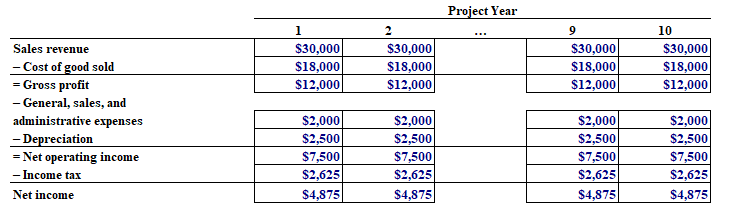
All of the estimates in the report seem correct. You note that the consultants used straightline depreciation for the new equipment that will be purchased today (year 0), which is what the accounting department recommended. The report concludes that because the project will increase earnings by $4.875 million per year for 10 years, the project is worth $48.75 million. First, you note that the consultants have not factored in that the project will require $10 million in working capital upfront (year 0), which will be fully recovered in year 10. Next, you see they have attributed $2 million of selling, general and administrative expenses to the project, but you know that $1 million of this amount is overhead that will be incurred even if the project is not accepted.
A. Given the available information, what are the free cash flows in years 0 through 10 that should be used to evaluate the proposed project?
B. If the cost of capital for this project is 14%, what is your estimate of the value of the new project?
Tax Rate: 35%
A. Given the available information, what are the free cash flows in years 0 through 10 that should be used to evaluate the proposed project?
B. If the cost of capital for this project is 14%, what is your estimate of the value of the new project?
Cost of Capital: 14%
NPV:?
Project Year Cost of machine Change in net working capital Sales revenue Minus cost of goods sold Equals gross profit Minus General, sales and administrative expense Plus overhead that would have occurred anyway Minus depreciation Equals net operating income Minus income tax Equals Net income Plus depreciation Cost of machine plus change in net working capital Equals cash flow Year 0 Year 1 \begin{tabular}{|r|r|r|r|} \hline$25,000 & & & \\ \hline$10,000 & & & \\ \hline & $30,000 & $30,000 & $30,000 \\ \hline & $18,000 & $18,000 & $18,000 \\ \hline & & & \\ \hline \end{tabular} Year 4 Year 5 Year 6 Year 7 Year 8 Year 9 Year 10
Step by Step Solution
There are 3 Steps involved in it

Get step-by-step solutions from verified subject matter experts
 Study Help