







Question: On C++ You will write the following sorts: Selection sort Straight insertion sort Bubble sort Quick sort You are to find a C++ implementation of
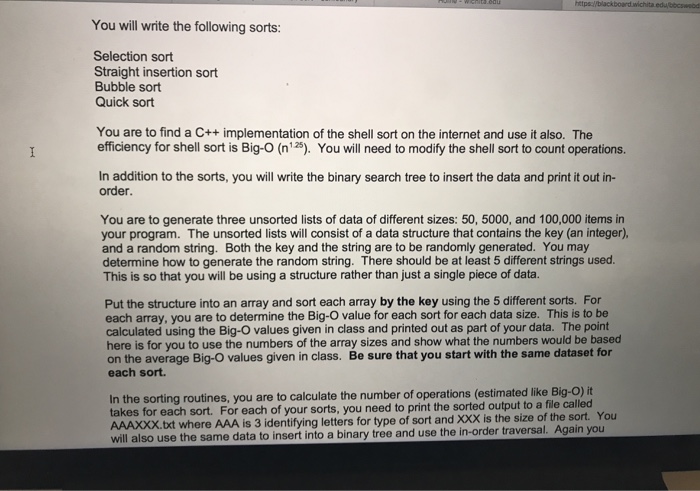
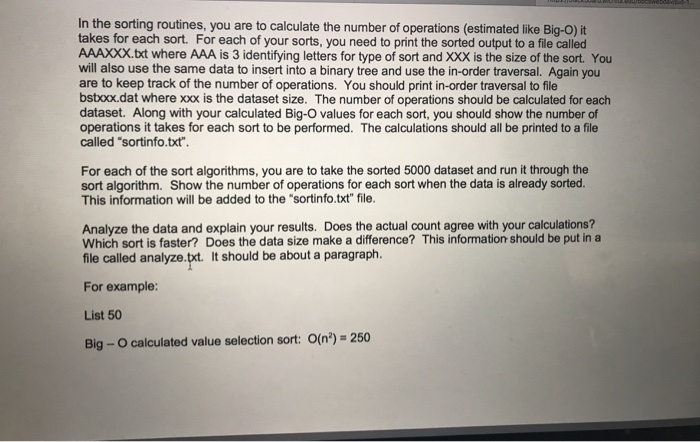
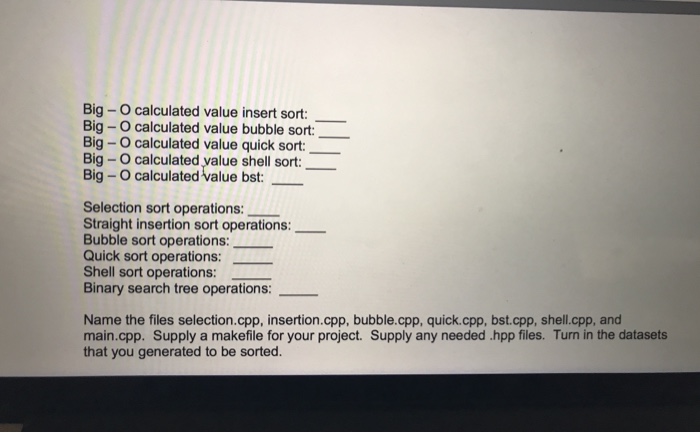
You will write the following sorts: Selection sort Straight insertion sort Bubble sort Quick sort You are to find a C++ implementation of the shell sort on the internet and use it also. The efficiency for shell sort is Big-O (n125). You will need to modify the shell sort to count operations. In addition to the sorts, you will write the binary search tree to insert the data and print it out in- order. You are to generate three unsorted lists of data of different sizes: 50, 5000, and 100,000 items in your program. The unsorted lists will consist of a data structure that contains the key (an integer) and a random string. Both the key and the string are to be randomly generated. You may determine how to generate the random string. There should be at least 5 different strings used This is so that you will be using a structure rathr than just a single piece of data. Put the structure into an array and sort each array by the key using the 5 different sorts. For each array, you are to determine the Big-O value for each sort for each data size. This is to be calculated using the Big-O values given in class and printed out as part of your data. The point here is for you to use the numbers of the array sizes and show what the numbers would be based on the average Big-O values given in class. Be sure that you start with the same dataset for each sort. In the sorting routines, you are to calculate the number of operations (estimated like Big-O) it takes for each sort. For each of your sorts, you need to print the sorted output to a file called XXX is the size of the sort. You AAAXXX.txt where AAA is 3 identifying letters for type of sort and will also use the same data to insert into a binary tree and use the in-order traversal. Aga You will write the following sorts: Selection sort Straight insertion sort Bubble sort Quick sort You are to find a C++ implementation of the shell sort on the internet and use it also. The efficiency for shell sort is Big-O (n125). You will need to modify the shell sort to count operations. In addition to the sorts, you will write the binary search tree to insert the data and print it out in- order. You are to generate three unsorted lists of data of different sizes: 50, 5000, and 100,000 items in your program. The unsorted lists will consist of a data structure that contains the key (an integer) and a random string. Both the key and the string are to be randomly generated. You may determine how to generate the random string. There should be at least 5 different strings used This is so that you will be using a structure rathr than just a single piece of data. Put the structure into an array and sort each array by the key using the 5 different sorts. For each array, you are to determine the Big-O value for each sort for each data size. This is to be calculated using the Big-O values given in class and printed out as part of your data. The point here is for you to use the numbers of the array sizes and show what the numbers would be based on the average Big-O values given in class. Be sure that you start with the same dataset for each sort. In the sorting routines, you are to calculate the number of operations (estimated like Big-O) it takes for each sort. For each of your sorts, you need to print the sorted output to a file called XXX is the size of the sort. You AAAXXX.txt where AAA is 3 identifying letters for type of sort and will also use the same data to insert into a binary tree and use the in-order traversal. Aga
Step by Step Solution
There are 3 Steps involved in it

Get step-by-step solutions from verified subject matter experts
 Study Help