







Question: On this input: 1 2 1 0 0 0 1 0 I am getting possible , but it should be impossible. Why? :) everything else
On this input: 1 2 1 0 0 0 1 0 I am getting "possible" , but it should be "impossible". Why? :) everything else is correct in the code
Code:
import sys
# Read the capacity and number of stations capacity, n = map(int, sys.stdin.readline().strip().split())
# Start with an empty train people_on_train = 0
# Loop through the stations for i in range(n): # Read the number of people that left, entered, and stayed at a station left, entered, stayed = map(int, sys.stdin.readline().strip().split())
# Update the number of people on the train people_on_train = people_on_train - left + entered
# Check if the number of people on the train exceeds the capacity if people_on_train > capacity: print("impossible") sys.exit(0)
# Check if there were passengers that had to wait in vain if stayed > 0 and people_on_train
# Check if the train finished the journey empty if people_on_train != 0: print("impossible") sys.exit(0)
# The measurements are consistent print("possible")
Output
One line containing one word: possible if the measurements are consistent, impossible otherwise.
| Sample Input 1 | Sample Output 1 |
|---|---|
1 2 0 1 1 1 0 0 | possible |
| Sample Input 2 | Sample Output 2 |
|---|---|
1 2 1 0 0 0 1 0 | impossible |
| Sample Input 3 | Sample Output 3 |
|---|---|
1 2 0 1 0 1 0 1 | impossible |
| Sample Input 4 | Sample Output 4 |
|---|---|
1 2 0 1 1 0 0 0 | impossible |
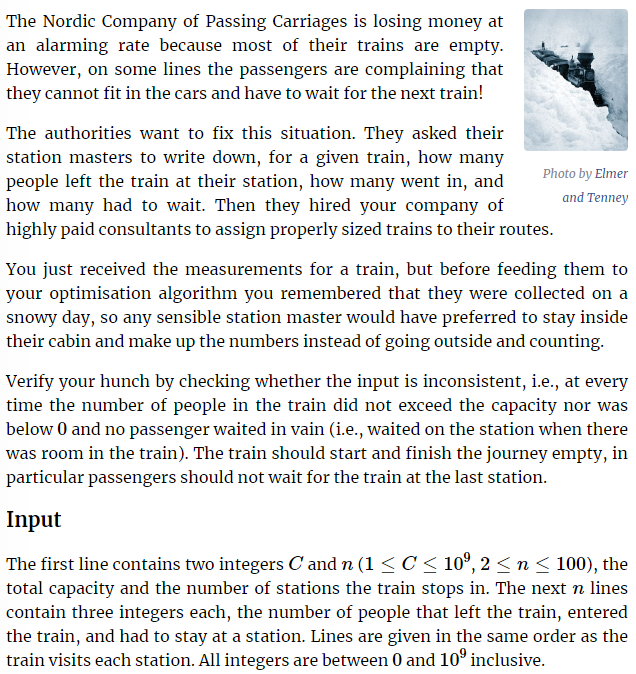
The Nordic Company of Passing Carriages is losing money at an alarming rate because most of their trains are empty. However, on some lines the passengers are complaining that they cannot fit in the cars and have to wait for the next train! The authorities want to fix this situation. They asked their station masters to write down, for a given train, how many people left the train at their station, how many went in, and how many had to wait. Then they hired your company of highly paid consultants to assign properly sized trains to their routes. You just received the measurements for a train, but before feeding them to your optimisation algorithm you remembered that they were collected on a snowy day, so any sensible station master would have preferred to stay inside their cabin and make up the numbers instead of going outside and counting. Verify your hunch by checking whether the input is inconsistent, i.e., at every time the number of people in the train did not exceed the capacity nor was below 0 and no passenger waited in vain (i.e., waited on the station when there was room in the train). The train should start and finish the journey empty, in particular passengers should not wait for the train at the last station. Input The first line contains two integers C and n(1C109,2n100), the total capacity and the number of stations the train stops in. The next n lines contain three integers each, the number of people that left the train, entered the train, and had to stay at a station. Lines are given in the same order as the train visits each station. All integers are between 0 and 109 inclusive
Step by Step Solution
There are 3 Steps involved in it

Get step-by-step solutions from verified subject matter experts
 Study Help