







Question: One byte is an 8-bit number; for example, 00000001. A byte can represent decimal numbers from 0 to 255, and is historically the smallest
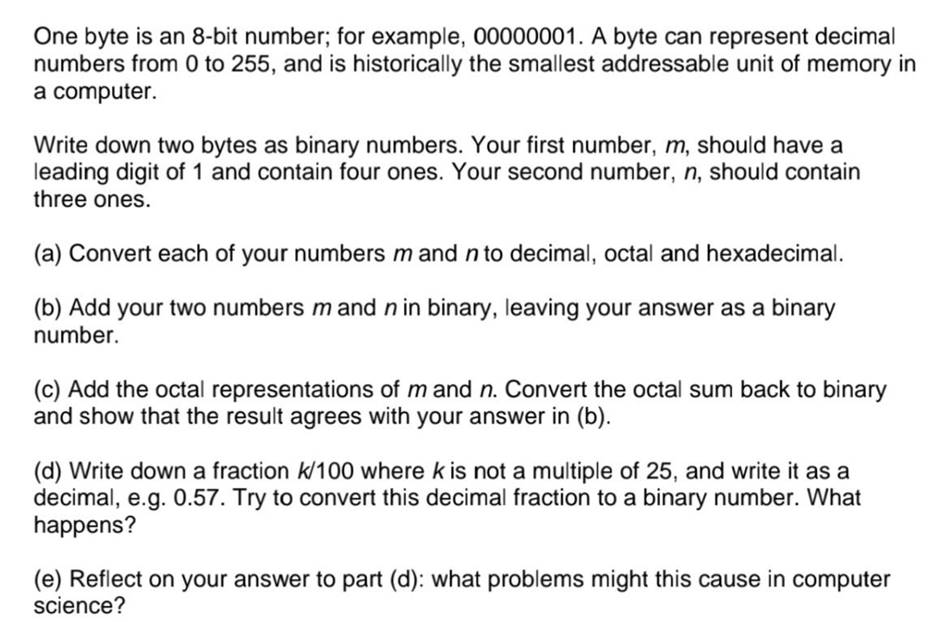
One byte is an 8-bit number; for example, 00000001. A byte can represent decimal numbers from 0 to 255, and is historically the smallest addressable unit of memory in a computer. Write down two bytes as binary numbers. Your first number, m, should have a leading digit of 1 and contain four ones. Your second number, n, should contain three ones. (a) Convert each of your numbers m and n to decimal, octal and hexadecimal. (b) Add your two numbers m and n in binary, leaving your answer as a binary number. (c) Add the octal representations of m and n. Convert the octal sum back to binary and show that the result agrees with your answer in (b). (d) Write down a fraction k/100 where k is not a multiple of 25, and write it as a decimal, e.g. 0.57. Try to convert this decimal fraction to a binary number. What happens? (e) Reflect on your answer to part (d): what problems might this cause in computer science?
Step by Step Solution
3.39 Rating (165 Votes )
There are 3 Steps involved in it
a The first number m is 1111 0000 in binary The decimal number is m240 In octal m is 360 In hexadeci... View full answer

Get step-by-step solutions from verified subject matter experts
 Study Help