







Question: One. Given the discussions we had during lecture one, use your understanding and knowledge gained from such lecture and answer the following questions. Kindly submit
One.
Given the discussions we had during lecture one, use your understanding and knowledge gained from such lecture and answer the following questions. Kindly submit online, your appropriate answers
1) There is a conflict of interest between stockholders and managers. In theory, stockholders are expected to exercise control over managers through the annual meeting or the board of directors. In practice, why might these disciplinary mechanisms not work?
2. Stockholders can transfer wealth from bondholders through a variety of actions. How would the following actions by stockholders transfer wealth from bondholders?
? a. An increase in dividends
? b. A leveraged buyout
? c. Acquiring a risky business
? How would bondholders protect themselves against these actions?
3) There are some corporate strategists who have suggested that firms focus on maximizing market share rather than market prices. When might this strategy work, and when might it fail?
4) It is often argued that managers, when asked to maximize stock price, have to choose between being socially responsible and carrying out their fiduciary duty. Do you agree? Can you provide an example where social responsibility and firm value maximization go hand in hand?
CORPORATE FINANCE
Week Two-Four Lecture Assignments
Instruction
Given the discussions we had during lecture one, use your understanding and knowledge gained from such lecture and answer the following questions. Kindly submit online, your appropriate answers
Question 1
Aluworks Co. is expected to pay a $21.00 dividend next year. The dividend will decline by 10 percent annually for the following three years. In year 5, Aluworks will sell off assets worth $100 per share. The year 5 dividend, which includes a distribution of some of the proceeds of the asset sale, is expected to be $60. In year 6, the dividend is expected to decrease to $40 and will be maintained at $40 for one additional year. The dividend is then expected to grow by 5 percent annually thereafter. If the required rate of return is 12 percent, what is the value of one share of Aluworks?
Question 2
Baggai Enterprises has an ROA of 10 percent, retains 30 percent of earnings, and has an equity multiplier of 1.25. Mondale Enterprises also has an ROA of 10 percent, but it retains two-thirds of earnings and has an equity multiplier of 2.00.
1. What are the sustainable dividend growth rates for (A) Baggai Enterprises and (B)
Mondale Enterprises?
2. Identify the drivers of the difference in the sustainable growth rates of Baggai Enterprises and Mondale Enterprises.
Question 3 (Relative Valuation Approach)
Company A's EPS is $1.50. Its closest competitor, Company B, is trading at a P/E of
22. Assume the companies have a similar operating and financial profile.
a). If Company A's stock is trading at $37.50, what does that indicate about its value relative to Company B?
b). If we assume that Company A's stock should trade at about the same P/E as Company
B's stock, what will we estimate as an appropriate price for Company A's stock?
Question 4
Toyota Motor Corporation (TYO: 7203; NYSE: TM) is one of the world's largest vehicle manufacturers. The company's most recent fiscal year ended on 31 March 2008. In early May 2008, you are valuing Toyota stock, which closed at 5,480 on the previous day. You have used a free cash flow to equity (FCFE) model to value the company stock and have obtained a value of 6,122 for the stock. For ease of communication, you want to express your valuation in terms of a forward P/E based on your forecasted fiscal year 2009 EPS of 580. Toyota's fiscal year 2009 is from April 2008 through March 2009.
1. What is Toyota's justified P/E based on forecasted fundamentals?
2. Based on a comparison of the current price of 5,480 with your estimated intrinsic value of 6,122, the stock appears to be slightly undervalued. Use your answer to question 1 to state this evaluation in terms of P/Es.
Question 5
Joel Williams follows Sonoco Products Company (NYSE: SON), a manufacturer of paper and plastic packaging for both consumer and industrial use. SON appears to have a dividend policy of recognizing sustainable increases in the level of earnings with increases in dividends, keeping the dividend payout ratio within a range of 40 percent to 60 percent. Williams also notes: SON's most recent quarterly dividend (ex-dividend date: 15 August 2007) was $0.26, consistent with a current annual dividend of 4x $0.26 =$1.04 per year. SON's forecasted dividend growth rate is 6.0 percent per year. With a beta of 1.13, given an equity risk premium (expected excess return of equities over the risk-free rate, E [RM] - RF) of 4.5 percent and a risk-free rate (RF)of 5 percent, SON's required return on equity is r= RF + beta[E(RM) - RF]=5.0+1.13(4.5)=10.1 percent, using the capital asset pricing model (CAPM).
Williams believes the Gordon growth model may be an appropriate model for valuing SON.
1. Calculate the Gordon growth model value for SON stock.
2. The current market price of SON stock is $30.18. Using your answer to question 1, judge whether SON stock is fairly valued, undervalued, or overvalued.
Question 6
Vincent Nguyen, an analyst, is examining the stock of British Airways (London Stock Exchange: BAY) as of the beginning of 2008. He notices that the consensus forecast by analysts is that the stock will pay a ? 4 dividend per share in 2009 (based on 21 analysts) and a ? 5 dividend in 2010 (based on 10 analysts). Nguyen expects the price of the stock at the end of 2010 to be ? 250. He has estimated that the required rate of return on the stock is 11 percent. Assume all dividends are paid at the end of the year.
Required:
a) Using the DDM, estimate the value of BAY stock at the end of 2009.
b) Using the DDM, estimate the value of BAY stock at the end of 2008.
Two.
Portfolio return and standard deviation Personal Finance Problem Jamie Wong is thinking of building an investment portfolio containing two? stocks, L and M. Stock L will represent 40?% of the dollar value of the? portfolio, and stock M will account for the other 60?%. The historical returns over the next 6? years, 2013?2018?, for each of these stocks are shown in the following? table:
Expected return
Year
Stock L
Stock M
2013
14?%
20?%
2014
14?%
18?%
2015
16?%
16?%
2016
17?%
14?%
2017
17?%
12?%
2018
19?%
10?%
a. Calculate the actual portfolio? return, rp?, for each of the 6 years.
b. Calculate the expected value of portfolio?returns, rp?, over the? 6-year period.
c. Calculate the standard deviation of expected portfolio? returns, ?rp?, over the?6-year period.
d. How would you characterize the correlation of returns of the two stocks L and? M?
e. Discuss any benefits of diversification achieved by Jamie through creation of the portfolio.
Three.
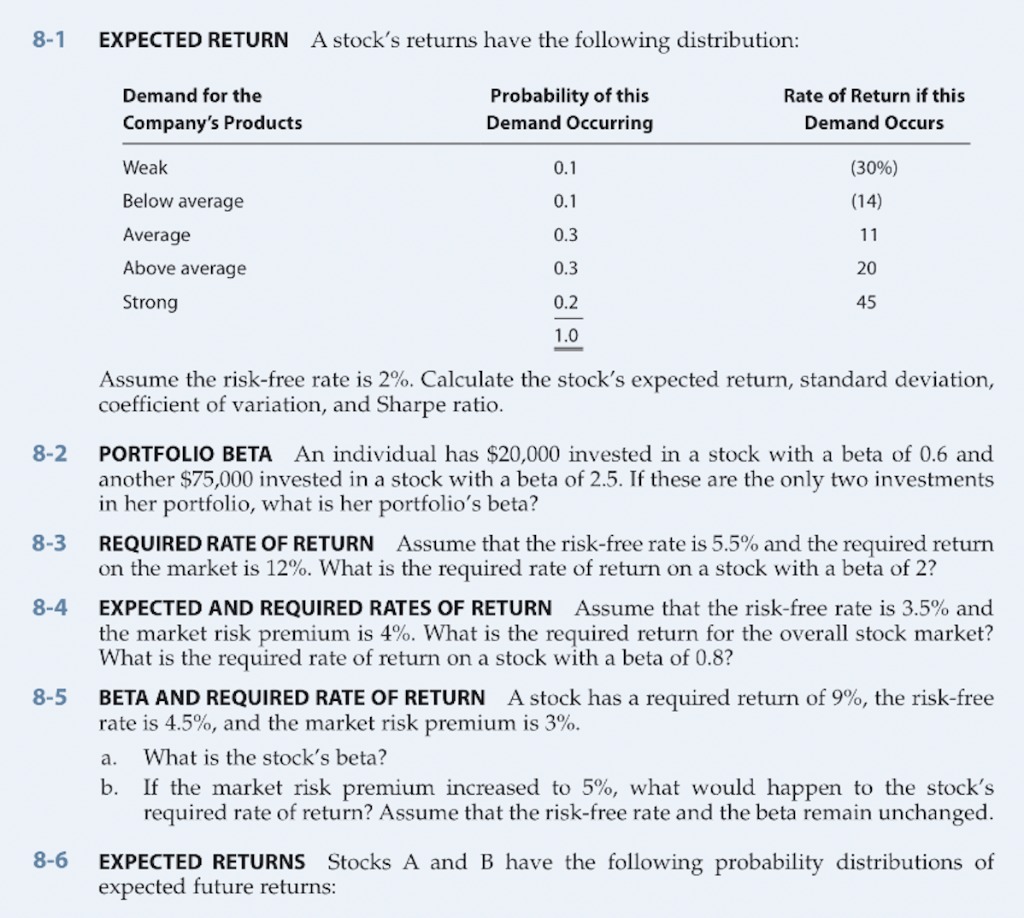
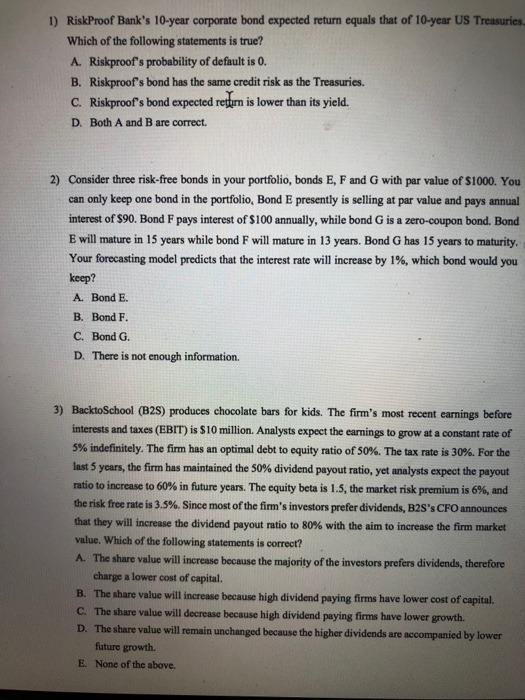
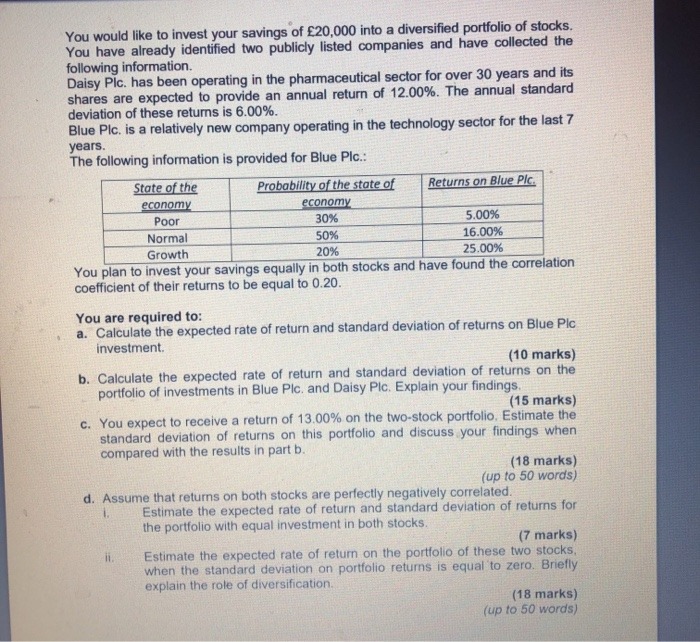
Answer the below questions.
Step by Step Solution
There are 3 Steps involved in it

Get step-by-step solutions from verified subject matter experts
 Study Help