







Question: ONLY ANALYSIS PLEASE and write in your own Words PLEASE Court Case: Davis v. Food Lion ONLY ANALYSIS PLEASE and write in your own Words
ONLY ANALYSIS PLEASE and write in your own Words PLEASE
Court Case: Davis v. Food Lion
ONLY ANALYSIS PLEASE and write in your own Words PLEASE
Court Case: Davis v. Food Lion
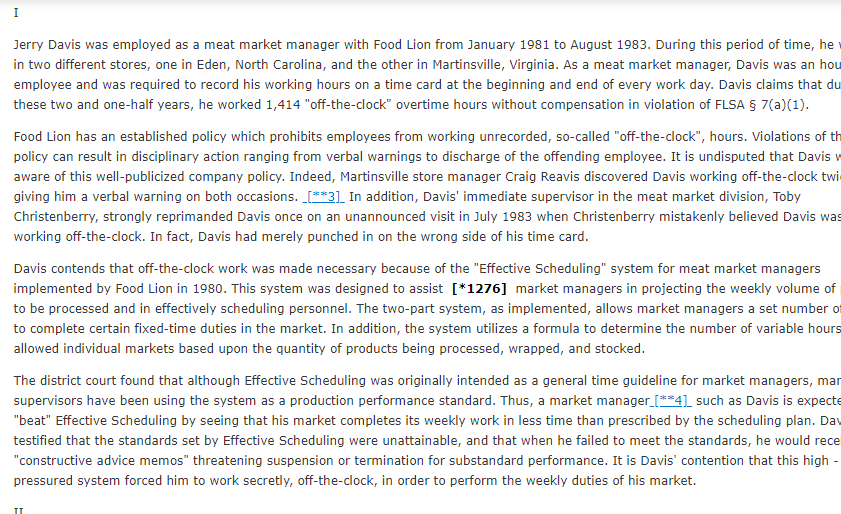
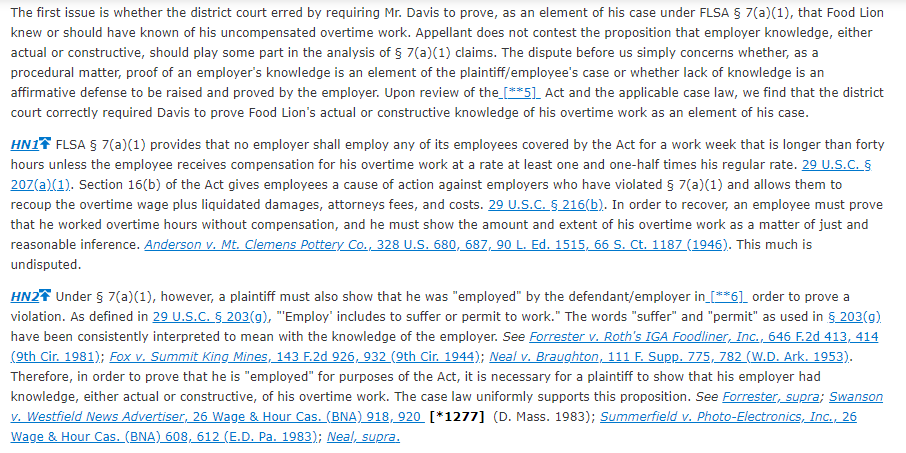
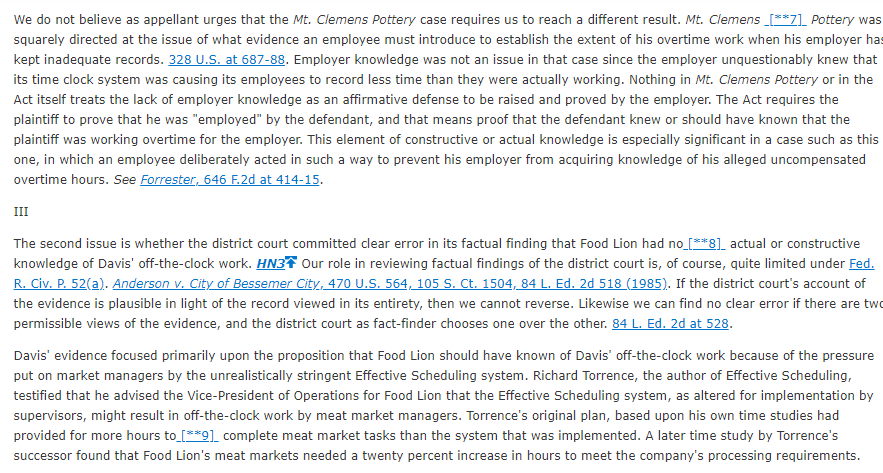
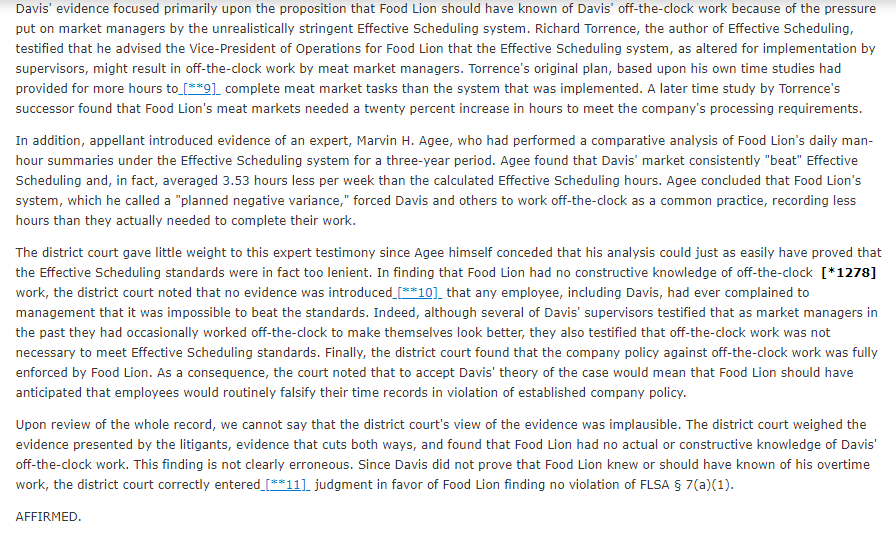
Jerry Davis was employed as a meat market manager with Food Lion from January 1981 to August 1983. During this period of time, he in two different stores, one in Eden, North Carolina, and the other in Martinsville, Virginia. As a meat market manager, Davis was an hou employee and was required to record his working hours on a time card at the beginning and end of every work day. Davis claims that du these two and one-half years, he worked 1,414 "off-the-clock" overtime hours without compensation in violation of FLSA $ 7(a)(1). Food Lion has an established policy which prohibits employees from working unrecorded, so-called "off-the-clock", hours. Violations of th policy can result in disciplinary action ranging from verbal warnings to discharge of the offending employee. It is undisputed that Davis aware of this well-publicized company policy. Indeed, Martinsville store manager Craig Reavis discovered Davis working off-the-clock twi giving him a verbal warning on both occasions. _[**3] In addition, Davis' immediate supervisor in the meat market division, Toby Christenberry, strongly reprimanded Davis once on an unannounced visit in July 1983 when Christenberry mistakenly believed Davis was working off-the-clock. In fact, Davis had merely punched in on the wrong side of his time card. Davis contends that off-the-clock work was made necessary because of the "Effective Scheduling" system for meat market managers implemented by Food Lion in 1980. This system was designed to assist (*1276] market managers in projecting the weekly volume of to be processed and in effectively scheduling personnel. The two-part system, as implemented, allows market managers a set number o to complete certain fixed-time duties in the market. In addition, the system utilizes a formula to determine the number of variable hours allowed individual markets based upon the quantity of products being processed, wrapped, and stocked. The district court found that although Effective Scheduling was originally intended as a general time guideline for market managers, mar supervisors have been using the system as a production performance standard. Thus, a market manager_(**41 such as Davis is expecte "beat" Effective Scheduling by seeing that his market completes its weekly work in less time than prescribed by the scheduling plan. Da testified that the standards set by Effective Scheduling were unattainable, and that when he failed to meet the standards, he would rece "constructive advice memos" threatening suspension or termination for substandard performance. It is Davis' contention that this high pressured system forced him to work secretly, off-the-clock, in order to perform the weekly duties of his market. TT The first issue is whether the district court erred by requiring Mr. Davis to prove, as an element of his case under FLSA $ 7(a)(1), that Food Lion knew or should have known of his uncompensated overtime work. Appellant does not contest the proposition that employer knowledge, either actual or constructive, should play some part in the analysis of $ 7(a)(1) claims. The dispute before us simply concerns whether, as a procedural matter, proof of an employer's knowledge is an element of the plaintiff/employee's case or whether lack of knowledge is an affirmative defense to be raised and proved by the employer. Upon review of the_[**5]. Act and the applicable case law, we find that the district court correctly required Davis to prove Food Lion's actual or constructive knowledge of his overtime work as an element of his case. HN17 FLSA $ 7(a)(1) provides that no employer shall employ any of its employees covered by the Act for a work week that is longer than forty hours unless the employee receives compensation for his overtime work at a rate at least one and one-half times his regular rate. 29 U.S.C. $ 207(a)(1). Section 16(b) of the Act gives employees a cause of action against employers who have violated 7(a)(1) and allows them to recoup the overtime wage plus liquidated damages, attorneys fees, and costs. 29 U.S.C. $ 216(b). In order to recover, an employee must prove that he worked overtime hours without compensation, and he must show the amount and extent of his overtime work as a matter of just and reasonable inference. Anderson v. Mt. Clemens Pottery Co., 328 U.S. 680, 687, 90 L. Ed. 1515, 66 S. Ct. 1187 (1946). This much is undisputed. HN27 Under $ 7(a) (1), however, a plaintiff must also show that he was "employed" by the defendant/employer in_**6] order to prove a violation. As defined in 29 U.S.C. $ 203(9), "Employ' includes to suffer or permit to work." The words "suffer" and "permit" as used in $ 203(9). have been consistently interpreted to mean with the knowledge of the employer. See Forrester v. Roth's IGA Foodliner, Inc., 646 F.2d 413, 414 (9th Cir. 1981); Fox v. Summit King Mines, 143 F.2d 926, 932 (9th Cir. 1944); Neal v. Braughton, 111 F. Supp. 775, 782 (W.D. Ark. 1953). Therefore, in order to prove that he is "employed" for purposes of the Act, it is necessary for a plaintiff to show that his employer had knowledge, either actual or constructive, of his overtime work. The case law uniformly supports this proposition. See Forrester, supra; Swanson V. Westfield News Advertiser, 26 Wage & Hour Cas. (BNA) 918, 920 [*1277] (D. Mass. 1983); Summerfield v. Photo-Electronics, Inc., 26 Wage & Hour Cas. (BNA) 608, 612 (E.D. Pa. 1983); Neal, supra. We do not believe as appellant urges that the Mt. Clemens Pottery case requires us to reach a different result. Mt. Clemens _(**7] Pottery was squarely directed at the issue of what evidence an employee must introduce to establish the extent of his overtime work when his employer has kept inadequate records. 328 U.S. at 687-88. Employer knowledge was not an issue in that case since the employer unquestionably knew that its time clock system was causing its employees to record less time than they were actually working. Nothing in Mt. Clemens Pottery or in the Act itself treats the lack of employer knowledge as an affirmative defense to be raised and proved by the employer. The Act requires the plaintiff to prove that he was "employed" by the defendant, and that means proof that the defendant knew or should have known that the plaintiff was working overtime for the employer. This element of constructive or actual knowledge is especially significant in a case such as this one, in which an employee deliberately acted in such a way to prevent his employer from acquiring knowledge of his alleged uncompensated overtime hours. See Forrester, 646 F.2d at 414-15. III The second issue is whether the district court committed clear error in its factual finding that Food Lion had no_[**8] actual or constructive knowledge of Davis' off-the-clock work. HN37 Our role in reviewing factual findings of the district court is, of course, quite limited under Fed. R. Civ. P. 52(a). Anderson v. City of Bessemer City, 470 U.S. 564, 105 S. Ct. 1504, 84 L. Ed. 2d 518 (1985). If the district court's account of the evidence is plausible in light of the record viewed in its entirety, then we cannot reverse. Likewise we can find no clear error if there are two permissible views of the evidence, and the district court as fact-finder chooses one over the other. 84 L. Ed. 2d at 528. Davis' evidence focused primarily upon the proposition that Food Lion should have known of Davis' off-the-clock work because of the pressure put on market managers by the unrealistically stringent Effective Scheduling system. Richard Torrence, the author of Effective Scheduling, testified that he advised the Vice-President of Operations for Food Lion that the Effective Scheduling system, as altered for implementation by supervisors, might result in off-the-clock work by meat market managers. Torrence's original plan, based upon his own time studies had provided for more hours to_[**9] complete meat market tasks than the system that was implemented. A later time study by Torrence's successor found that Food Lion's meat markets needed a twenty percent increase in hours to meet the company's processing requirements. Davis' evidence focused primarily upon the proposition that Food Lion should have known of Davis' off-the-clock work because of the pressure put on market managers by the unrealistically stringent Effective Scheduling system. Richard Torrence, the author of Effective Scheduling, testified that he advised the Vice-President of Operations for Food Lion that the Effective Scheduling system, as altered for implementation by supervisors, might result in off-the-clock work by meat market managers. Torrence's original plan, based upon his own time studies had provided for more hours to_[**9] complete meat market tasks than the system that was implemented. A later time study by Torrence's successor found that Food Lion's meat markets needed a twenty percent increase in hours to meet the company's processing requirements. In addition, appellant introduced evidence of an expert, Marvin H. Agee, who had performed a comparative analysis of Food Lion's daily man- hour summaries under the Effective Scheduling system for a three-year period. Agee found that Davis' market consistently "beat" Effective Scheduling and, in fact, averaged 3.53 hours less per week than the calculated Effective Scheduling hours. Agee concluded that Food Lion's system, which he called a "planned negative variance," forced Davis and others to work off-the-clock as a common practice, recording less hours than they actually needed to complete their work. The district court gave little weight to this expert testimony since Agee himself conceded that his analysis could just as easily have proved that the Effective Scheduling standards were in fact too lenient. In finding that Food Lion had no constructive knowledge of off-the-clock [*1278] work, the district court noted that no evidence was introduced_(**10] that any employee, including Davis, had ever complained to management that it was impossible to beat the standards. Indeed, although several of Davis' supervisors testified that as market managers in the past they had occasionally worked off-the-clock to make themselves look better, they also testified that off-the-clock work was not necessary to meet Effective Scheduling standards. Finally, the district court found that the company policy against off-the-clock work was fully enforced by Food Lion. As a consequence, the court noted that to accept Davis' theory of the case would mean that Food Lion should have anticipated that employees would routinely falsify their time records in violation of established company policy. Upon review of the whole record, we cannot say that the district court's view of the evidence was implausible. The district court weighed the evidence presented by the litigants, evidence that cuts both ways, and found that Food Lion had no actual or constructive knowledge of Davis' off-the-clock work. This finding is not clearly erroneous. Since Davis did not prove that Food Lion knew or should have known of his overtime work, the district court correctly entered_[**11] judgment in favor of Food Lion finding no violation of FLSA $ 7(a)(1). AFFIRMEDStep by Step Solution
There are 3 Steps involved in it
1 Expert Approved Answer
Step: 1 Unlock

Question Has Been Solved by an Expert!
Get step-by-step solutions from verified subject matter experts
Step: 2 Unlock
Step: 3 Unlock
 Study Help