







Question: Only answer c, d, e, and f, if possible! An important reaction in the industry is the so-called water-gas shift reaction: CO + H2O +
Only answer c, d, e, and f, if possible!
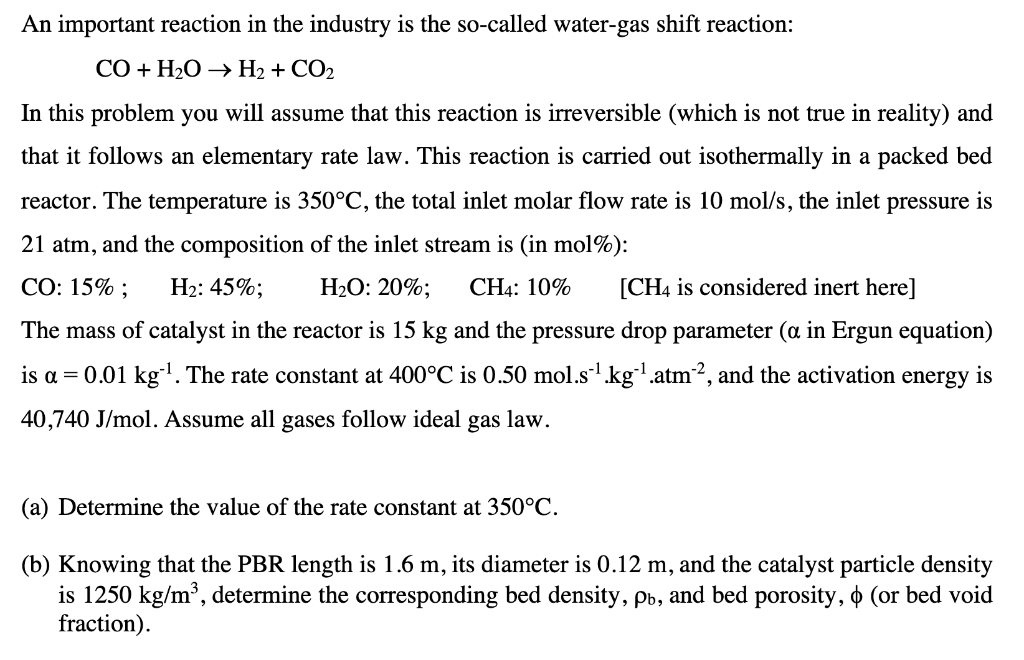
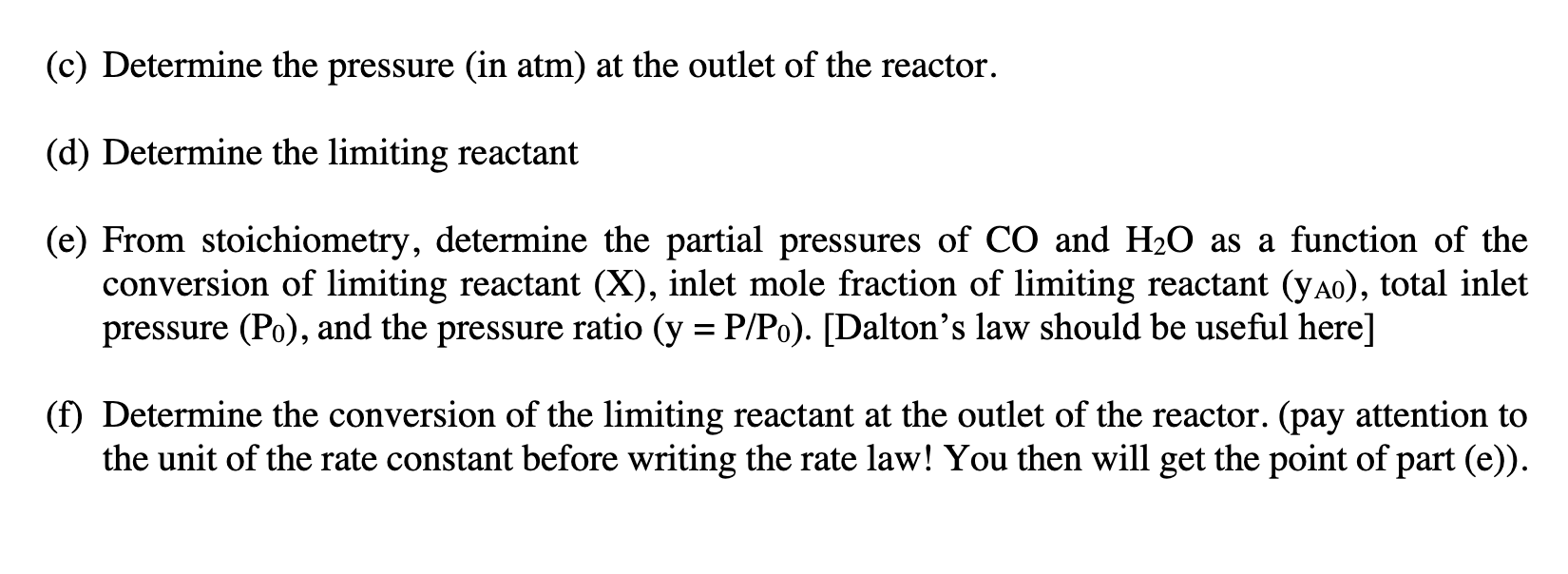
An important reaction in the industry is the so-called water-gas shift reaction: CO + H2O + H2 + CO2 In this problem you will assume that this reaction is irreversible (which is not true in reality) and that it follows an elementary rate law. This reaction is carried out isothermally in a packed bed reactor. The temperature is 350C, the total inlet molar flow rate is 10 mol/s, the inlet pressure is 21 atm, and the composition of the inlet stream is (in mol%): CO: 15%; H2: 45%; H2O: 20%; CH4: 10% [CH4 is considered inert here) The mass of catalyst in the reactor is 15 kg and the pressure drop parameter (a in Ergun equation) is a=0.01 kg-1. The rate constant at 400C is 0.50 mol.s-1.kg .atm?, and the activation energy is 40,740 J/mol. Assume all gases follow ideal gas law. (a) Determine the value of the rate constant at 350C. (b) Knowing that the PBR length is 1.6 m, its diameter is 0.12 m, and the catalyst particle density is 1250 kg/m, determine the corresponding bed density, Pb, and bed porosity, (or bed void fraction). (c) Determine the pressure (in atm) at the outlet of the reactor. (d) Determine the limiting reactant (e) From stoichiometry, determine the partial pressures of CO and H20 as a function of the conversion of limiting reactant (X), inlet mole fraction of limiting reactant (yao), total inlet pressure (Po), and the pressure ratio (y = P/Po). [Dalton's law should be useful here] > (f) Determine the conversion of the limiting reactant at the outlet of the reactor. (pay attention to the unit of the rate constant before writing the rate law! You then will get the point of part (e))
Step by Step Solution
There are 3 Steps involved in it

Get step-by-step solutions from verified subject matter experts
 Study Help