







Question: only answer Q.2.1 Read the case study and answer the following questions in your answer booklet. Nestle starts selling Starbucks-branded coffee in China Food giant
only answer Q.2.1
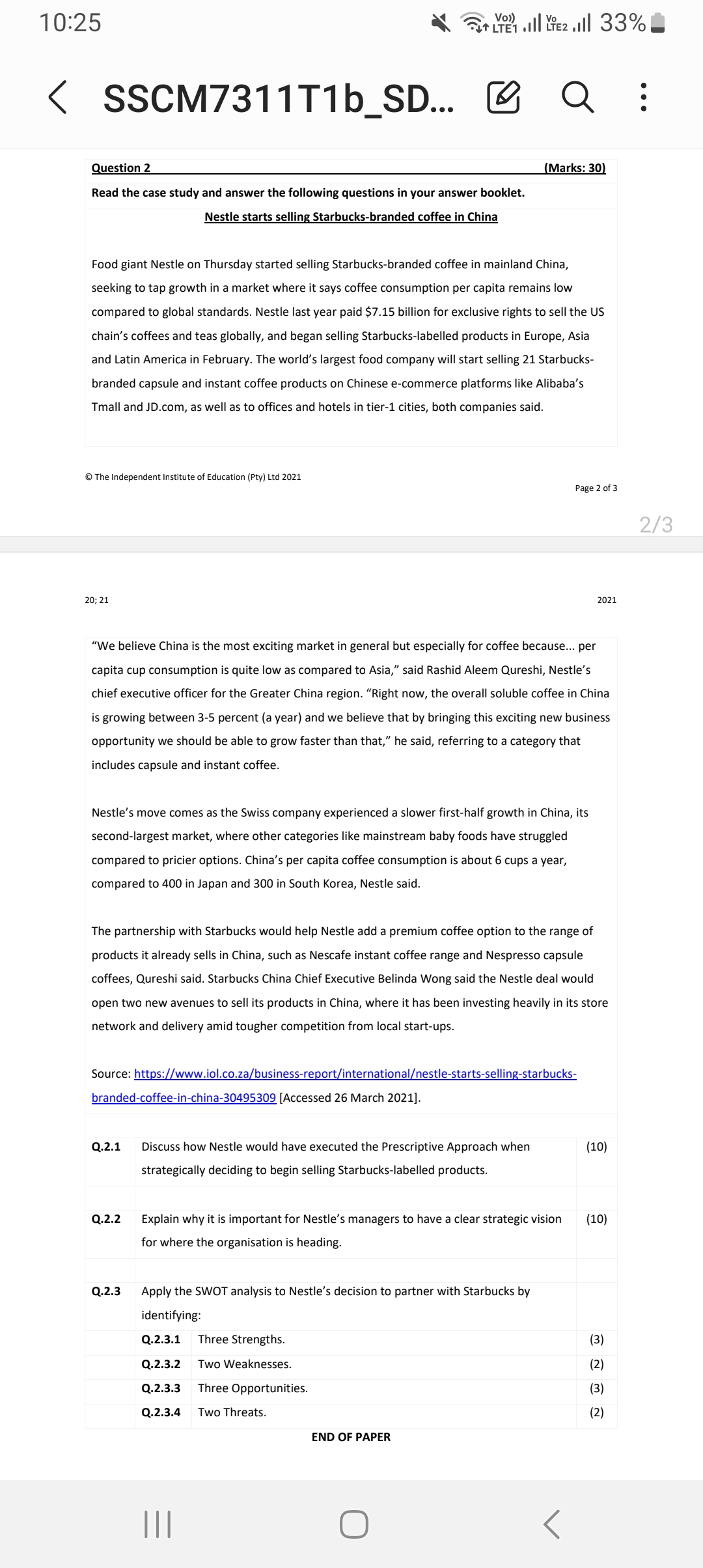
Read the case study and answer the following questions in your answer booklet. Nestle starts selling Starbucks-branded coffee in China Food giant Nestle on Thursday started selling Starbucks-branded coffee in mainland China, seeking to tap growth in a market where it says coffee consumption per capita remains low compared to global standards. Nestle last year paid $7.15 billion for exclusive rights to sell the US chain's coffees and teas globally, and began selling Starbucks-labelled products in Europe, Asia and Latin America in February. The world's largest food company will start selling 21 Starbucksbranded capsule and instant coffee products on Chinese e-commerce platforms like Alibaba's Tmall and JD.com, as well as to offices and hotels in tier-1 cities, both companies said. (c) The Independent Institute of Education (Pty) Ltd 2021 Page 2 of 3 20;21 2021 "We believe China is the most exciting market in general but especially for coffee because... per capita cup consumption is quite low as compared to Asia," said Rashid Aleem Qureshi, Nestle's chief executive officer for the Greater China region. "Right now, the overall soluble coffee in China is growing between 3-5 percent (a year) and we believe that by bringing this exciting new business opportunity we should be able to grow faster than that," he said, referring to a category that includes capsule and instant coffee. Nestle's move comes as the Swiss company experienced a slower first-half growth in China, its second-largest market, where other categories like mainstream baby foods have struggled compared to pricier options. China's per capita coffee consumption is about 6 cups a year, compared to 400 in Japan and 300 in South Korea, Nestle said. The partnership with Starbucks would help Nestle add a premium coffee option to the range of products it already sells in China, such as Nescafe instant coffee range and Nespresso capsule coffees, Qureshi said. Starbucks China Chief Executive Belinda Wong said the Nestle deal would open two new avenues to sell its products in China, where it has been investing heavily in its store network and delivery amid tougher competition from local start-ups. Source: https://www.iol.co.za/business-report/internationalestle-starts-selling-starbucks- branded-coffee-in-china-30495309 [Accessed 26 March 2021]. Q.2.1 Discuss how Nestle would have executed the Prescriptive Approach when (10) strategically deciding to begin selling Starbucks-labelled products. Q.2.2 Explain why it is important for Nestle's managers to have a clear strategic vision (10) for where the organisation is heading. Q.2.3 Apply the SWOT analysis to Nestle's decision to partner with Starbucks by identifying: Q.2.3.1 Three Strengths. Q.2.3.2 Two Weaknesses. Q.2.3.3 Three Opportunities. Q.2.3.4 Two Threats. END OF PAPER Read the case study and answer the following questions in your answer booklet. Nestle starts selling Starbucks-branded coffee in China Food giant Nestle on Thursday started selling Starbucks-branded coffee in mainland China, seeking to tap growth in a market where it says coffee consumption per capita remains low compared to global standards. Nestle last year paid $7.15 billion for exclusive rights to sell the US chain's coffees and teas globally, and began selling Starbucks-labelled products in Europe, Asia and Latin America in February. The world's largest food company will start selling 21 Starbucksbranded capsule and instant coffee products on Chinese e-commerce platforms like Alibaba's Tmall and JD.com, as well as to offices and hotels in tier-1 cities, both companies said. (c) The Independent Institute of Education (Pty) Ltd 2021 Page 2 of 3 20;21 2021 "We believe China is the most exciting market in general but especially for coffee because... per capita cup consumption is quite low as compared to Asia," said Rashid Aleem Qureshi, Nestle's chief executive officer for the Greater China region. "Right now, the overall soluble coffee in China is growing between 3-5 percent (a year) and we believe that by bringing this exciting new business opportunity we should be able to grow faster than that," he said, referring to a category that includes capsule and instant coffee. Nestle's move comes as the Swiss company experienced a slower first-half growth in China, its second-largest market, where other categories like mainstream baby foods have struggled compared to pricier options. China's per capita coffee consumption is about 6 cups a year, compared to 400 in Japan and 300 in South Korea, Nestle said. The partnership with Starbucks would help Nestle add a premium coffee option to the range of products it already sells in China, such as Nescafe instant coffee range and Nespresso capsule coffees, Qureshi said. Starbucks China Chief Executive Belinda Wong said the Nestle deal would open two new avenues to sell its products in China, where it has been investing heavily in its store network and delivery amid tougher competition from local start-ups. Source: https://www.iol.co.za/business-report/internationalestle-starts-selling-starbucks- branded-coffee-in-china-30495309 [Accessed 26 March 2021]. Q.2.1 Discuss how Nestle would have executed the Prescriptive Approach when (10) strategically deciding to begin selling Starbucks-labelled products. Q.2.2 Explain why it is important for Nestle's managers to have a clear strategic vision (10) for where the organisation is heading. Q.2.3 Apply the SWOT analysis to Nestle's decision to partner with Starbucks by identifying: Q.2.3.1 Three Strengths. Q.2.3.2 Two Weaknesses. Q.2.3.3 Three Opportunities. Q.2.3.4 Two Threats. END OF PAPER
Step by Step Solution
There are 3 Steps involved in it

Get step-by-step solutions from verified subject matter experts
 Study Help