







Question: Only answer this question not the ones on pic 10-16 Very Briefly, in 2 bulleted lines total, Compare the relationship between information technology and Ubers
Only answer this question not the ones on pic
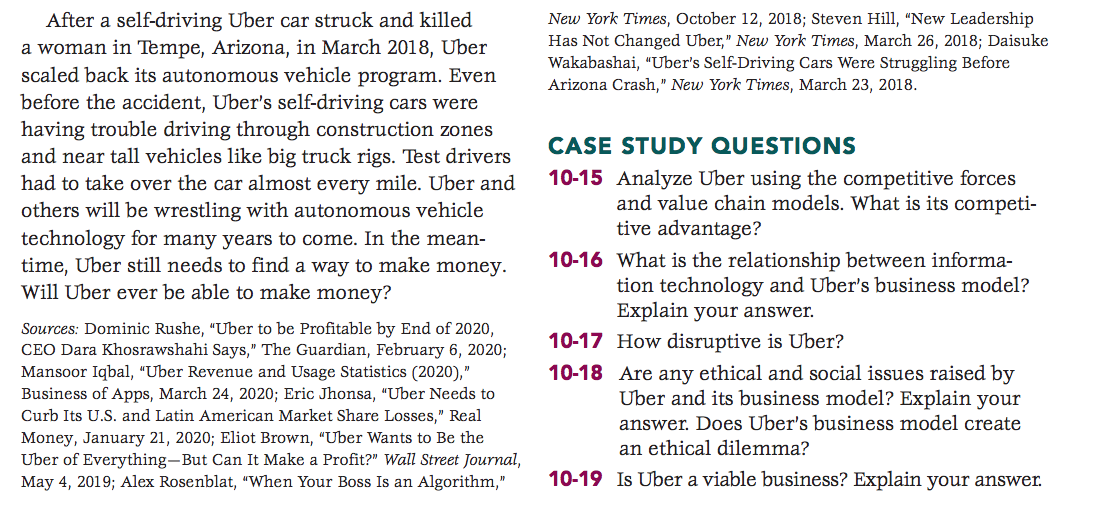
10-16 Very Briefly, in 2 bulleted lines total,
Compare the relationship between information technology and Ubers business model
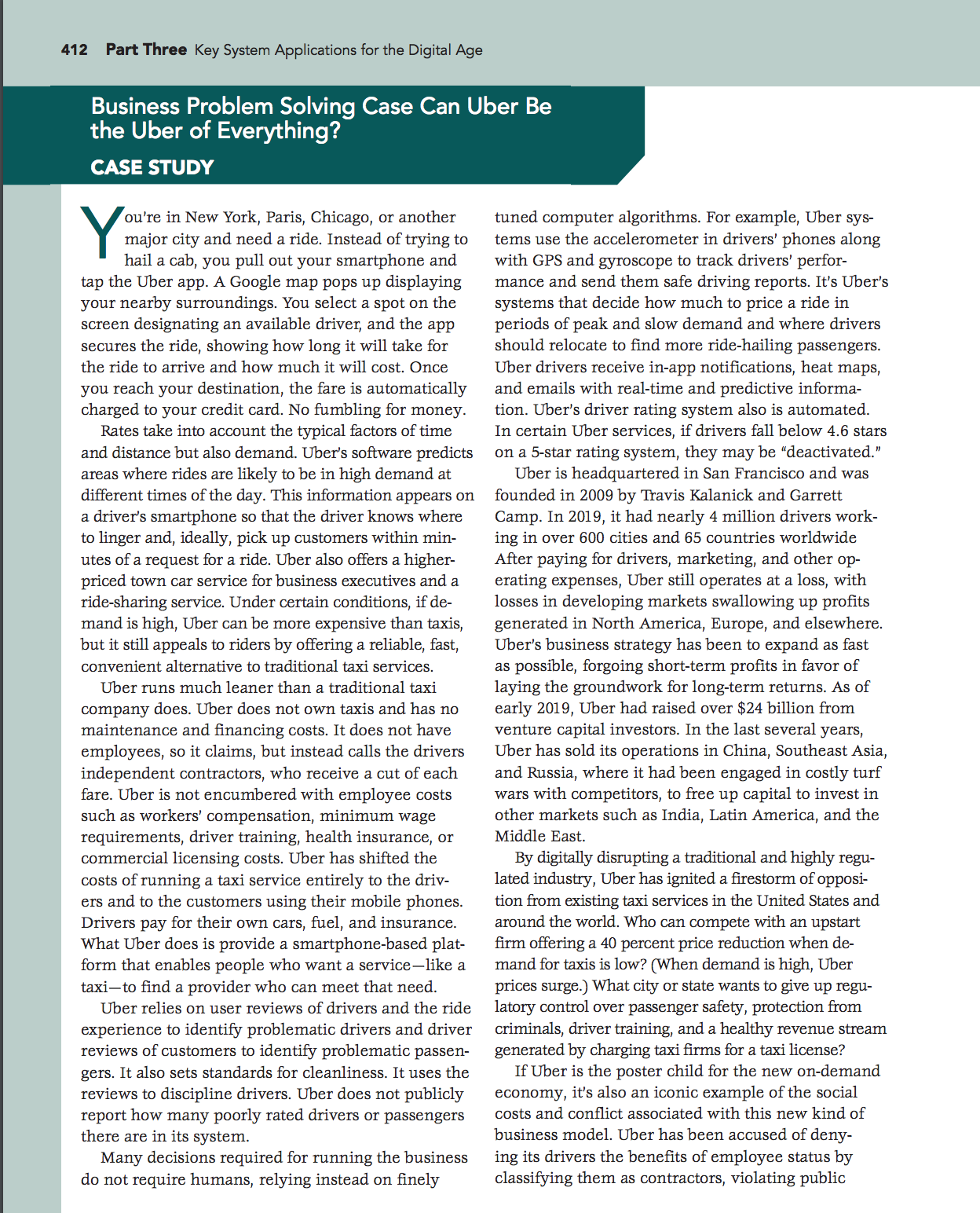
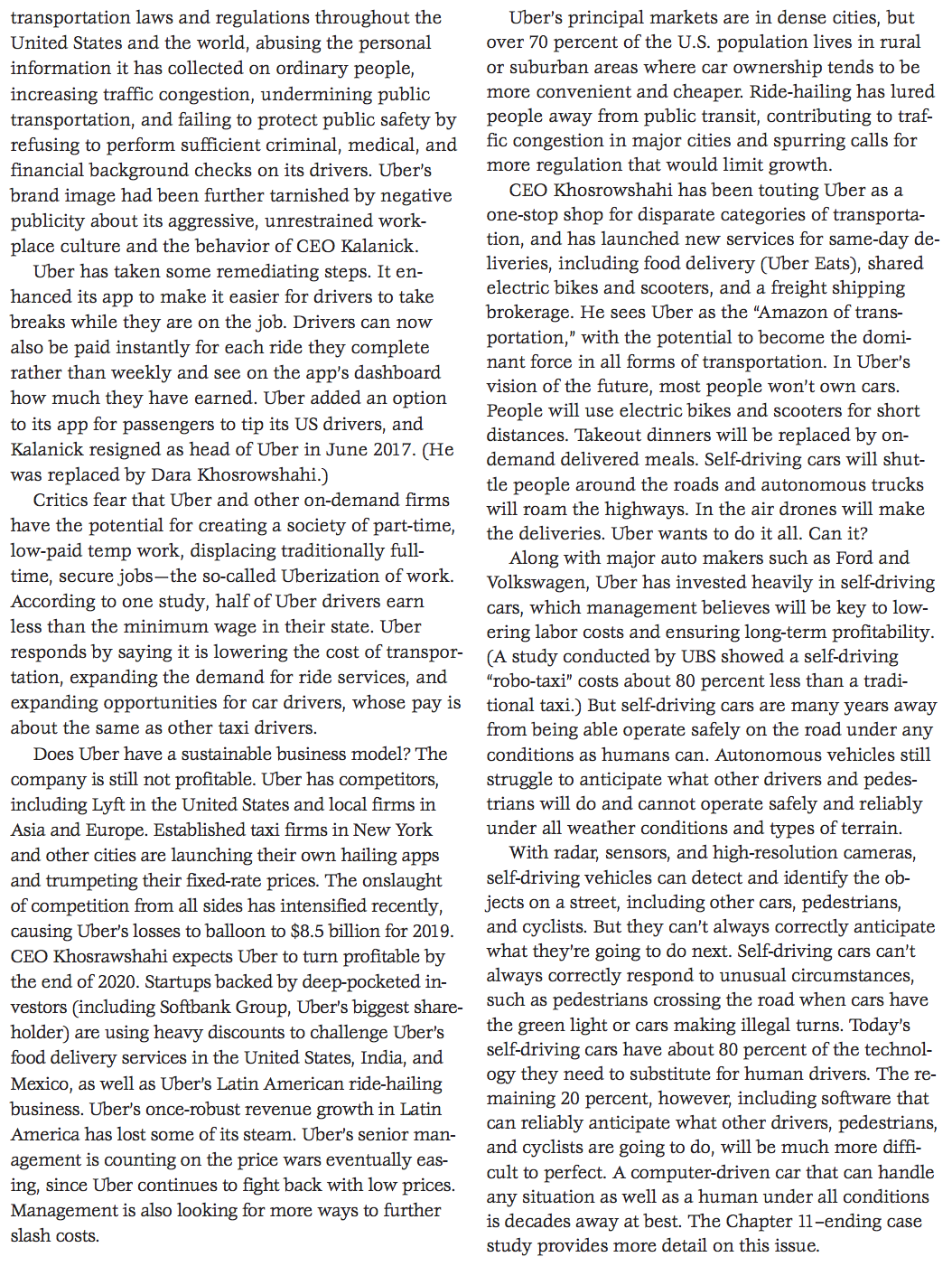
412 Part Three Key System Applications for the Digital Age Business Problem Solving Case Can Uber Be the Uber of Everything? CASE STUDY Y ou're in New York, Paris, Chicago, or another major city and need a ride. Instead of trying to hail a cab, you pull out your smartphone and tap the Uber app. A Google map pops up displaying your nearby surroundings. You select a spot on the screen designating an available driver, and the app secures the ride, showing how long it will take for the ride to arrive and how much it will cost. Once you reach your destination, the fare is automatically charged to your credit card. No fumbling for money. Rates take into account the typical factors of time and distance but also demand. Uber's software predicts areas where rides are likely to be in high demand at different times of the day. This information appears on a driver's smartphone so that the driver knows where to linger and, ideally, pick up customers within min- utes of a request for a ride. Uber also offers a higher- priced town car service for business executives and a ride-sharing service. Under certain conditions, if de- mand is high, Uber can be more expensive than taxis, but it still appeals to riders by offering a reliable, fast, convenient alternative to traditional taxi services. Uber runs much leaner than a traditional taxi company does. Uber does not own taxis and has no maintenance and financing costs. It does not have employees, so it claims, but instead calls the drivers independent contractors, who receive a cut of each fare. Uber is not encumbered with employee costs such as workers' compensation, minimum wage requirements, driver training, health insurance, or commercial licensing costs. Uber has shifted the costs of running a taxi service entirely to the driv- ers and to the customers using their mobile phones. Drivers pay for their own cars, fuel, and insurance. What Uber does is provide a smartphone-based plat- form that enables people who want a service-like a taxi-to find a provider who can meet that need. Uber relies on user reviews of drivers and the ride experience to identify problematic drivers and driver reviews of customers to identify problematic passen- gers. It also sets standards for cleanliness. It uses the reviews to discipline drivers. Uber does not publicly report how many poorly rated drivers or passengers there are in its system. Many decisions required for running the business do not require humans, relying instead on finely tuned computer algorithms. For example, Uber sys- tems use the accelerometer in drivers' phones along with GPS and gyroscope to track drivers' perfor- mance and send them safe driving reports. It's Uber's systems that decide how much to price a ride in periods of peak and slow demand and where drivers should relocate to find more ride-hailing passengers. Uber drivers receive in-app notifications, heat maps, and emails with real-time and predictive informa- tion. Uber's driver rating system also is automated. In certain Uber services, if drivers fall below 4.6 stars on a 5-star rating system, they may be "deactivated." Uber is headquartered in San Francisco and was founded in 2009 by Travis Kalanick and Garrett Camp. In 2019, it had nearly 4 million drivers work- ing in over 600 cities and 65 countries worldwide After paying for drivers, marketing, and other op- erating expenses, Uber still operates at a loss, with losses in developing markets swallowing up profits generated in North America, Europe, and elsewhere. Uber's business strategy has been to expand as fast as possible, forgoing short-term profits in favor of laying the groundwork for long-term returns. As of early 2019, Uber had raised over $24 billion from venture capital investors. In the last several years, Uber has sold its operations in China, Southeast Asia, and Russia, where it had been engaged in costly turf wars with competitors, to free up capital to invest in other markets such as India, Latin America, and the Middle East. By digitally disrupting a traditional and highly regu- lated industry, Uber has ignited a firestorm of opposi- tion from existing taxi services in the United States and around the world. Who can compete with an upstart firm offering a 40 percent price reduction when de- mand for taxis is low? (When demand is high, Uber prices surge.) What city or state wants to give up regu- latory control over passenger safety, protection from criminals, driver training, and a healthy revenue stream generated by charging taxi firms for a taxi license? If Uber is the poster child for the new on-demand economy, it's also an iconic example of the social costs and conflict associated with this new kind of business model. Uber has been accused of deny- ing its drivers the benefits of employee status by classifying them as contractors, violating public
Step by Step Solution
There are 3 Steps involved in it
Relationship Between Information Technology and Ubers Business Model Core Integration Ub... View full answer

Get step-by-step solutions from verified subject matter experts
 Study Help