Question: Uber Case History Founded in 2009 by Garrett Camp and Travis Kalanickas UberCab, met at LeWebin Paris, France in 2008. Camp wanted to solve the
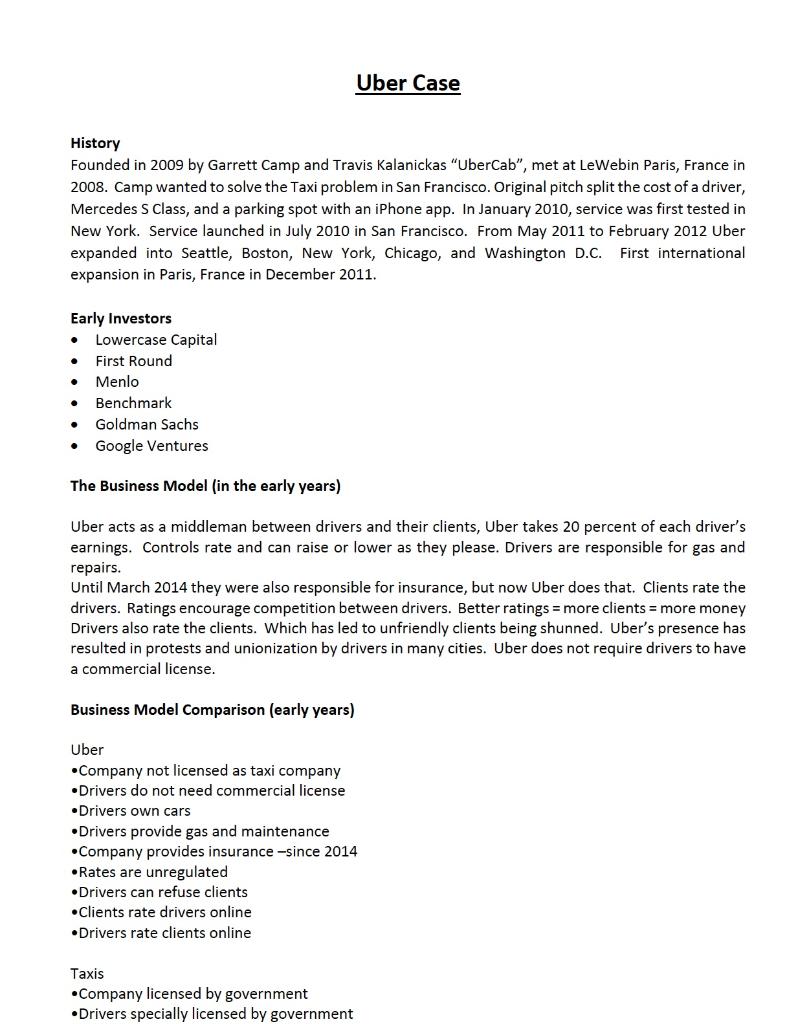
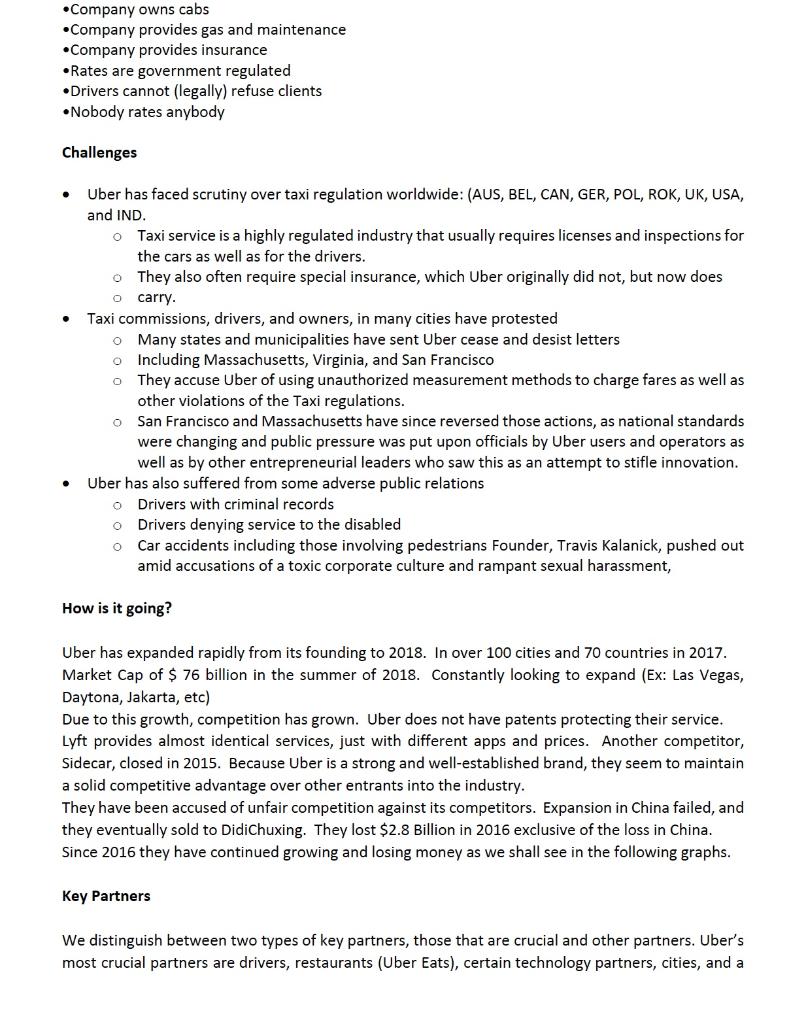
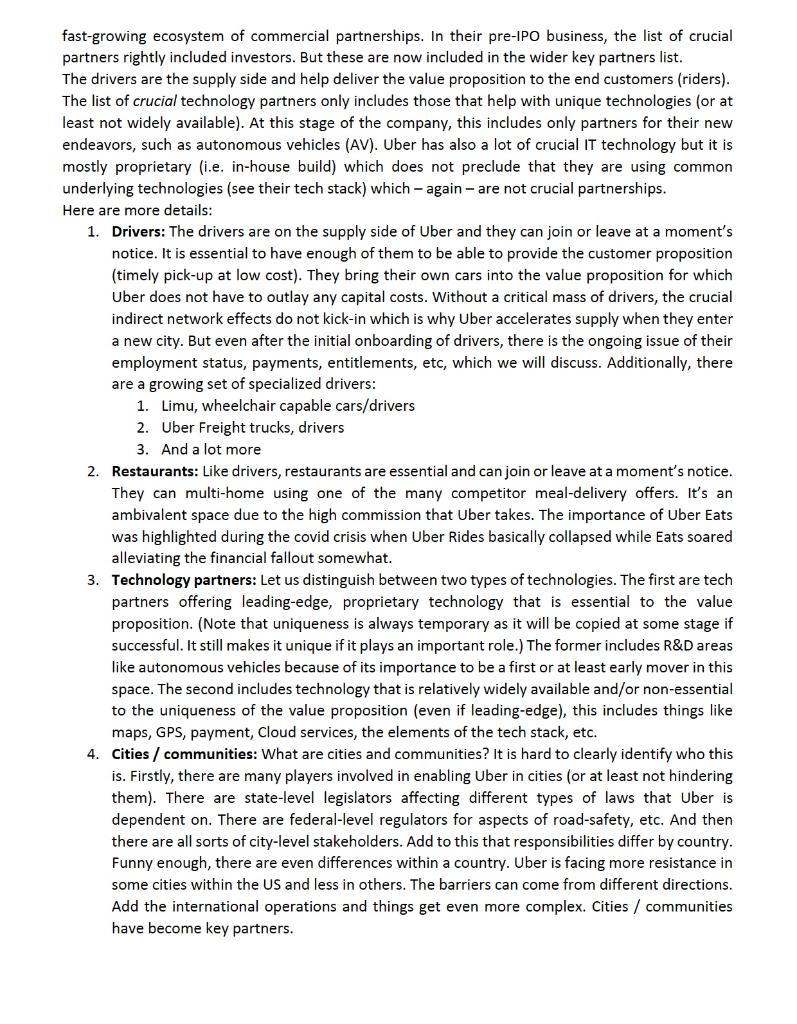
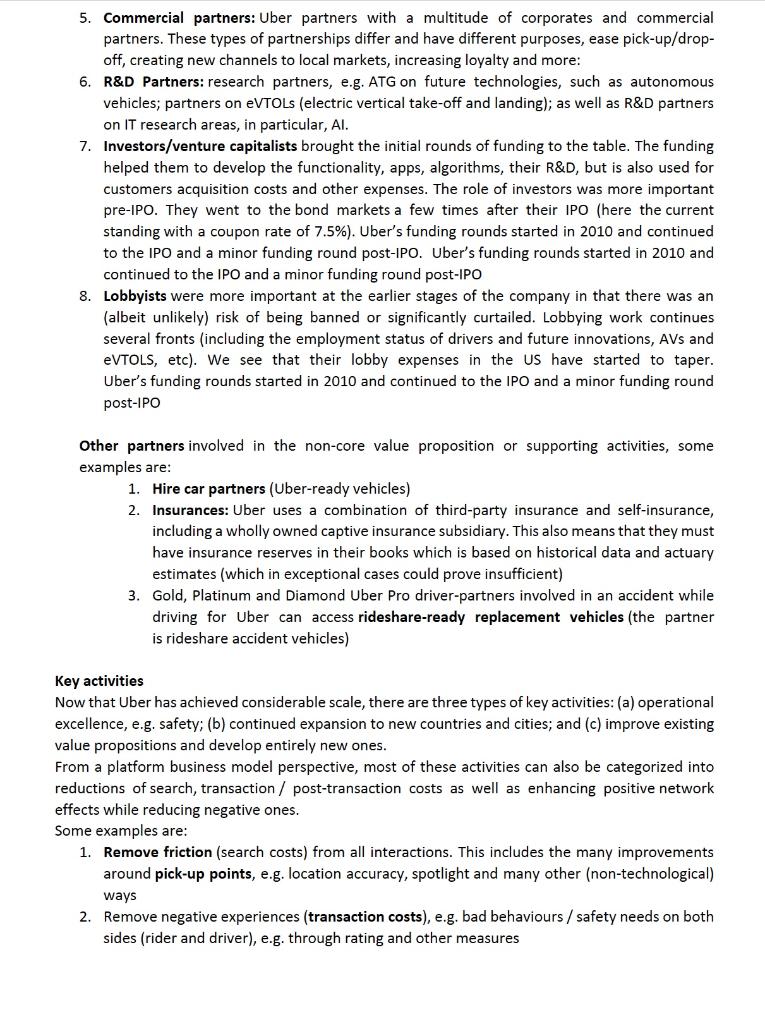
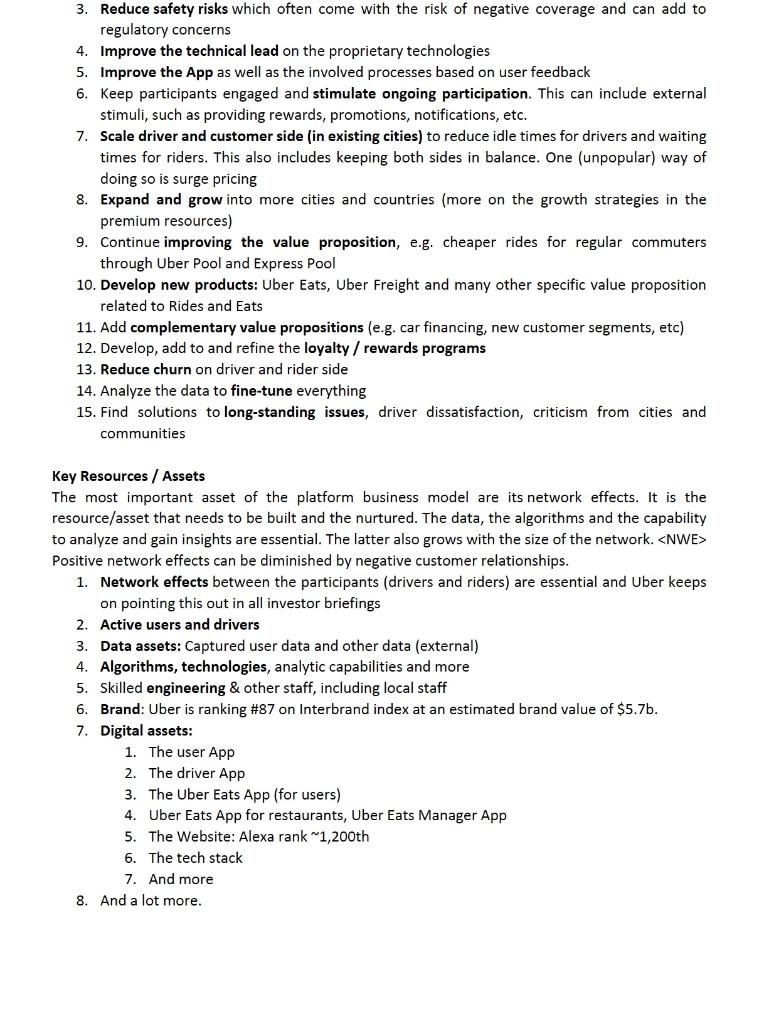
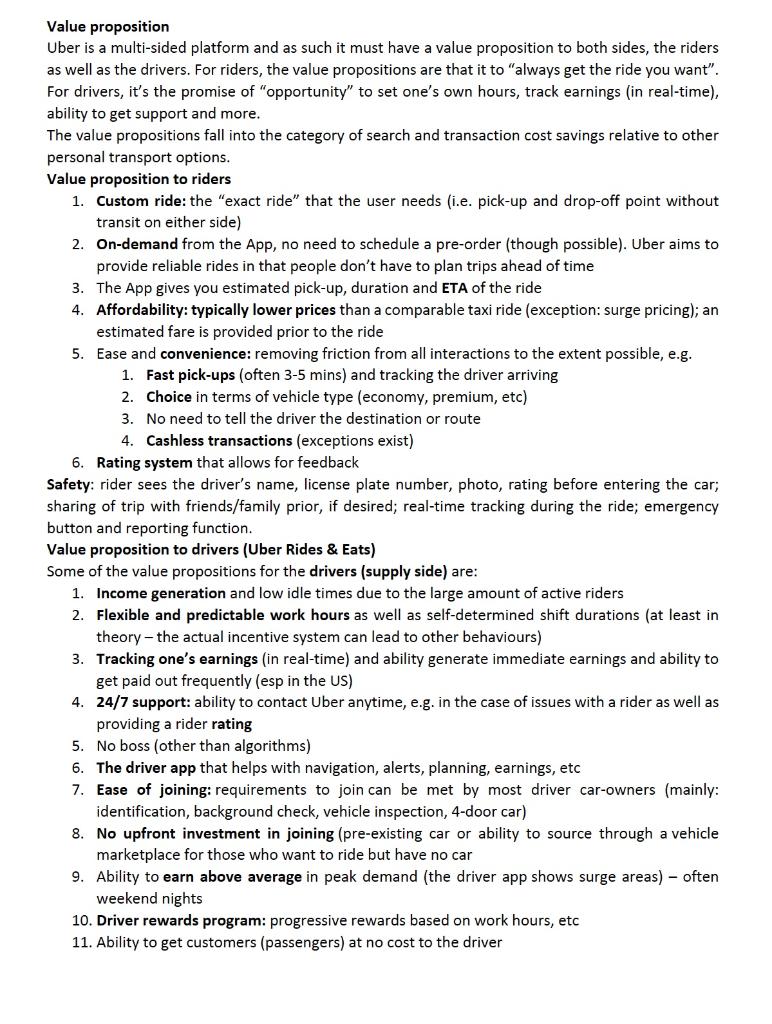
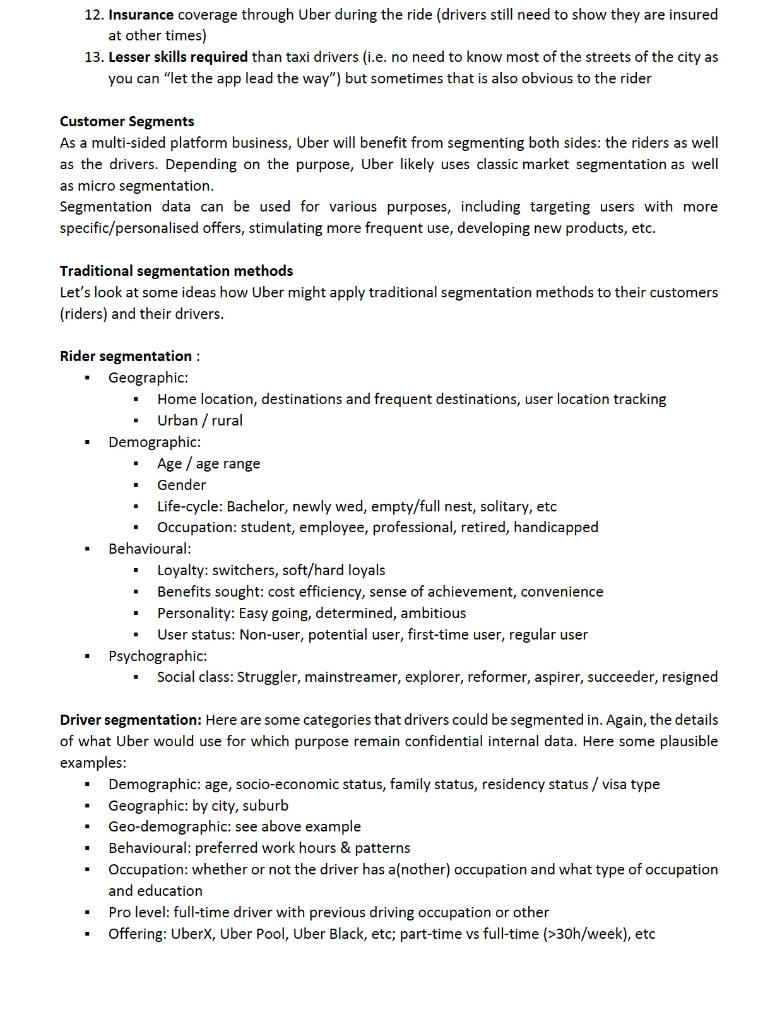
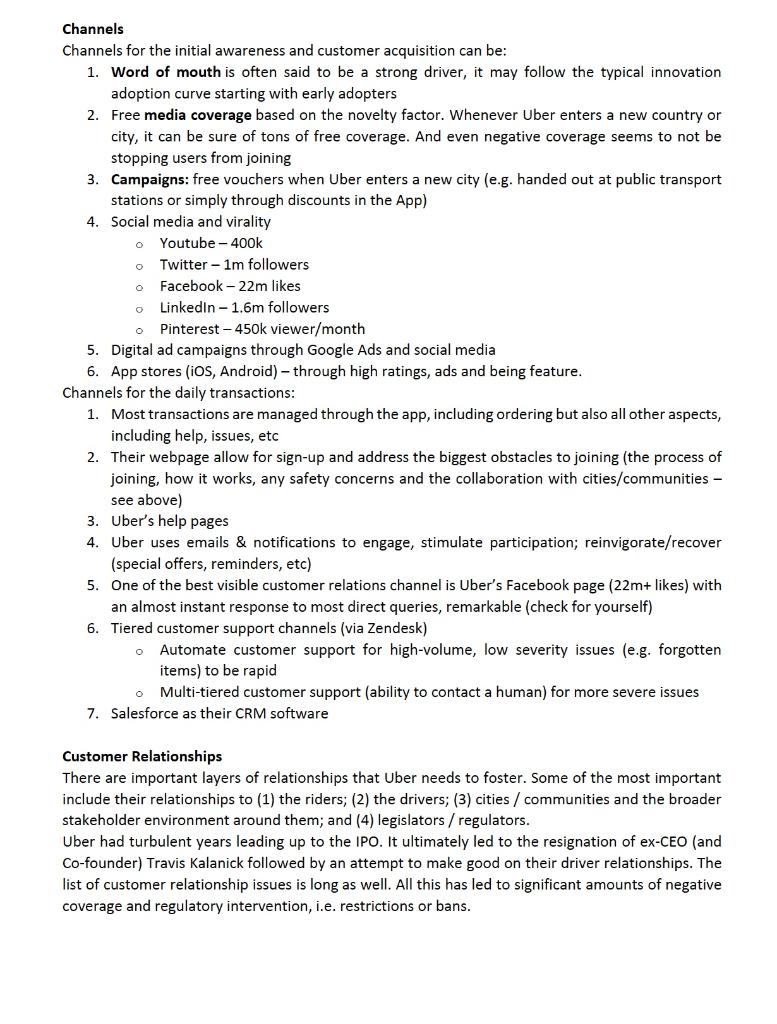
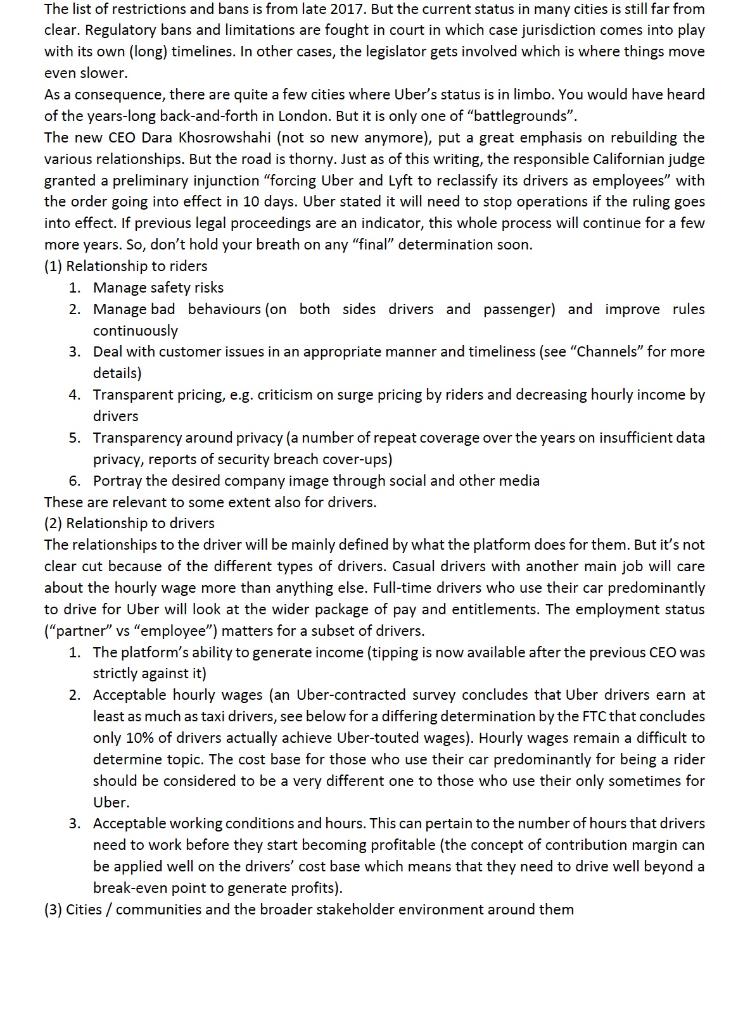
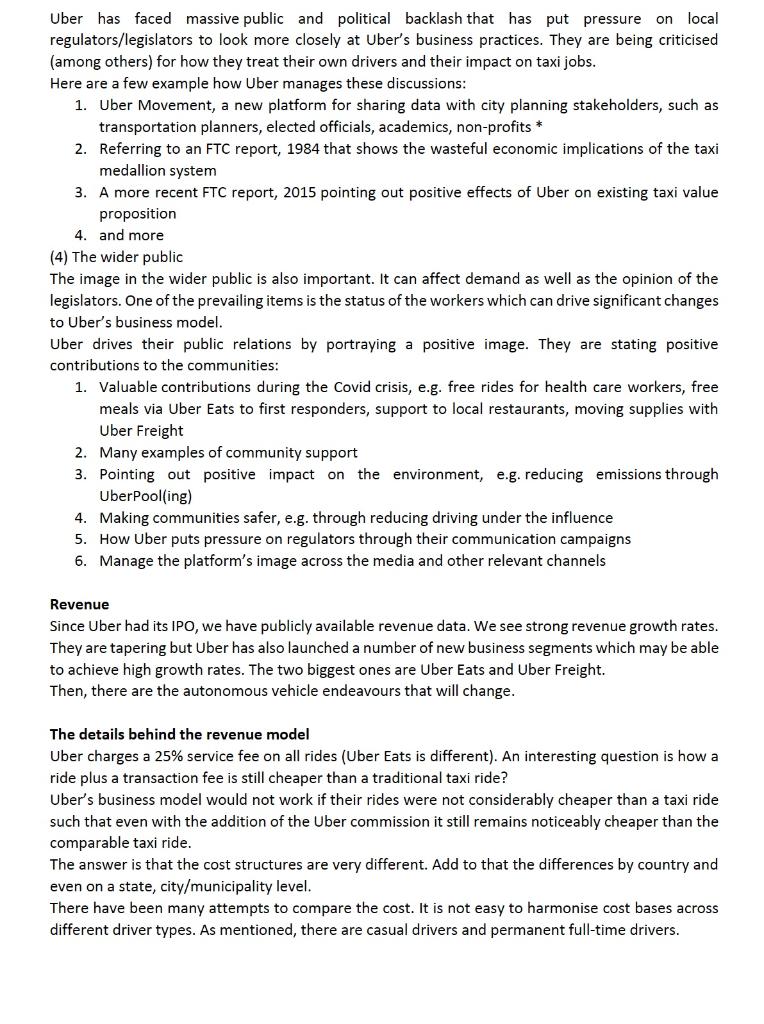
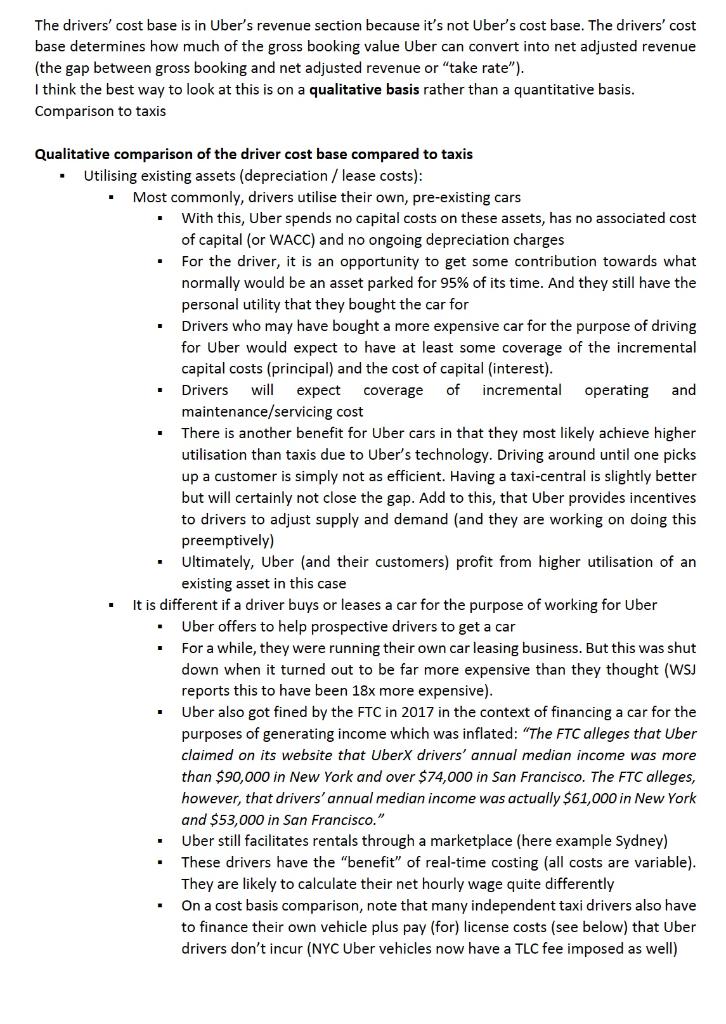
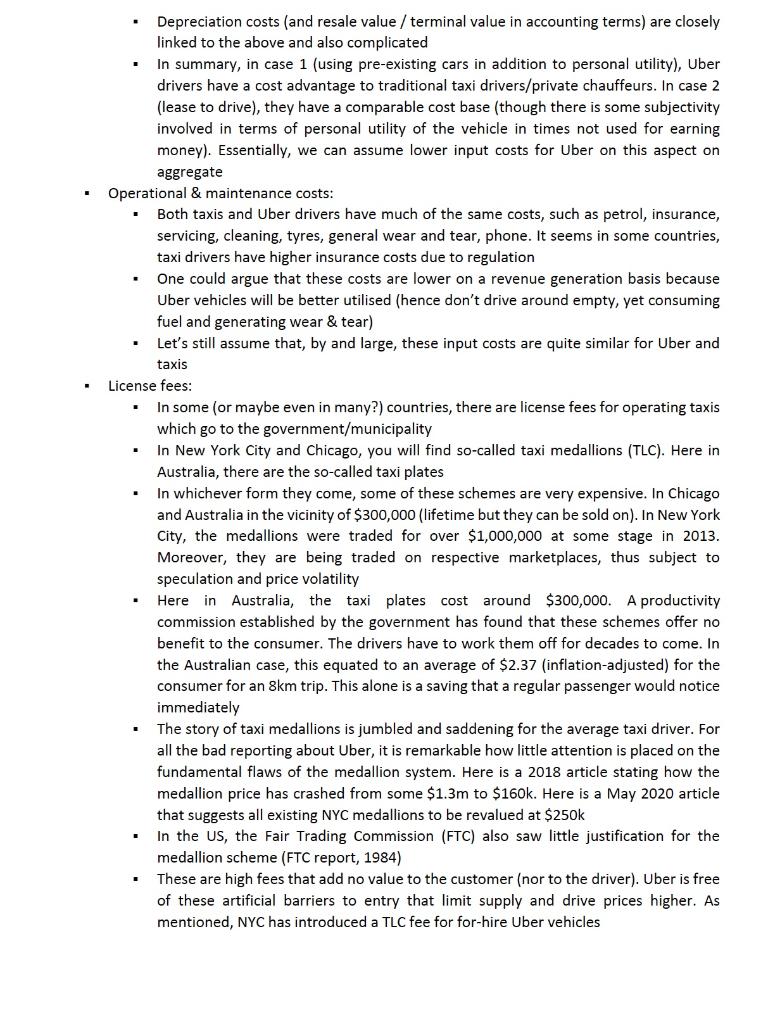
Uber Case History Founded in 2009 by Garrett Camp and Travis Kalanickas "UberCab", met at LeWebin Paris, France in 2008. Camp wanted to solve the Taxi problem in San Francisco. Original pitch split the cost of a driver, Mercedes S Class, and a parking spot with an iPhone app. In January 2010, service was first tested in New York. Service launched in July 2010 in San Francisco. From May 2011 to February 2012 Uber expanded into Seattle, Boston, New York, Chicago, and Washington D.C. First international expansion in Paris, France in December 2011. . Early Investors Lowercase Capital First Round Menlo Benchmark Goldman Sachs Google Ventures . . The Business Model (in the early years) Uber acts as a middleman between drivers and their clients, Uber takes 20 percent of each driver's earnings. Controls rate and can raise or lower as they please. Drivers are responsible for gas and repairs. Until March 2014 they were also responsible for insurance, but now Uber does that. Clients rate the drivers. Ratings encourage competition between drivers. Better ratings = more clients = more money Drivers also rate the clients. Which has led to unfriendly clients being shunned. Uber's presence has resulted in protests and unionization by drivers in many cities. Uber does not require drivers to have a commercial license. Business Model Comparison (early years) Uber Company not licensed as taxi company Drivers do not need commercial license Drivers own cars Drivers provide gas and maintenance Company provides insurance -since 2014 Rates are unregulated Drivers can refuse clients Clients rate drivers online Drivers rate clients online Taxis Company licensed by government Drivers specially licensed by government Company owns cabs Company provides gas and maintenance Company provides insurance Rates are government regulated Drivers cannot (legally) refuse clients Nobody rates anybody Challenges . Uber has faced scrutiny over taxi regulation worldwide: (AUS, BEL, CAN, GER, POL, ROK, UK, USA, and IND. Taxi service is a highly regulated industry that usually requires licenses and inspections for the cars as well as for the drivers. o They also often require special insurance, which Uber originally did not, but now does carry. Taxi commissions, drivers, and owners, in many cities have protested o Many states and municipalities have sent Uber cease and desist letters o Including Massachusetts, Virginia, and San Francisco o They accuse Uber of using unauthorized measurement methods to charge fares as well as other violations of the Taxi regulations. o San Francisco and Massachusetts have since reversed those actions, as national standards were changing and public pressure was put upon officials by Uber users and operators as well by entrepreneurial leaders who saw this as an attempt to stifle innovation. Uber has also suffered from some adverse public relations 0 Drivers with criminal records Drivers denying service to the disabled o Car accidents including those involving pedestrians Founder, Travis Kalanick, pushed out amid accusations of a toxic corporate culture and rampant sexual harassment, . How is it going? Uber has expanded rapidly from its founding to 2018. In over 100 cities and 70 countries in 2017. Market Cap of $ 76 billion in the summer of 2018. Constantly looking to expand (Ex: Las Vegas, Daytona, Jakarta, etc) Due to this growth, competition has grown. Uber does not have patents protecting their service. Lyft provides almost identical services, just with different apps and prices. Another competitor, Sidecar, closed in 2015. Because Uber is a strong and well-established brand, they seem to maintain a solid competitive advantage over other entrants into the industry. They have been accused of unfair competition against its competitors. Expansion in China failed, and they eventually sold to Didichuxing. They lost $2.8 Billion in 2016 exclusive of the loss in China. Since 2016 they have continued growing and losing money as we shall see in the following graphs. Key Partners We distinguish between two types of key partners, those that are crucial and other partners. Uber's most crucial partners are drivers, restaurants (Uber Eats), certain technology partners, cities, and a fast-growing ecosystem of commercial partnerships. In their pre-IPO business, the list of crucial partners rightly included investors. But these are now included in the wider key partners list. The drivers are the supply side and help deliver the value proposition to the end customers (riders). The list of crucial technology partners only includes those that help with unique technologies (or at least not widely available). At this stage of the company, this includes only partners for their new endeavors, such as autonomous vehicles (AV). Uber has also a lot of crucial IT technology but it is mostly proprietary (.e. in-house build) which does not preclude that they are using common underlying technologies (see their tech stack) which-again-are not crucial partnerships. Here are more details: 1. Drivers: The drivers are on the supply side of Uber and they can join or leave at a moment's notice. It is essential to have enough of them to be able to provide the customer proposition (timely pick-up at low cost). They bring their own cars into the value proposition for which Uber does not have to outlay any capital costs. Without a critical mass of drivers, the crucial indirect network effects do not kick-in which is why Uber accelerates supply when they enter a new city. But even after the initial onboarding of drivers, there is the ongoing issue of their employment status, payments, entitlements, etc, which we will discuss. Additionally, there are a growing set of specialized drivers: 1. Limu, wheelchair capable cars/drivers 2. Uber Freight trucks, drivers 3. And a lot more 2. Restaurants: Like drivers, restaurants are essential and can join or leave at a moment's notice. They can multi-home using one of the many competitor meal-delivery offers. It's an ambivalent space due to the high commission that Uber takes. The importance of Uber Eats was highlighted during the covid crisis when Uber Rides basically collapsed while Eats soared alleviating the financial fallout somewhat. 3. Technology partners: Let us distinguish between two types of technologies. The first are tech partners offering leading-edge, proprietary technology that is essential to the value proposition. (Note that uniqueness is always temporary as it will be copied at some stage if successful. It still makes it unique if it plays an important role.) The former includes R&D areas like autonomous vehicles because of its importance to be a first or at least early mover in this space. The second includes technology that is relatively widely available and/or non-essential to the uniqueness of the value proposition (even if leading-edge), this includes things like maps, GPS, payment, Cloud services, the elements of the tech stack, etc. 4. Cities / communities: What are cities and communities? It is hard to clearly identify who this is. Firstly, there are many players involved in enabling Uber in cities (or at least not hindering them). There are state-level legislators affecting different types of laws that Uber is dependent on. There are federal-level regulators for aspects of road-safety, etc. And then there are all sorts of city-level stakeholders. Add to this that responsibilities differ by country. Funny enough, there are even differences within a country. Uber is facing more resistance in some cities within the US and less in others. The barriers can come from different directions. Add the international operations and things get even more complex. Cities / communities have become key partners. 5. Commercial partners: Uber partners with a multitude of corporates and commercial partners. These types of partnerships differ and have different purposes, ease pick-up/drop- off, creating new channels to local markets, increasing loyalty and more! 6. R&D Partners: research partners, e.g. ATG on future technologies, such as autonomous vehicles; partners on eVTOLs (electric vertical take-off and landing); as well as R&D partners on IT research areas, in particular, Al. 7. Investors/venture capitalists brought the initial rounds of funding to the table. The funding helped them to develop the functionality, apps, algorithms, their R&D, but is also used for customers acquisition costs and other expenses. The role of investors was more important pre-IPO. They went to the bond markets a few times after their IPO (here the current standing with a coupon rate of 7.5%). Uber's funding rounds started in 2010 and continued to the IPO and a minor funding round post-IPO. Uber's funding rounds started in 2010 and continued to the IPO and a minor funding round post-IPO 8. Lobbyists were more important at the earlier stages of the company in that there was an (albeit unlikely) risk of being banned or significantly curtailed. Lobbying work continues several fronts (including the employment status of drivers and future innovations, AVs and eVTOLS, etc). We see that their lobby expenses in the US have started to taper. Uber's funding rounds started in 2010 and continued to the IPO and a minor funding round post-IPO Other partners involved in the non-core value proposition or supporting activities, some examples are: 1. Hire car partners (Uber-ready vehicles) 2. Insurances: Uber uses a combination of third-party insurance and self-insurance, including a wholly owned captive insurance subsidiary. This also means that they must have insurance reserves in their books which is based on historical data and actuary estimates (which in exceptional cases could prove insufficient) 3. Gold, Platinum and Diamond Uber Pro driver-partners involved in an accident while driving for Uber can access rideshare-ready replacement vehicles (the partner is rideshare accident vehicles) Key activities Now that Uber has achieved considerable scale, there are three types of key activities: (a) operational excellence, e.g. safety; (b) continued expansion to new countries and cities; and (c) improve existing value propositions and develop entirely new ones. From a platform business model perspective, most of these activities can also be categorized into reductions of search, transaction / post-transaction costs as well as enhancing positive network effects while reducing negative ones. Some examples are: 1. Remove friction (search costs) from all interactions. This includes the many improvements around pick-up points, e.g. location accuracy, spotlight and many other (non-tec ways 2. Remove negative experiences (transaction costs), e.g. bad behaviours / safety needs on both sides (rider and driver), e.g. through rating and other measures 3. Reduce safety risks which often come with the risk of negative coverage and can add to regulatory concerns 4. Improve the technical lead on the proprietary technologies 5. Improve the App as well as the involved processes based on user feedback 6. Keep participants engaged and stimulate ongoing participation. This can include external stimuli, such as providing rewards, promotions, notifications, etc. 7. Scale driver and customer side (in existing cities) to reduce idle times for drivers and waiting times for riders. This also includes keeping both sides in balance. One (unpopular) way of doing so is surge pricing 8. Expand and grow into more cities and countries (more on the growth strategies in the premium resources) 9. Continue improving the value proposition, e.g. cheaper rides for regular commuters through Uber Pool and Express Pool 10. Develop new products: Uber Eats, Uber Freight and many other specific value proposition related to Rides and Eats 11. Add complementary value propositions (e.g. car financing, new customer segments, etc) 12. Develop, add to and refine the loyalty / rewards programs 13. Reduce churn on driver and rider side 14. Analyze the data to fine-tune everything 15. Find solutions to long-standing issues, driver dissatisfaction, criticism from cities and communities Key Resources / Assets The most important asset of the platform business model are its network effects. It is the resource/asset that needs to be built and the nurtured. The data, the algorithms and the capability to analyze and gain insights are essential. The latter also grows with the size of the network.
Positive network effects can be diminished by negative customer relationships. 1. Network effects between the participants (drivers and riders) are essential and Uber keeps on pointing this out in all investor briefings 2. Active users and drivers 3. Data assets: Captured user data and other data (external) 4. Algorithms, technologies, analytic capabilities and more 5. Skilled engineering & other staff, including local staff 6. Brand: Uber is ranking #87 on Interbrand index at an estimated brand value of $5.7b. 7. Digital assets: 1. The user App 2. The driver App 3. The Uber Eats App (for users) 4. Uber Eats App for restaurants, Uber Eats Manager App 5. The Website: Alexa rank 1,200th 6. The tech stack 7. And more 8. And a lot more. Value proposition Uber is a multi-sided platform and as such it must have a value proposition to both sides, the riders as well as the drivers. For riders, the value propositions are that it to "always get the ride you want". For drivers, it's the promise of "opportunity" to set one's own hours, track earnings (in real-time), ability to get support and more. The value propositions fall into the category of search and transaction cost savings relative to other personal transport options. Value proposition to riders 1. Custom ride: the "exact ride" that the user needs (i.e. pick-up and drop-off point without transit on either side) 2. On-demand from the App, no need to schedule a pre-order (though possible). Uber aims to provide reliable rides in that people don't have to plan trips ahead of time 3. The App gives you estimated pick-up, duration and ETA of the ride 4. Affordability: typically lower prices than a comparable taxi ride (exception: surge pricing); an estimated fare is provided prior to the ride 5. Ease and convenience: removing friction from all interactions to the extent possible, e.g. 1. Fast pick-ups (often 3-5 mins) and tracking the driver arriving 2. Choice in terms of vehicle type (economy, premium, etc) 3. No need to tell the driver the destination or route 4. Cashless transactions (exceptions exist) 6. Rating system that allows for fe Safety: rider sees the driver's name, license plate number, photo, rating before entering the car; sharing of trip with friends/family prior, if desired; real-time tracking during the ride; emergency button and reporting function. Value proposition to drivers (Uber Rides & Eats) Some of the value propositions for the drivers (supply side) are: 1. Income generation and low idle times due to the large amount of active riders 2. Flexible and predictable work hours as well as self-determined shift durations (at least in theory - the actual incentive system can lead to other behaviours) 3. Tracking one's earnings (in real-time) and ability generate immediate earnings and ability to get paid out frequently (esp in the US) 4. 24/7 support: ability to contact Uber anytime, e.g. in the case of issues with a rider as well as providing a rider rating 5. No boss (other than algorithms) 6. The driver app that helps with navigation, alerts, planning, earnings, etc 7. Ease of joining: requirements to join can be met by most driver car-owners (mainly: identification, background check, vehicle inspection, 4-door car) 8. No upfront investment in joining (pre-existing car or ability to source through a vehicle marketplace for those who want to ride but have no car 9. Ability to earn above average in peak demand (the driver app shows surge areas) - often weekend nights 10. Driver rewards program: progressive rewards based work hours, etc 11. Ability to get customers (passengers) at no cost to the driver 12. Insurance coverage through Uber during the ride (drivers still need to show they are insured at other times) 13. Lesser skills required than taxi drivers (i.e. no need to know most of the streets of the city as you can "let the app lead the way") but sometimes that is also obvious to the rider Customer Segments As a multi-sided platform business, Uber will benefit from segmenting both sides: the riders as well as the drivers. Depending on the purpose, Uber likely uses classic market segmentation as well as micro segmentation. Segmentation data can be used for various purposes, including targeting users with more specific/personalised offers, stimulating more frequent use, developing new products, etc. Traditional segmentation methods Let's look at some ideas how Uber might apply traditional segmentation methods to their customers (riders) and their drivers. . Rider segmentation : Geographic: Home location, destinations and frequent destinations, user location tracking Urban / rural Demographic: Age / age range Gender Life-cycle: Bachelor, newly wed, empty/full nest, solitary, etc Occupation: student, employee, professional, retired, handicapped Behavioural: Loyalty: switchers, soft/hard loyals Benefits sought: cost efficiency, sense of achievement, convenience Personality: Easy going, determined, ambitious User status: Non-user, potential user, first-time user, regular user Psychographic: Social class: Struggler, mainstreamer, explorer, reformer, aspirer, succeeder, resigned . Driver segmentation: Here are some categories that drivers could be segmented in. Again, the details of what Uber would use for which purpose remain confidential internal data. Here some plausible examples: Demographic: age, socio-economic status, family status, residency status / visa type Geographic: by city, suburb Geo-demographic: see above example Behavioural: preferred work hours & patterns Occupation: whether or not the driver has another) occupation and what type of occupation and education Pro level: full-time driver with previous driving occupation or other Offering: UberX, Uber Pool, Uber Black, etc; part-time vs full-time (>30h/week), etc . o 0 0 Channels Channels for the initial awareness and customer acquisition can be: 1. Word of mouth is often said to be a strong driver, it may follow the typical innovation adoption curve starting with early adopters 2. Free media coverage based on the novelty factor. Whenever Uber enters a new country or city, it can be sure of tons of free coverage. And even negative coverage seems to not be stopping users from joining 3. Campaigns: free vouchers when Uber enters a new city (e.g. handed out at public transport stations or simply through discounts in the App) 4. Social media and virality Youtube - 400k Twitter - 1m followers Facebook - 22m likes Linkedin - 1.6m followers Pinterest - 450k viewer/month 5. Digital ad campaigns through Google Ads and social media 6. App stores (iOS, Android) - through high ratings, ads and being feature. Channels for the daily transactions: 1. Most transactions are managed through the app, including ordering but also all other aspects, including help, issues, etc 2. Their webpage allow for sign-up and address the biggest obstacles to joining (the process of joining, how it works, any safety concerns and the collaboration with cities/communities - see above) 3. Uber's help pages 4. Uber uses emails & notifications to engage, stimulate participation; reinvigorate/recover (special offers, reminders, etc) 5. One of the best visible customer relations channel is Uber's Facebook page (22m+ likes) with an almost instant response to most direct queries, remarkable (check for yourself) 6. Tiered customer support channels (via Zendesk) Automate customer support for high-volume, low severity issues (e.g. forgotten items) to be rapid Multi-tiered customer support (ability to contact a human) for more severe issues 7. Salesforce as their CRM software Customer Relationships There are important layers of relationships that Uber needs to foster. Some of the most important include their relationships to (1) the riders; (2) the drivers; (3) cities / communities and the broader stakeholder environment around them; and (4) legislators / regulators. Uber had turbulent years leading up to the IPO. It ultimately led to the resignation of ex-CEO (and Co-founder) Travis Kalanick followed by an attempt to make good on their driver relationships. The list of customer relationship issues is long as well. All this has led to significant amounts of negative coverage and regulatory intervention, i.e. restrictions or bans. The list of restrictions and bans is from late 2017. But the current status in many cities is still far from clear. Regulatory bans and limitations are fought in court in which case jurisdiction comes into play with its own (long) timelines. In other cases, the legislator gets involved which is where things move even slower. As a consequence, there are quite a few cities where Uber's status is in limbo. You would have heard of the years-long back-and-forth in London. But it is only one of "battlegrounds". The new CEO Dara Khosrowshahi (not so new anymore), put a great emphasis on rebuilding the various relationships. But the road is thorny. Just as of this writing, the responsible Californian judge granted a preliminary injunction "forcing Uber and Lyft to reclassify its drivers as employees" with the order going into effect in 10 days. Uber stated it will need to stop operations if the ruling goes into effect. If previous legal proceedings are an indicator, this whole process will continue for a few more years. So, don't hold your breath on any "final" determination soon. (1) Relationship to riders 1. Manage safety risks 2. Manage bad behaviours (on both sides drivers and passenger) and improve rules continuously 3. Deal with customer issues in an appropriate manner and timeliness (see "Channels" for more details) 4. Transparent pricing, e.g. criticism on surge pricing by riders and decreasing hourly income by drivers 5. Transparency around privacy (a number of repeat coverage over the years on insufficient data privacy, reports of security breach cover-ups) 6. Portray the desired company image through social and other media These are relevant to some extent also for drivers. (2) Relationship to drivers The relationships to the driver will be mainly defined by what the platform does for them. But it's not clear cut because of the different types of drivers. Casual drivers with another main job will care about the hourly wage more than anything else. Full-time drivers who use their car predominantly to drive for Uber will look at the wider package of pay and entitlements. The employment status ("partner" vs "employee") matters for a subset of drivers. 1. The platform's ability to generate income (tipping is now available after the previous CEO was strictly against it) 2. Acceptable hourly wages (an Uber-contracted survey concludes that Uber drivers earn at least as much as taxi drivers, see below for a differing determination by the FTC that concludes only 10% of drivers actually achieve Uber-touted wages). Hourly wages remain a difficult to determine topic. The cost base for those who use their car predominantly for being a rider should be considered to be a very different one to those who use their only sometimes for Uber. 3. Acceptable working conditions and hours. This can pertain to the number of hours that drivers need to work before they start becoming profitable (the concept of contribution margin can be applied well on the drivers' cost base which means that they need to drive well beyond a break-even point to generate profits). (3) Cities / communities and the broader stakeholder environment around them Uber has faced massive public and political backlash that has put pressure on local regulators/legislators to look more closely Uber's business practices. They are being criticised (among others) for how they treat their own drivers and their impact on taxi jobs. Here are a few example how Uber manages these discussions: 1. Uber Movement, a new platform for sharing data with city planning stakeholders, such as transportation planners, elected officials, academics, non-profits * 2. Referring to an FTC report, 1984 that shows the wasteful economic implications of the taxi medallion system 3. A more recent FTC report, 2015 pointing out positive effects of Uber on existing taxi value proposition 4. and more (4) The wider public The image in the wider public is also important. It can affect demand as well as the opinion of the legislators. One of the prevailing items is the status of the workers which can drive significant changes to Uber's business model. Uber drives their public relations by portraying a positive image. They are stating positive contributions to the communities: 1. Valuable contributions during the Covid crisis, e.g. free rides for health care workers, free meals via Uber Eats to first responders, support to local restaurants, moving supplies with Uber Freight 2. Many examples of community support 3. Pointing out positive impact on the environment, e.g. reducing emissions through UberPooling) 4. Making communities safer, e.g. through reducing driving under the influence 5. How Uber puts pressure on regulators through their communication campaigns 6. Manage the platform's image across the media and other relevant channels Revenue Since Uber had its IPO, we have publicly available revenue data. We see strong revenue growth rates. They are tapering but Uber has also launched a number of new business segments which may be able to achieve high growth rates. The two biggest ones are Uber Eats and Uber Freight. Then, there are the autonomous vehicle endeavours that will change. The details behind the revenue model Uber charges a 25% service fee on all rides (Uber Eats is different). An interesting question is how a ride plus a transaction fee is still cheaper than a traditional taxi ride? Uber's business model would not work if their rides were not considerably cheaper than a taxi ride such that even with the addition of the Uber commission it still remains noticeably cheaper than the comparable taxi ride. The answer is that the cost structures are very different. Add to that the differences by country and even on a state, city/municipality level. There have been many attempts to compare the cost. It is not easy to harmonise cost bases across different driver types. As mentioned, there are casual drivers and permanent full-time drivers. The drivers' cost base is in Uber's revenue section because it's not Uber's cost base. The drivers' cost base determines how much of the gross booking value Uber can convert into net adjusted revenue (the gap between gross booking and net adjusted revenue or "take rate"). I think the best way to look at this is on a qualitative basis rather than a quantitative basis. Comparison to taxis Qualitative comparison of the driver cost base compared to taxis Utilising existing assets (depreciation / lease costs): Most commonly, drivers utilise their own, pre-existing cars With this, Uber spends no capital costs on these assets, has no associated cost of capital (or WACC) and no ongoing depreciation charges For the driver, it is an opportunity to get some contribution towards what normally would be an asset parked for 95% of its time. And they still have the personal utility that they bought the car for Drivers who may have bought a more expensive car for the purpose of driving for Uber would expect to have at least some coverage of the incremental capital costs (principal) and the cost of capital (interest). Drivers will expect coverage of incremental operating and maintenance/servicing cost There is another benefit for Uber cars in that they most likely achieve higher utilisation than taxis due to Uber's technology. Driving around until one picks up a customer is simply not as efficient. Having a taxi-central is slightly better but will certainly not close the gap. Add to this, that Uber provides incentives to drivers to adjust supply and demand (and they are working on doing this preemptively) Ultimately, Uber (and their customers) profit from higher utilisation of an existing asset in this case It is different if a driver buys or leases a car for the purpose of working for Uber Uber offers to help prospective drivers to get a car For a while, they were running their own car leasing business. But this was shut down when it turned out to be far more expensive than they thought (WSJ reports this to have been 18% more expensive). Uber also got fined by the FTC in 2017 in the context of financing a car for the purposes of generating income which was inflated: "The FTC alleges that Uber claimed on its website that UberX drivers' annual median income was more than $90,000 in New York and over $74,000 in San Francisco. The FTC alleges, however, that drivers' annual median income was actually $61,000 in New York and $53,000 in San Francisco." Uber still facilitates rentals through a marketplace (here example Sydney) These drivers have the "benefit" of real-time costing (all costs are variable). They are likely to calculate their net hourly wage quite differently On a cost basis comparison, note that many independent taxi drivers also have to finance their own vehicle plus pay (for) license costs (see below) that Uber drivers don't incur (NYC Uber vehicles now have a TLC fee imposed as well) . . Depreciation costs and resale value / terminal value in accounting terms) are closely linked to the above and also complicated In summary, in case 1 (using pre-existing cars in addition to personal utility), Uber drivers have a cost advantage to traditional taxi drivers/private chauffeurs. In case 2 (lease to drive), they have a comparable cost base (though there is some subjectivity involved in terms of personal utility of the vehicle in times not used for earning money). Essentially, we can assume lower input costs for Uber on this aspect on aggregate Operational & maintenance costs: Both taxis and Uber drivers have much of the same costs, such as petrol, insurance, servicing, cleaning, tyres, general wear and tear, phone. It seems in some countries, taxi drivers have higher insurance costs due to regulation One could argue that these costs are lower on a revenue generation basis because Uber vehicles will be better utilised (hence don't drive around empty, yet consuming fuel and generating wear & tear) . Let's still assume that, by and large, these input costs are quite similar for Uber and taxis License fees: In some (or maybe even in many?) countries, there are license fees for operating taxis which go to the government/municipality In New York City and Chicago, you will find so-called taxi medallions (TLC). Here in Australia, there are the so-called taxi plates In whichever form they come, some of these schemes are very expensive. In Chicago and Australia in the vicinity of $300,000 (lifetime but they can be sold on). In New York City, the medallions were traded for over $1,000,000 at some stage in 2013. Moreover, they are being traded on respective marketplaces, thus subject to speculation and price volatility Here in Australia, the taxi plates cost around $300,000. A productivity commission established by the government has found that these schemes offer no benefit to the consumer. The drivers have to work them off for decades to come. In the Australian case, this equated to an average of $2.37 (inflation-adjusted) for the consumer for an 8km trip. This alone is a saving that a regular passenger would notice immediately The story of taxi medallions is jumbled and saddening for the average taxi driver. For all the bad reporting about Uber, it is remarkable how little attention is placed on the fundamental flaws of the medallion system. Here is a 2018 article stating how the medallion price has crashed from some $1.3m to $160k. Here is a May 2020 article that suggests all existing NYC medallions to be revalued at $250k In the US, the Fair Trading Commission (FTC) also saw little justification for the medallion scheme (FTC report, 1984) These are high fees that add no value to the customer (nor to the driver). Uber is free of these artificial barriers to entry that limit supply and drive prices higher. As mentioned, NYC has introduced a TLC fee for for-hire Uber vehicles . Nothing has changed (in Australia) in the 18 years since the productivity report delivered these clear findings Nothing has changed in the US in the 35 years since the FTC findings. Worse yet, the number of medallions in New York City today is lower than it was in 1937 when the medallions were introduced and this despite increasing population and mobility needs and traffic Barry Ritholtz (a regular Bloomberg investor-columnist) explains "How the TLC & Medallion Owners Created Uber" (note, it's an opinion piece) Employee entitlements: Uber engages drivers as contractors. Thus, they do not accrue annual/sick leave, nor do they contribute to social security, pensions or other entitlement There are some savings here compared to taxi companies. But there are vast differences between countries what taxi drivers are entitled to. This is obviously one of the most contentious aspects of the Uber business model. But it is not black and white as it is often portrayed. Neither is this discussion is not limited to Uber. In any case, Uber is trialing affordable sickness, injury, life insurance partnerships for their drivers. I believe that casual drivers will be more interested in maximising short-term cash flow because they see driving for Uber as temporary. Permanent full-time drivers may have a different view. One 2017 article states that only 4% of drivers remain on the platform after one year. Certainly, some cost savings here for Uber but it's not clear how much Taxes: There are some interesting points here Most interestingly, it seems in many countries Uber drivers can claim mileage (i.e. tax deductions for business-related kilometres), here: US and here Australia This can tip the comparison considerably. Let's do a high-level calculation. Let's say one can travel at 20m/h (yes, miles) in city traffic (this should be an ok estimate for many cities). Now, let's say the driver is utilised 75% of the time. This makes 15m per hour. The standard IRS mileage deduction is $0.52c/m. This calculates to $7.8 per hour. Now, let's assume the driver net wage per hour is $18/h (this is at the high-end - remember some say it's closer to $10/h). Even at the high end ($18/h), some 43% of net income comes from tax deductions (I'm sure you can calculate this percentage for the case of $10/h). I.e. taxpayers foot a considerable amount of this One can see that this is contentious. Sure, taxis get the same tax break. But taxis companies are fully based in the country that they get the tax break in. Thus, the money stays in the local economy (country level view). The criticism will be that a taxpayer in, say Australia, will indirectly pay corporations overseas (the more tax subsidies there are, the less Uber needs to give the driver). Uber will say that the consumer will benefit in terms of lower costs for the ride. It will remain contentious until a productivity commission looks into this Both Uber drivers and taxis pay GST and some other taxes From a cost base perspective, taxis and Uber drivers appear to be on a similar footing with the big caveat of mileage needing a more detailed analysis . . Economies of scale: One of the potentially most interesting cost savings comes from Uber's ability to achieve better prices for their drivers' input costs. fuel (here the Australian example), maintenance, insurance, phone and many other things Uber staggers the benefits depending on the activity of the drivers. Those that drive more, can achieve more savings. There are discount levels from bronze to platinum. Note that some of the 3rd party discounts are also available to the provider's retail base, e.g. their loyalty members. In some cases, the Uber-obtained discount may be higher or the driver can join the program without membership fees or incurring other expenses to get the discounts. It is definitely an economic benefit for drivers and a strengthening of Uber's business model in that scale can lead to lower unit cost. You can see how complex the matter is. It's not about solving this for Uber. The message is that as an innovator you should be aware of these kinds of considerations. The most important insight should be that the revenue is not just the sum of transaction fees. The question will always be if a platform can create enough cumulative value for its participants so that it can capture value for itself. Cost Structure For many online platforms, the biggest cost element are customer acquisition costs (CAC). Up to the release of the IPO document, this was also assumed to be the case for Uber. However, one rather interesting point that was revealed in the IPO document and subsequent annual report, was the significant cost of revenue. These reports indicate that the biggest elements of it are insurance and payment costs. Cost of revenue was higher than marketing and sales since 2014. It still is possible that cost of customer acquisition is the single biggest driver given that both buckets (cost of revenue and sales and marketing) include many sub-items. But it might not be the case. Uber's cost elements are ordered in the highest percent of revenue, 2019): 1. Cost of revenue (51% of revenue, 2019): including "insurance expenses, credit card processing fees, hosting and co-located data center expenses, mobile device and service expenses." This cost item went up from 50% in 2018. This would be concerning because it is a direct cost and was coming down over the recent years (in terms of % of revenue) as one should expect. However, the 2019 10-K indicates that the increased inefficiency was caused by the new business areas. 2. Sales and marketing (33% of revenue): "advertising expenses, expenses related to consumer acquisition and retention, including consumer discounts, promotions, refunds, and credits, Driver referrals, and allocated overhead" (and post-IPO it also includes stock-based compensation to sales and marketing employees) 3. Research & Development (soared up to 34% of revenue in 2019): slightly higher than sales and marketing (but it was far lower for most of the previous reporting periods). It was largely driven by stock-based compensation for engineering employees, hence likely to go back to previous levels of around 15% over time. R&D costs "consist primarily of compensation expenses for engineering, product development, and design employees, including stock-based compensation, expenses associated with ongoing improvements to, and maintenance of, our platform offerings, and ATG and Other Technology Programs development expenses, as well as allocated overhead." 4. General & Admin (23% of revenue in 2019): "General and administrative expenses consist primarily of compensation expenses, including stock-based compensation, for executive management and administrative employees, ...) also include legal settlements." 5. Depreciation and Amortization (3% of revenue, 2019): It's this low because most assets (the cars) are owned by the drivers. Once autonomous vehicles come into play this will likely change (though there could be different ownership models). "all depreciation and amortization expenses associated with our property and equipment and acquired intangible assets/...), and dockless e-bikes (...)" 6. And other costs, including interest expense. Recent bond coupon rates were 7.5% which would be higher without the support of the Fed in the wake of Covid. Questions 1. How did Uber's business model give them an advantage over the early competition? Is this advantage sustainable? Uber has raised cash through both equity and debt. The most 2. recent equity event val them at $76 billion. The most recent debt offering was at the junk bond level of 8%.: a. Do you think the equity investments make sense? Why or why not? b. Do you think the debt (would be a good investment? Why or why not? 3. Uber has faced significant challenges due to the ethics and business climate of the company. How do you feel that this has affected the future prospects of the company? 4. Uber has faced scrutiny and regulation from governments at various levels. How do you feel that this has affected the future prospects of the company? 5. Use the information provided in the case and the provided Canvas Template to develop Uber's Business Model Canvas









 Study Help