







Question: ONLY NEED E, F, G, H, I Question 1 Consider a city where all housing is owned by absentee landlords, and the only people who
ONLY NEED E, F, G, H, I
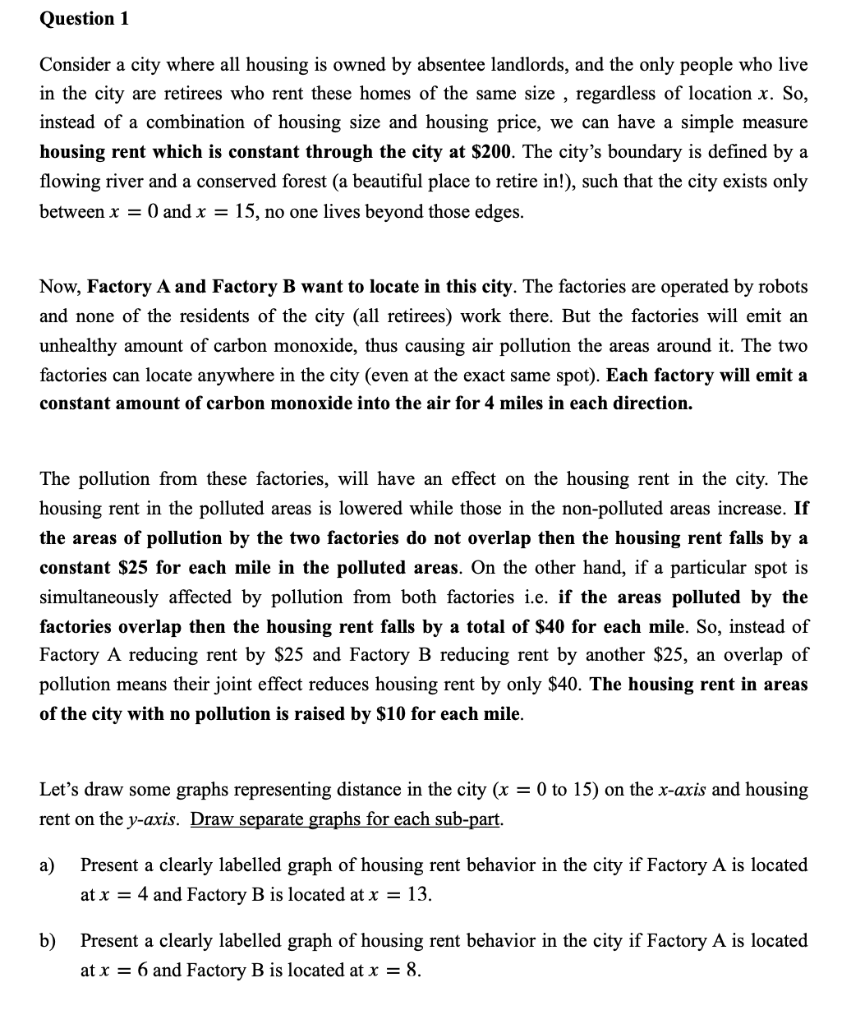
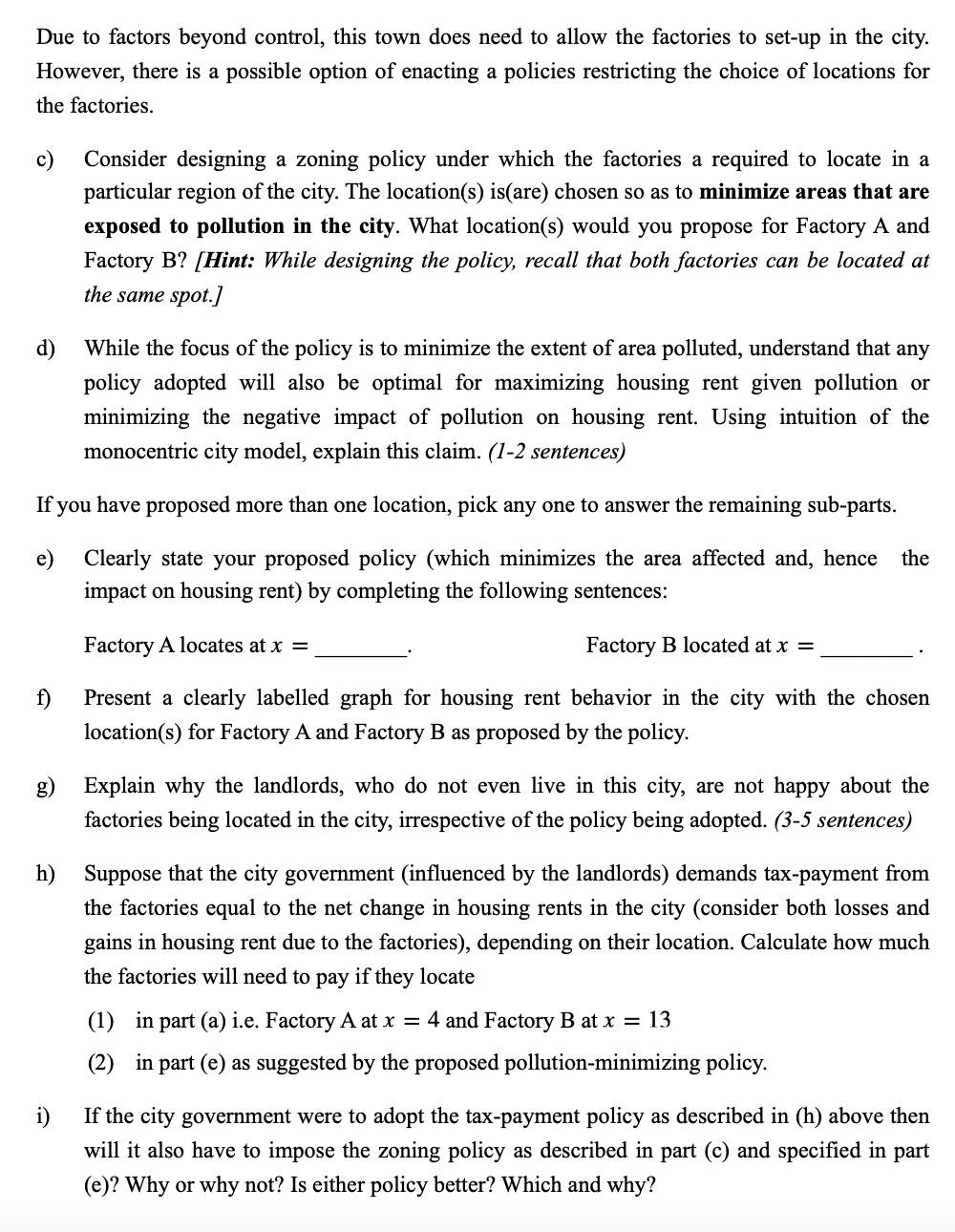
Question 1 Consider a city where all housing is owned by absentee landlords, and the only people who live in the city are retirees who rent these homes of the same size , regardless of location x. So, instead of a combination of housing size and housing price, we can have a simple measure housing rent which is constant through the city at $200. The city's boundary is defined by a flowing river and a conserved forest (a beautiful place to retire in!), such that the city exists only between x = 0 and x = 15, no one lives beyond those edges. Now, Factory A and Factory B want to locate in this city. The factories are operated by robots and none of the residents of the city (all retirees) work there. But the factories will emit an unhealthy amount of carbon monoxide, thus causing air pollution the areas around it. The two factories can locate anywhere in the city (even at the exact same spot). Each factory will emit a constant amount of carbon monoxide into the air for 4 miles in each direction. The pollution from these factories, will have an effect on the housing rent in the city. The housing rent in the polluted areas is lowered while those in the non-polluted areas increase. If the areas of pollution by the two factories do not overlap then the housing rent falls by a constant $25 for each mile in the polluted areas. On the other hand, if a particular spot is simultaneously affected by pollution from both factories i.e. if the areas polluted by the factories overlap then the housing rent falls by a total of $40 for each mile. So, instead of Factory A reducing rent by $25 and Factory B reducing rent by another $25, an overlap of pollution means their joint effect reduces housing rent by only $40. The housing rent in areas of the city with no pollution is raised by $10 for each mile. Let's draw some graphs representing distance in the city (x = 0 to 15) on the x-axis and housing rent on the y-axis. Draw separate graphs for each sub-part. a) Present a clearly labelled graph of housing rent behavior in the city if Factory A is located at x = 4 and Factory B is located at x = 13. b) Present a clearly labelled graph of housing rent behavior in the city if Factory A is located at x = 6 and Factory B is located at x = 8. Due to factors beyond control, this town does need to allow the factories to set-up in the city. However, there is a possible option of enacting a policies restricting the choice of locations for the factories. c) Consider designing a zoning policy under which the factories a required to locate in a particular region of the city. The location(s) is(are) chosen so as to minimize areas that are exposed to pollution in the city. What location(s) would you propose for Factory A and Factory B? (Hint: While designing the policy, recall that both factories can be located at the same spot.] d) While the focus of the policy is to minimize the extent of area polluted, understand that any policy adopted will also be optimal for maximizing housing rent given pollution or minimizing the negative impact of pollution on housing rent. Using intuition of the monocentric city model, explain this claim. (1-2 sentences) If you have proposed more than one location, pick any one to answer the remaining sub-parts. e) the Clearly state your proposed policy (which minimizes the area affected and, hence impact on housing rent) by completing the following sentences: Factory A locates at x = Factory B located at x = f) Present a clearly labelled graph for housing rent behavior in the city with the chosen location(s) for Factory A and Factory B as proposed by the policy. g) Explain why the landlords, who do not even live in this city, are not happy about the factories being located in the city, irrespective of the policy being adopted. (3-5 sentences) h) Suppose that the city government (influenced by the landlords) demands tax-payment from the factories equal to the net change in housing rents in the city (consider both losses and gains in housing rent due to the factories), depending on their location. Calculate how much the factories will need to pay if they locate (1) in part (a) i.e. Factory A at x = 4 and Factory B at x = 13 (2) in part (e) as suggested by the proposed pollution-minimizing policy. i) If the city government were to adopt the tax-payment policy as described in (h) above then will it also have to impose the zoning policy as described in part (c) and specified in part (e)? Why or why not? Is either policy better? Which and why? Question 1 Consider a city where all housing is owned by absentee landlords, and the only people who live in the city are retirees who rent these homes of the same size , regardless of location x. So, instead of a combination of housing size and housing price, we can have a simple measure housing rent which is constant through the city at $200. The city's boundary is defined by a flowing river and a conserved forest (a beautiful place to retire in!), such that the city exists only between x = 0 and x = 15, no one lives beyond those edges. Now, Factory A and Factory B want to locate in this city. The factories are operated by robots and none of the residents of the city (all retirees) work there. But the factories will emit an unhealthy amount of carbon monoxide, thus causing air pollution the areas around it. The two factories can locate anywhere in the city (even at the exact same spot). Each factory will emit a constant amount of carbon monoxide into the air for 4 miles in each direction. The pollution from these factories, will have an effect on the housing rent in the city. The housing rent in the polluted areas is lowered while those in the non-polluted areas increase. If the areas of pollution by the two factories do not overlap then the housing rent falls by a constant $25 for each mile in the polluted areas. On the other hand, if a particular spot is simultaneously affected by pollution from both factories i.e. if the areas polluted by the factories overlap then the housing rent falls by a total of $40 for each mile. So, instead of Factory A reducing rent by $25 and Factory B reducing rent by another $25, an overlap of pollution means their joint effect reduces housing rent by only $40. The housing rent in areas of the city with no pollution is raised by $10 for each mile. Let's draw some graphs representing distance in the city (x = 0 to 15) on the x-axis and housing rent on the y-axis. Draw separate graphs for each sub-part. a) Present a clearly labelled graph of housing rent behavior in the city if Factory A is located at x = 4 and Factory B is located at x = 13. b) Present a clearly labelled graph of housing rent behavior in the city if Factory A is located at x = 6 and Factory B is located at x = 8. Due to factors beyond control, this town does need to allow the factories to set-up in the city. However, there is a possible option of enacting a policies restricting the choice of locations for the factories. c) Consider designing a zoning policy under which the factories a required to locate in a particular region of the city. The location(s) is(are) chosen so as to minimize areas that are exposed to pollution in the city. What location(s) would you propose for Factory A and Factory B? (Hint: While designing the policy, recall that both factories can be located at the same spot.] d) While the focus of the policy is to minimize the extent of area polluted, understand that any policy adopted will also be optimal for maximizing housing rent given pollution or minimizing the negative impact of pollution on housing rent. Using intuition of the monocentric city model, explain this claim. (1-2 sentences) If you have proposed more than one location, pick any one to answer the remaining sub-parts. e) the Clearly state your proposed policy (which minimizes the area affected and, hence impact on housing rent) by completing the following sentences: Factory A locates at x = Factory B located at x = f) Present a clearly labelled graph for housing rent behavior in the city with the chosen location(s) for Factory A and Factory B as proposed by the policy. g) Explain why the landlords, who do not even live in this city, are not happy about the factories being located in the city, irrespective of the policy being adopted. (3-5 sentences) h) Suppose that the city government (influenced by the landlords) demands tax-payment from the factories equal to the net change in housing rents in the city (consider both losses and gains in housing rent due to the factories), depending on their location. Calculate how much the factories will need to pay if they locate (1) in part (a) i.e. Factory A at x = 4 and Factory B at x = 13 (2) in part (e) as suggested by the proposed pollution-minimizing policy. i) If the city government were to adopt the tax-payment policy as described in (h) above then will it also have to impose the zoning policy as described in part (c) and specified in part (e)? Why or why not? Is either policy better? Which and why
Step by Step Solution
There are 3 Steps involved in it

Get step-by-step solutions from verified subject matter experts
 Study Help