







Question: only need question 5 but use question 4 to help complete it only need the first a-e, but use the second a-e to help (5
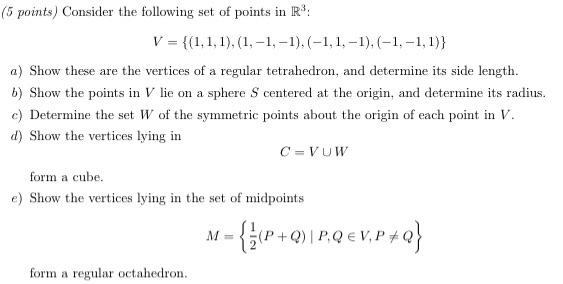
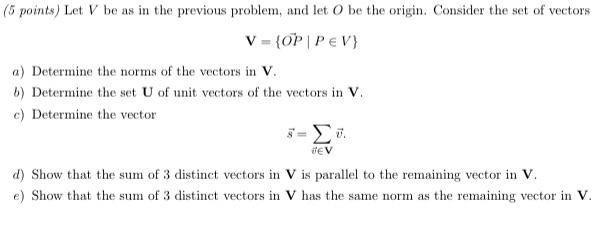
(5 points) Consider the following set of points in R*: V = {(1,1,1),(1,-1,-1),(-1,1,-1),(-1,-1,1)} a) Show these are the vertices of a regular tetrahedron, and determine its side length. b) Show the points in V lie on a sphere S centered at the origin, and determine its radius. c) Determine the set W of the symmetric points about the origin of each point in V. d) Show the vertices lying in C = VUW form a cube. e) Show the vertices lying in the set of midpoints M= = {p+Q)|PQEV, - +9} form a regular octahedron, (5 points) Let V be as in the previous problem, and let O be the origin. Consider the set of vectors V- {OPPEV) a) Determine the norms of the vectors in V. b) Determine the set U of unit vectors of the vectors in V. c) Determine the vector . d'EV d) Show that the sum of 3 distinct vectors in V is parallel to the remaining vector in V. e) Show that the sum of 3 distinct vectors in V has the same norm as the remaining vector in V. (5 points) Consider the following set of points in R*: V = {(1,1,1),(1,-1,-1),(-1,1,-1),(-1,-1,1)} a) Show these are the vertices of a regular tetrahedron, and determine its side length. b) Show the points in V lie on a sphere S centered at the origin, and determine its radius. c) Determine the set W of the symmetric points about the origin of each point in V. d) Show the vertices lying in C = VUW form a cube. e) Show the vertices lying in the set of midpoints M= = {p+Q)|PQEV, - +9} form a regular octahedron, (5 points) Let V be as in the previous problem, and let O be the origin. Consider the set of vectors V- {OPPEV) a) Determine the norms of the vectors in V. b) Determine the set U of unit vectors of the vectors in V. c) Determine the vector . d'EV d) Show that the sum of 3 distinct vectors in V is parallel to the remaining vector in V. e) Show that the sum of 3 distinct vectors in V has the same norm as the remaining vector in V
Step by Step Solution
There are 3 Steps involved in it

Get step-by-step solutions from verified subject matter experts
 Study Help