







Question: To find the points of inflection, we examine the zeros of f(x), the second derivative. We use the name ypp for this. >> hold
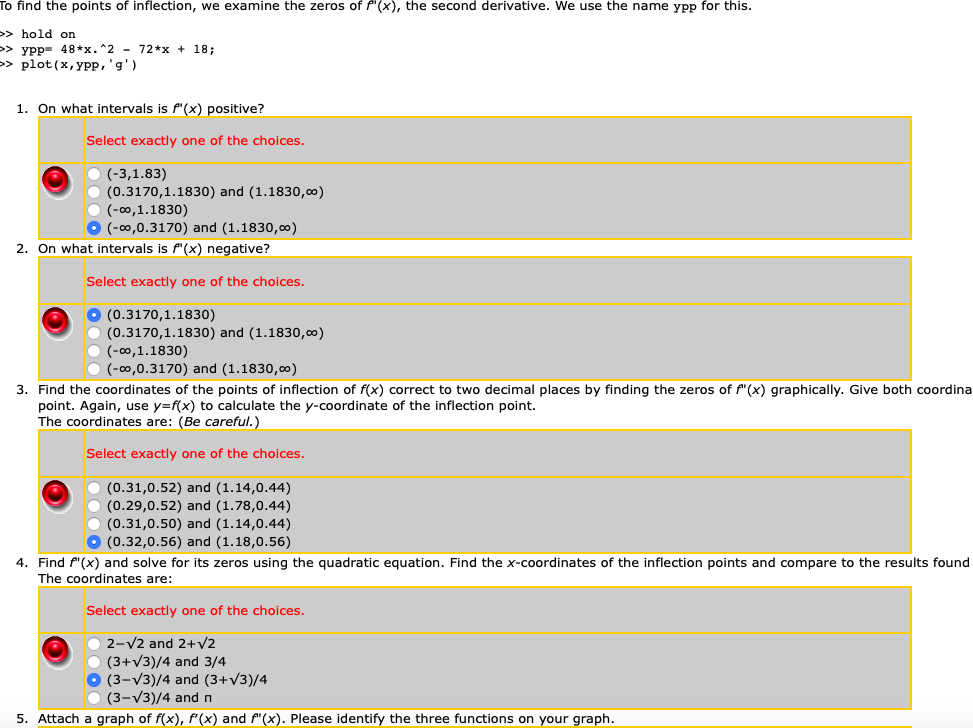
To find the points of inflection, we examine the zeros of f(x), the second derivative. We use the name ypp for this. >> hold on >> ypp= 48*x. ^272*x + 18; >> plot (x,ypp,'g'). 1. On what intervals is f'(x) positive? Select exactly one of the choices. (-3,1.83) (0.3170,1.1830) and (1.1830,) (-0,1.1830) (-0,0.3170) and (1.1830,00) 2. On what intervals is f(x) negative? Select exactly one of the choices. (0.3170,1.1830) (0.3170,1.1830) and (1.1830,) (-00,1.1830) (-0,0.3170) and (1.1830,00) 3. Find the coordinates of the points of inflection of f(x) correct to two decimal places by finding the zeros of f'(x) graphically. Give both coordina point. Again, use y=f(x) to calculate the y-coordinate of the inflection point. The coordinates are: (Be careful.) Select exactly one of the choices. (0.31,0.52) and (1.14,0.44) (0.29,0.52) and (1.78,0.44) (0.31,0.50) and (1.14,0.44) 0 (0.32,0.56) and (1.18,0.56) 4. Find f'(x) and solve for its zeros using the quadratic equation. Find the x-coordinates of the inflection points and compare to the results found The coordinates are: Select exactly one of the choices. 2-2 and 2+2 (3+3)/4 and 3/4 (3-3)/4 and (3+3)/4 (3-3)/4 and n 5. Attach a graph of f(x), f'(x) and f(x). Please identify the three functions on your graph.
Step by Step Solution
There are 3 Steps involved in it

Get step-by-step solutions from verified subject matter experts
 Study Help