


Question: ONLY NEED TO SOLVE QUESTION NUMBER 5 You are a manager of an equity fund with an expected return of 12% and standard deviation of

ONLY NEED TO SOLVE QUESTION NUMBER 5
ONLY NEED TO SOLVE QUESTION NUMBER 5 You are a
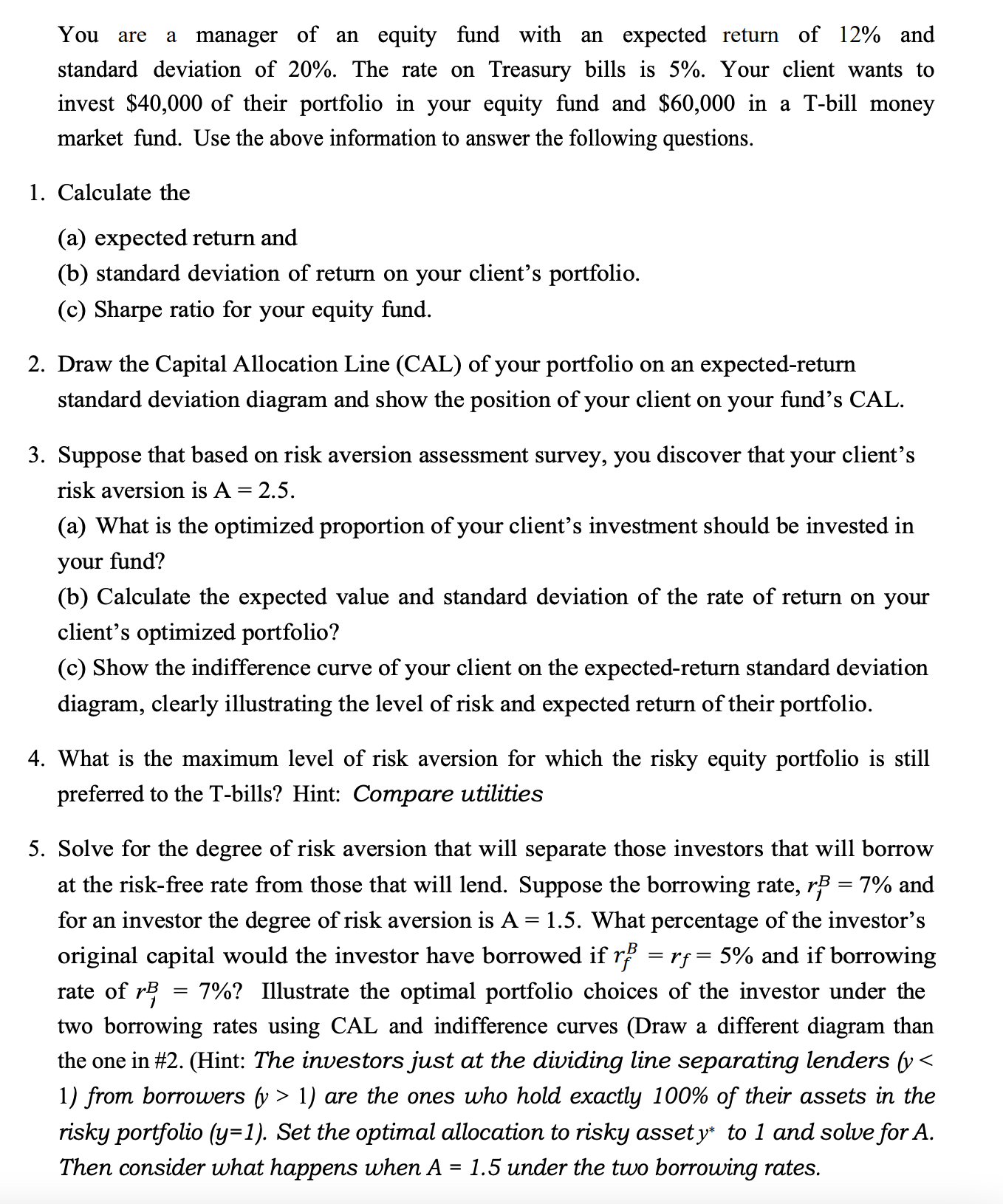
You are a manager of an equity fund with an expected return of 12% and standard deviation of 20%. The rate on Treasury bills is 5%. Your client wants to invest $40,000 of their portfolio in your equity fund and $60,000 in a T-bill money market fund. Use the above information to answer the following questions. . Calculate the (a) expected return and (b) standard deviation of return on your client's portfolio. (c) Sharpe ratio for your equity fund. . Draw the Capital Allocation Line (CAL) of your portfolio on an expected-return standard deviation diagram and show the position of your client on your fund's CAL. . Suppose that based on risk aversion assessment survey, you discover that your client's risk aversion is A = 2.5. (a) What is the optimized proportion of your client's investment should be invested in your fund? (b) Calculate the expected value and standard deviation of the rate of return on your client's optimized portfolio? (0) Show the indifference curve of your client on the expected-return standard deviation diagram, clearly illustrating the level of risk and expected return of their portfolio. . What is the maximum level of risk aversion for which the risky equity portfolio is still preferred to the T-bills? Hint: Compare utilities . Solve for the degree of risk aversion that will separate those investors that will borrow at the risk-free rate from those that will lend. Suppose the borrowing rate, r? = 7% and for an investor the degree of risk aversion is A = 1.5. What percentage of the investor's original capital would the investor have borrowed if rfB = rf = 5% and if borrowing rate of I"? = 7%? Illustrate the optimal portfolio choices of the investor under the two borrowing rates using CAL and indifference curves (Draw a different diagram than the one in #2. (Hint: The investors just at the dividing line separating lenders (y 1) are the ones who hold exactly 100% of their assets in the risky portfolio (y=1). Set the optimal allocation to risky asset y* to 1 and solve forA. Then consider what happens when A = 1.5 under the two borrowing rates

Step by Step Solution

There are 3 Steps involved in it

1 Expert Approved Answer
Step: 1 Unlock blur-text-image

Question Has Been Solved by an Expert!

Get step-by-step solutions from verified subject matter experts

Step: 2 Unlock
Step: 3 Unlock

Students Have Also Explored These Related Finance Questions!