



Question: Only Part B b) Suppose there are two A or two B machines and the arrival rate is doubled. What happens to cycle time? WIP=1.84T/C2=1.841/.25=7.36/2=3.68hoursWIP=1.84T/C2=1.84.85/4=.395/2=.198hours
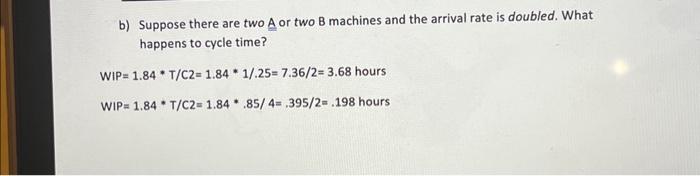
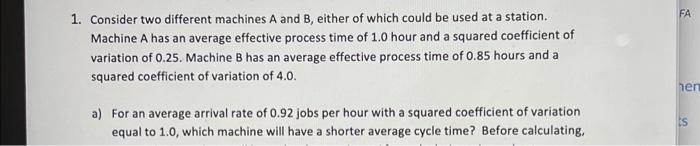
b) Suppose there are two A or two B machines and the arrival rate is doubled. What happens to cycle time? WIP=1.84T/C2=1.841/.25=7.36/2=3.68hoursWIP=1.84T/C2=1.84.85/4=.395/2=.198hours 1. Consider two different machines A and B, either of which could be used at a station. Machine A has an average effective process time of 1.0 hour and a squared coefficient of variation of 0.25 . Machine B has an average effective process time of 0.85 hours and a squared coefficient of variation of 4.0 . a) For an average arrival rate of 0.92 jobs per hour with a squared coefficient of variation equal to 1.0 , which machine will have a shorter average cycle time? Before calculating
Step by Step Solution
There are 3 Steps involved in it

Get step-by-step solutions from verified subject matter experts