







Question: Only solve for parts e through o 3. Recall the problem on the lecture notes on the short run. All of these notes are in
Only solve for parts e through o
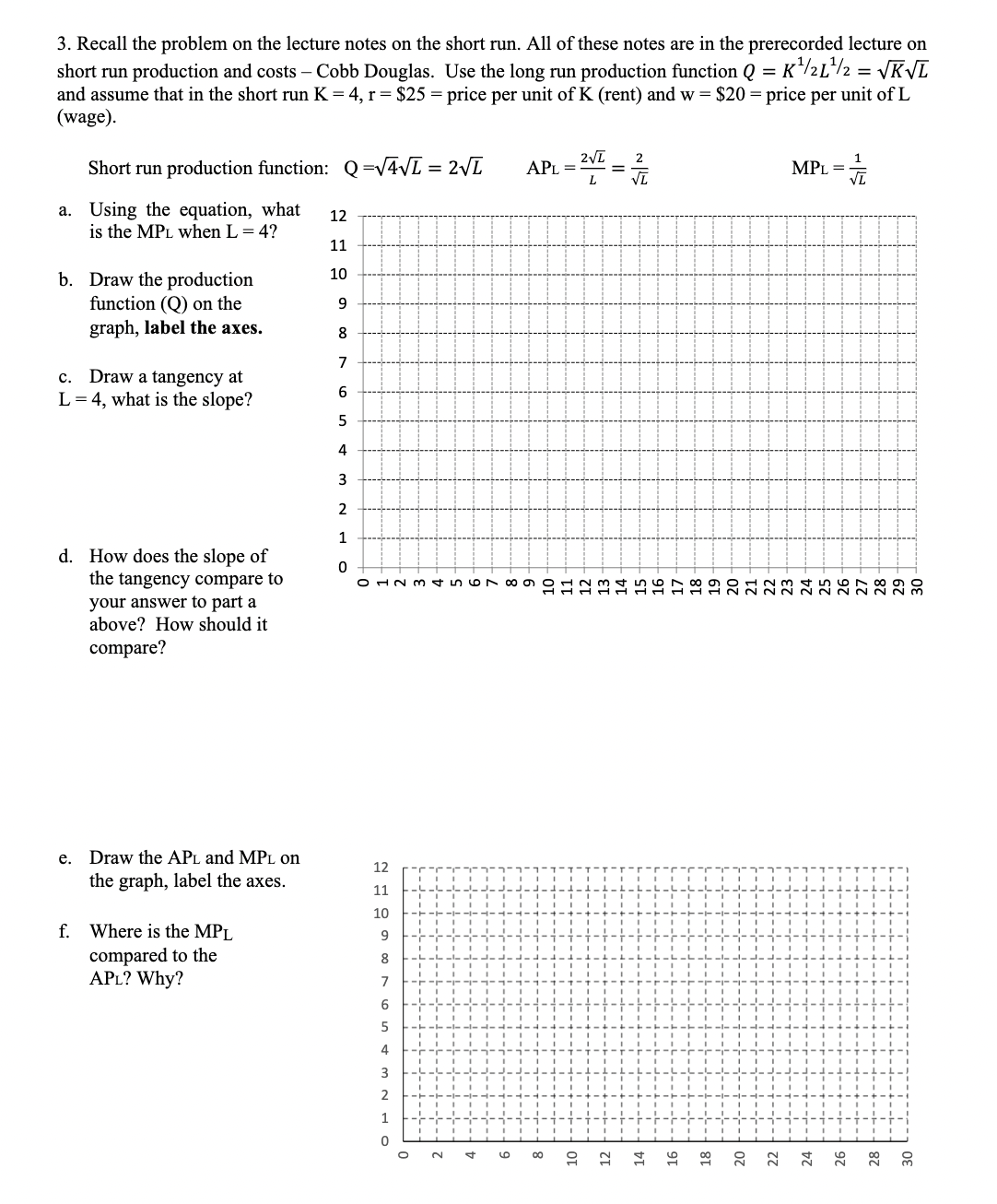
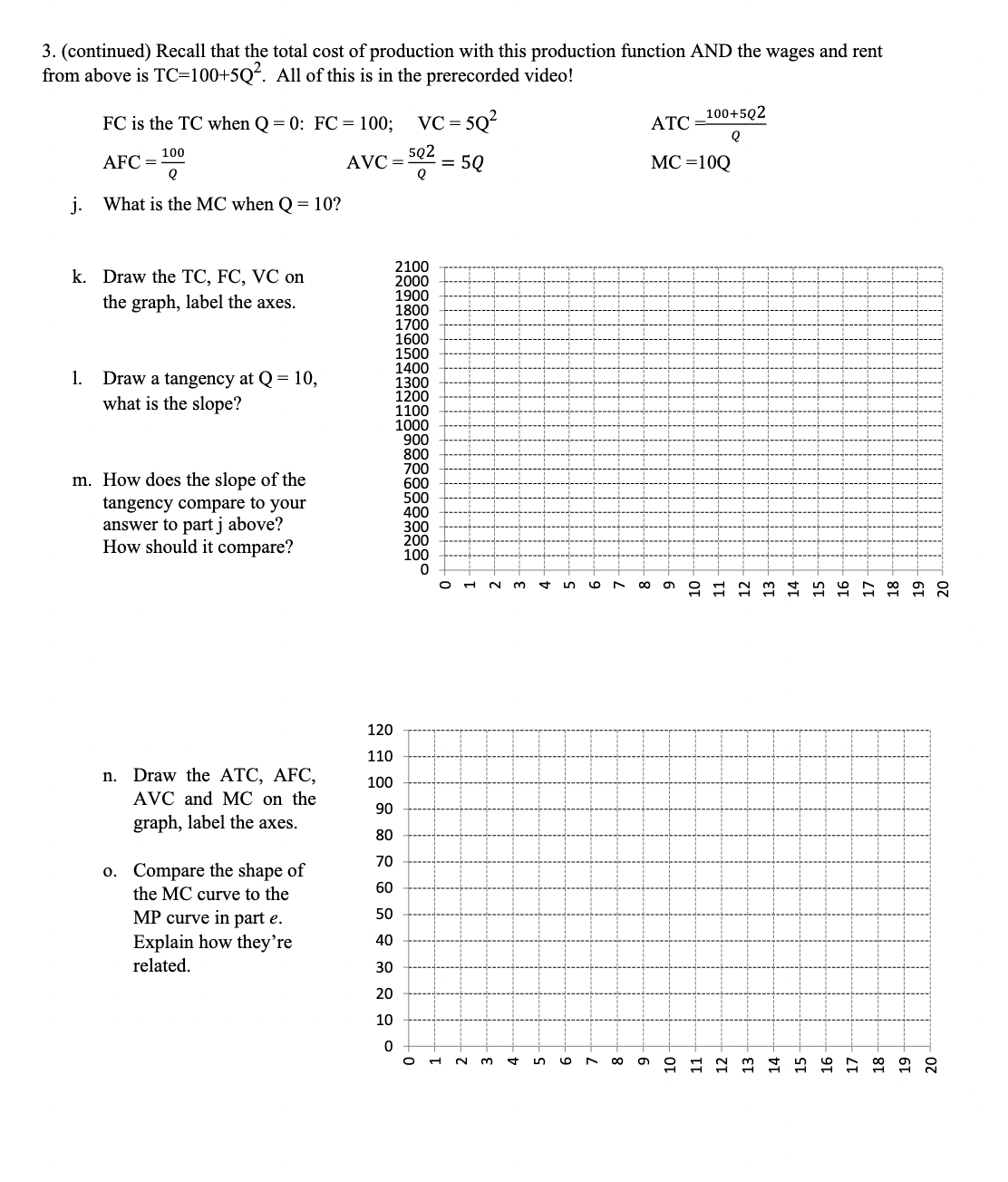
3. Recall the problem on the lecture notes on the short run. All of these notes are in the prerecorded lecture on short run production and costs - Cobb Douglas. Use the long run production function Q=K1/2L1/2=KL and assume that in the short run K=4,r=$25= price per unit of K (rent) and w=$20= price per unit of L (wage). Short run production function: Q=4L=2LAPL=L2L=L2MPL=L1 a. Using the equation, what is the MPL when L=4 ? b. Draw the production function (Q) on the graph, label the axes. c. Draw a tangency at L=4, what is the slope? d. How does the slope of the tangency compare to your answer to part a above? How should it compare? e. Draw the APL and MPL on the graph, label the axes. f. Where is the MPL compared to the APL? Why? 3. (continued) Recall that the total cost of production with this production function AND the wages and rent from above is TC=100+5Q2. All of this is in the prerecorded video! FC is the TC when Q=0:FC=100;VC=5Q2 AFC=Q100 AVC=Q5Q2=5Q ATC=Q100+5Q2 j. What is the MC when Q=10 ? k. Draw the TC, FC, VC on the graph, label the axes. 1. Draw a tangency at Q=10, what is the slope? m. How does the slope of the tangency compare to your answer to part j above? How should it compare? n. Draw the ATC, AFC, AVC and MC on the graph, label the axes. o. Compare the shape of the MC curve to the MP curve in part e. Explain how they're related. 3. Recall the problem on the lecture notes on the short run. All of these notes are in the prerecorded lecture on short run production and costs - Cobb Douglas. Use the long run production function Q=K1/2L1/2=KL and assume that in the short run K=4,r=$25= price per unit of K (rent) and w=$20= price per unit of L (wage). Short run production function: Q=4L=2LAPL=L2L=L2MPL=L1 a. Using the equation, what is the MPL when L=4 ? b. Draw the production function (Q) on the graph, label the axes. c. Draw a tangency at L=4, what is the slope? d. How does the slope of the tangency compare to your answer to part a above? How should it compare? e. Draw the APL and MPL on the graph, label the axes. f. Where is the MPL compared to the APL? Why? 3. (continued) Recall that the total cost of production with this production function AND the wages and rent from above is TC=100+5Q2. All of this is in the prerecorded video! FC is the TC when Q=0:FC=100;VC=5Q2 AFC=Q100 AVC=Q5Q2=5Q ATC=Q100+5Q2 j. What is the MC when Q=10 ? k. Draw the TC, FC, VC on the graph, label the axes. 1. Draw a tangency at Q=10, what is the slope? m. How does the slope of the tangency compare to your answer to part j above? How should it compare? n. Draw the ATC, AFC, AVC and MC on the graph, label the axes. o. Compare the shape of the MC curve to the MP curve in part e. Explain how they're related
Step by Step Solution
There are 3 Steps involved in it

Get step-by-step solutions from verified subject matter experts
 Study Help