



Question: only the last three questions on problem 2. Thank you 4. Compare the way the rooms was handled in model 1. What is different? [1pt]
only the last three questions on problem 2. Thank you
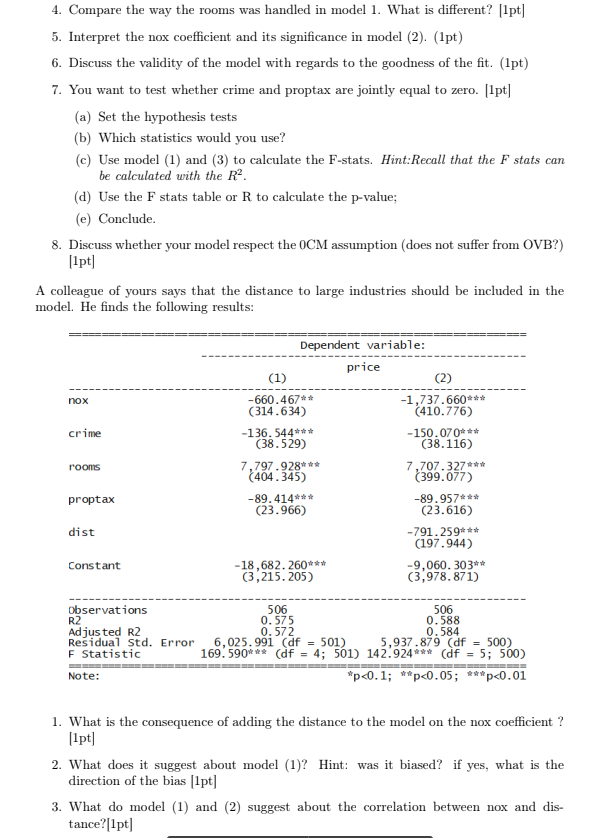
4. Compare the way the rooms was handled in model 1. What is different? [1pt] 5. Interpret the nox coefficient and its significance in model (2). (1pt) 6. Discuss the validity of the model with regards to the goodness of the fit. (Ipt) 7. You want to test whether crime and proptax are jointly equal to zero. [1pt] (a) Set the hypothesis tests (b) Which statistics would you use? (c) Use model (1) and (3) to calculate the F-stats. Hint:Recall that the F stats can be calculated with the R. (a) Use the F stats table or R to calculate the p-value; (e) Conclude. 8. Discuss whether your model respect the OCM assumption (does not suffer from OVB?) [1pt] A colleague of yours says that the distance to large industries should be included in the model. He finds the following results: nox crime Dependent variable: price (1) (2) -660.467** -1,737.660*** (314.634) (410.776) -136.544*** - 150.07O*** (38.529) (38.116) 7,797.928*** 7,707.327*** (404 345) (399.077) -89.414*** -89.957*** (23.966) (23.616) -791.259*** (197.944) -18,682.260*** -9,060.303** (3,215.205) (3,978. 871) rooms proptax dist Constant observations R2 Adjusted R2 Residual Std. Error F Statistic Note: 506 506 0.575 0.588 0.572 0.584 6,025.991 (df = 501) 5,937.879 (df = 500) 169.590*** (df = 4; 501) 142.924*** (df = 5; 500) *pStep by Step Solution
There are 3 Steps involved in it
1 Expert Approved Answer
Step: 1 Unlock

Question Has Been Solved by an Expert!
Get step-by-step solutions from verified subject matter experts
Step: 2 Unlock
Step: 3 Unlock