







Question: Open the following simulation https://phet.colorado.edu/sims/html/masses-and-springs/latest/masses-and-springs_en.html Select the Lab option. Set damping to none on the right side of the screen. Check off the first two
- Open the following simulation
- https://phet.colorado.edu/sims/html/masses-and-springs/latest/masses-and-springs_en.html
- Select the "Lab" option. Set damping to "none" on the right side of the screen.
- Check off the first two boxes (for the blue and black lines) in the upper right of the screen. The "natural length" line marks the position of the bottom of the spring when there is no mass hanging off it.
Pick a mass, place it on one of the springs, and let go. Notice that the motion is oscillatory
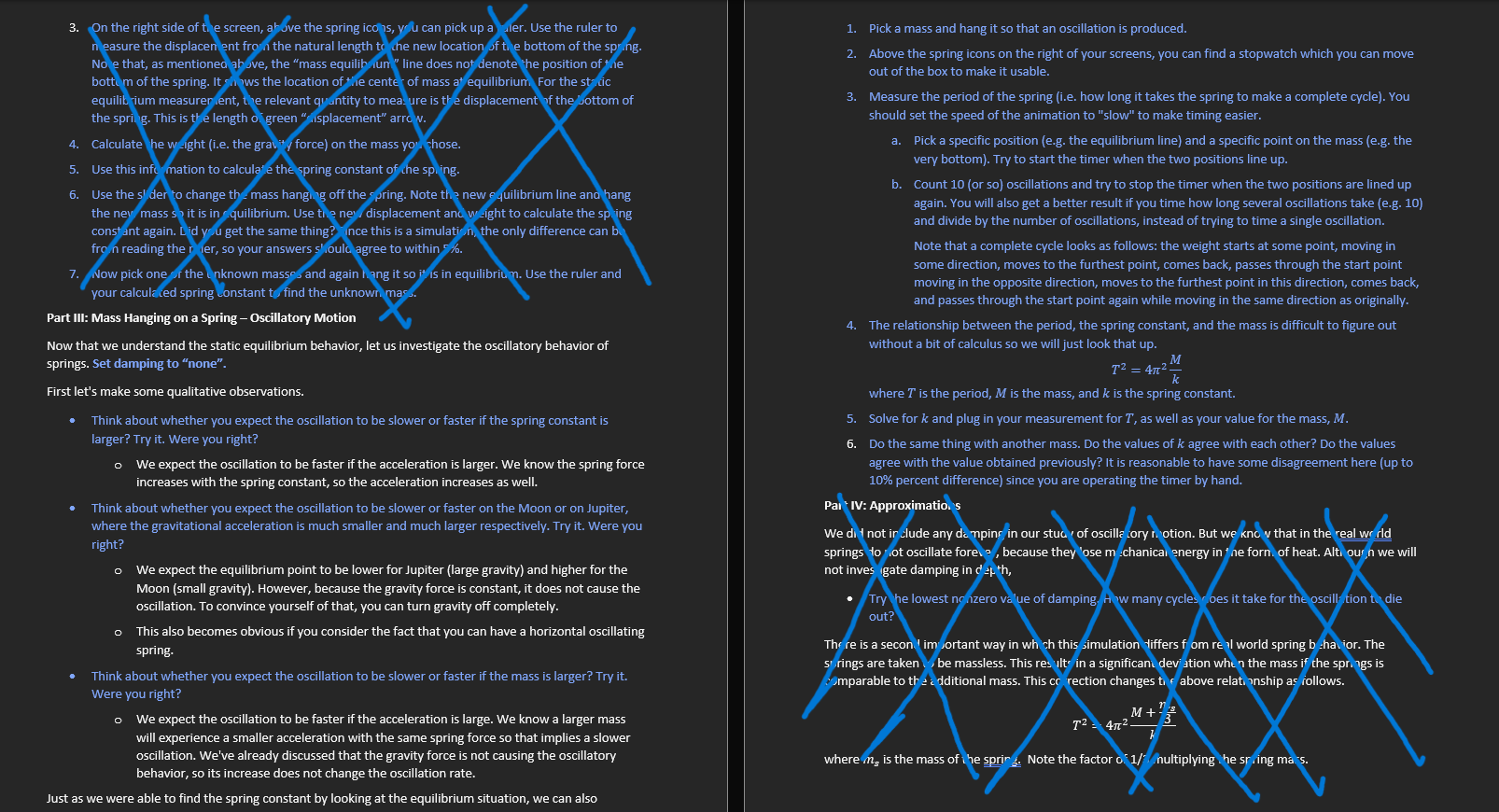
3. On the right side of the screen, above the spring icons, you can pick up a der. Use the ruler to 1. Pick a mass and hang it so that an oscillation is produced. n easure the displacen ent from the natural length to the new location of the bottom of the spring. No e that, as mentioned above, the "mass equilibrium " line does not denote the position of the 2. Above the spring icons on the right of your screens, you can find a stopwatch which you can move bottom of the spring. It shows the location of the center of mass at equilibrium For the static out of the box to make it usable. equilibrium measurement, the relevant quantity to measure is the displacement of the bottom of 3. Measure the period of the spring (i.e. how long it takes the spring to make a complete cycle). You the spring. This is the length o green " displacement" arrow. should set the speed of the animation to "slow" to make timing easier. 4. Calculate he wright (i.e. the gravy force) on the mass you chose. a. Pick a specific position (e.g. the equilibrium line) and a specific point on the mass (e.g. the 5. Use this information to calculate the spring constant of the spring. very bottom). Try to start the timer when the two positions line up. Use the sider to change the mass hanging off the spring. Note the new equilibrium line and hang b. Count 10 (or so) oscillations and try to stop the timer when the two positions are lined up the ney mass s it is in quilibrium. Use the ney/ displacement and weight to calculate the spring again. You will also get a better result if you time how long several oscillations take (e.g. 10) constant again. Lid you get the same thing? once this is a simulation, the only difference can b and divide by the number of oscillations, instead of trying to time a single oscillation. from reading the r er, so your answers should agree to within fo. Note that a complete cycle looks as follows: the weight starts at some point, moving in 7. Now pick one of the nknown massed and again hang it so j is in equilibrium. Use the ruler and some direction, moves to the furthest point, comes back, passes through the start point your calculated spring constant tofind the unknown mars. moving in the opposite direction, moves to the furthest point in this direction, comes back, and passes through the start point again while moving in the same direction as originally. Part III: Mass Hanging on a Spring - Oscillatory Motion 4. The relationship between the period, the spring constant, and the mass is difficult to figure out Now that we understand the static equilibrium behavior, let us investigate the oscillatory behavior of without a bit of calculus so we will just look that up. springs. Set damping to "none". T2 = 412 4 First let's make some qualitative observations. where T is the period, M is the mass, and k is the spring constant. Think about whether you expect the oscillation to be slower or faster if the spring constant is 5. Solve for k and plug in your measurement for T, as well as your value for the mass, M. larger? Try it. Were you right? 6. Do the same thing with another mass. Do the values of k agree with each other? Do the values We expect the oscillation to be faster if the acceleration is larger. We know the spring force agree with the value obtained previously? It is reasonable to have some disagreement here (up to increases with the spring constant, so the acceleration increases as well. 10% percent difference) since you are operating the timer by hand. Think about whether you expect the oscillation to be slower or faster on the Moon or on Jupiter, Pai IV: Approximations where the gravitational acceleration is much smaller and much larger respectively. Try it. Were you We did not ir clude any dempins in our stuc of oscilla fory notion. But we know that in the real world right? springs to not oscillate fore , because they 'ose mechanical energy in he form of heat. Alti ourn we will o We expect the equilibrium point to be lower for Jupiter (large gravity) and higher for the not inves gate damping in depth, Moon (small gravity). However, because the gravity force is constant, it does not cause the oscillation. To convince yourself of that, you can turn gravity off completely. Try the lowest nonzero value of damping, how many cycles does it take for the oscilla tion to die out? o This also becomes obvious if you consider the fact that you can have a horizontal oscillating spring. They're is a secon ' important way in which this simulation differs f om real world spring behavior. The springs are taken be massless. This results in a significant dev ation when the mass if the springs is Think about whether you expect the oscillation to be slower or faster if the mass is larger? Try it. comparable to the t dditional mass. This co rection changes to above relationship as follows. Were you right? o We expect the oscillation to be faster if the acceleration is large. We know a larger mass M+ 4TT 2 will experience a smaller acceleration with the same spring force so that implies a slower oscillation. We've already discussed that the gravity force is not causing the oscillatory where in, is the mass of the spring. Note the factor o 1/ multiplying he sr ing ma s. behavior, so its increase does not change the oscillation rate. Just as we were able to find the spring constant by looking at the equilibrium situation, we can also
Step by Step Solution
There are 3 Steps involved in it

Get step-by-step solutions from verified subject matter experts
 Study Help