







Question: operations in Python. For each operation, print its output with the given data. (k, e) - an item of (key, element). vw-node 1) [15] Insert(ke):
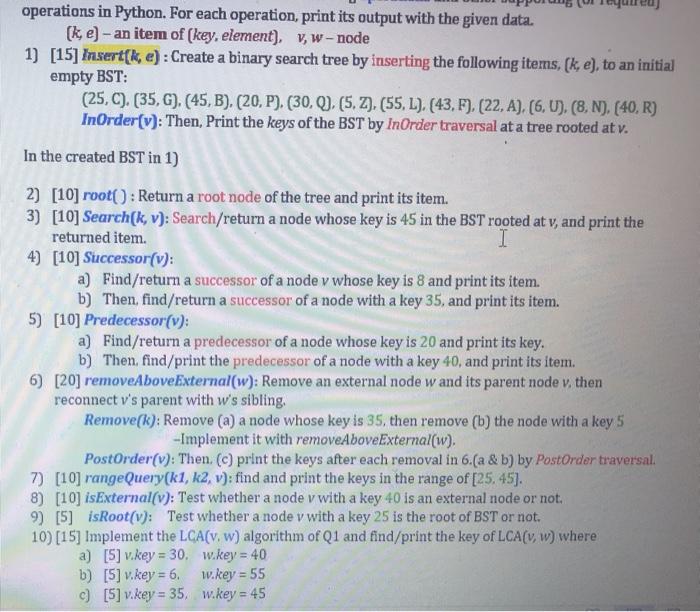
operations in Python. For each operation, print its output with the given data. (k, e) - an item of (key, element). vw-node 1) [15] Insert(ke): Create a binary search tree by inserting the following items, (k, e), to an initial empty BST: (25, C). (35,G),(45, B). (20,P). (30,0). (5,2), (55, L). (43,F), (22,A),(6, U), (8, N), (40, R) InOrder(v): Then, Print the keys of the BST by InOrder traversal at a tree rooted at v. In the created BST in 1) 2) [10] root() : Return a root node of the tree and print its item. 3) [10] Search(k, v): Search/return a node whose key is 45 in the BST rooted at v, and print the returned item. I 4) [10] Successor(v): a) Find/return a successor of a node v whose key is 8 and print its item. b) Then find/return a successor of a node with a key 35, and print its item. 5) [10] Predecessor(v): a) Find/return a predecessor of a node whose key is 20 and print its key. b) Then, find/print the predecessor of a node with a key 40, and print its item. 6) [20] removeAbove External(w): Remove an external node wand its parent node v. then reconnect v's parent with w's sibling, Remove(k): Remove (a) a node whose key is 35, then remove (b) the node with a key 5 -Implement it with removeAbove External(w). PostOrder(v): Then. (c) print the keys after each removal in 6. (a & b) by Postorder traversal 7) [10] rangeQuery(k1, k2, v): find and print the keys in the range of [25. 45). 8) [10] isExternal(v): Test whether a node v with a key 40 is an external node or not. 9) [5] isRoot(v): Test whether a node v with a key 25 is the root of BST or not. 10) [15] Implement the LCA[v. W) algorithm of Q1 and find/print the key of LCA(V, ) where a) [5] v. key = 30. w.key = 40 b) [5] v.key = 6. w.key = 55 c) [5] v. key = 35. w.key = 45
Step by Step Solution
There are 3 Steps involved in it

Get step-by-step solutions from verified subject matter experts
 Study Help