







Question: Operations Management ( POM 3 4 3 0 ) Quantitative Problems for Constraint Management and Capacity Planning November 1 2 , 2 0 2 4
Operations Management POM
Quantitative Problems for Constraint Management and Capacity Planning
November
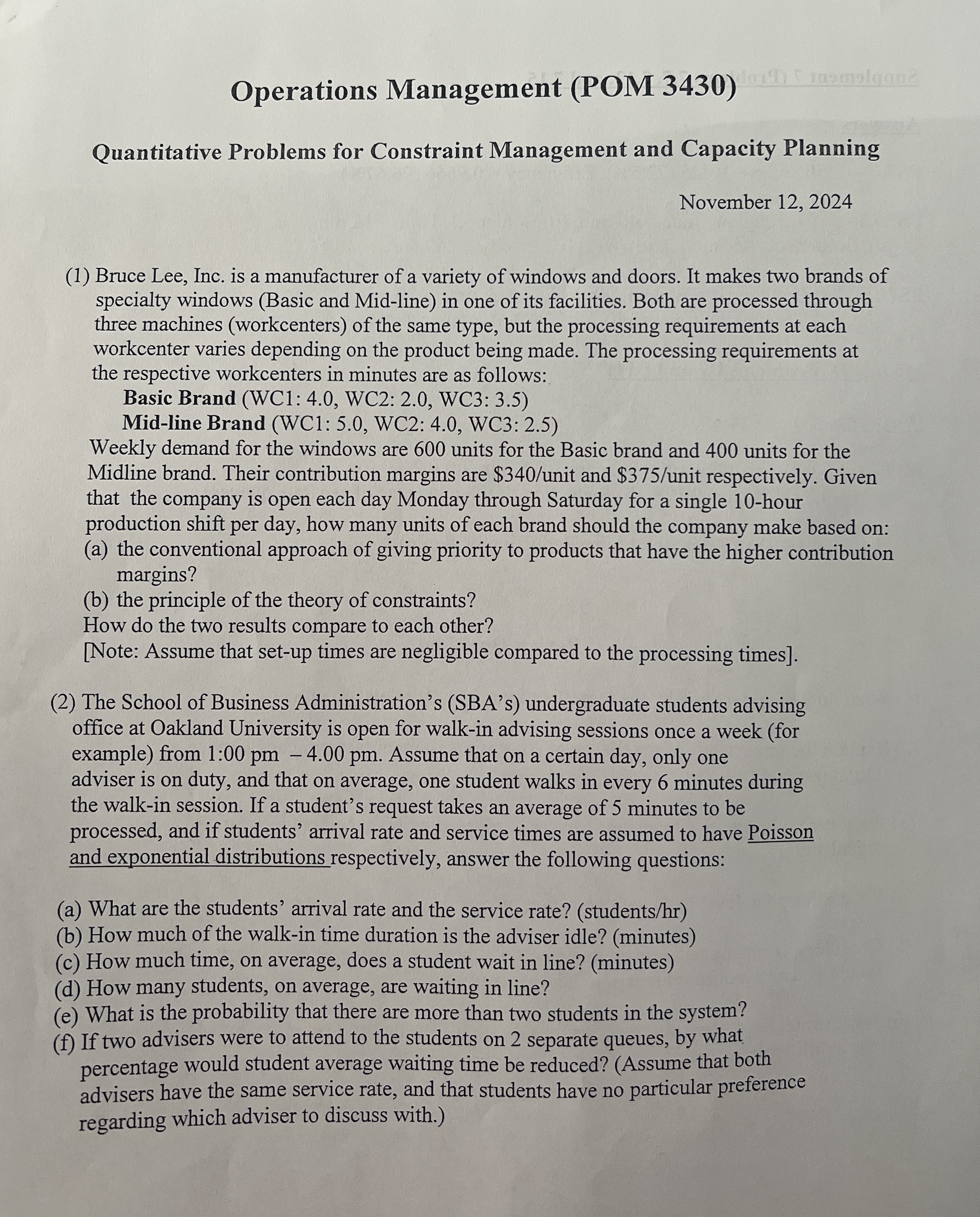
Bruce Lee, Inc. is a manufacturer of a variety of windows and doors. It makes two brands of specialty windows Basic and Midline in one of its facilities. Both are processed through three machines workcenters of the same type, but the processing requirements at each workcenter varies depending on the product being made. The processing requirements at the respective workcenters in minutes are as follows:
Basic Brand WC: WC: WC:
Midline Brand WC: WC: WC:
Weekly demand for the windows are units for the Basic brand and units for the Midline brand. Their contribution margins are $unit and $ unit respectively. Given that the company is open each day Monday through Saturday for a single hour production shift per day, how many units of each brand should the company make based on:
a the conventional approach of giving priority to products that have the higher contribution margins?
b the principle of the theory of constraints?
How do the two results compare to each other?
Note: Assume that setup times are negligible compared to the processing times
The School of Business Administration's SBAs undergraduate students advising office at Oakland University is open for walkin advising sessions once a week for example from : pm pm Assume that on a certain day, only one adviser is on duty, and that on average, one student walks in every minutes during the walkin session. If a student's request takes an average of minutes to be processed, and if students' arrival rate and service times are assumed to have Poisson and exponential distributions respectively, answer the following questions:
a What are the students' arrival rate and the service rate? studentshr
b How much of the walkin time duration is the adviser idle? minutes
c How much time, on average, does a student wait in line? minutes
d How many students, on average, are waiting in line?
e What is the probability that there are more than two students in the system?
f If two advisers were to attend to the students on separate queues, by what percentage would student average waiting time be reduced? Assume that both advisers have the same service rate, and that students have no particular preference regarding which adviser to discuss with.
Step by Step Solution
There are 3 Steps involved in it
1 Expert Approved Answer
Step: 1 Unlock

Question Has Been Solved by an Expert!
Get step-by-step solutions from verified subject matter experts
Step: 2 Unlock
Step: 3 Unlock
 Study Help