







Question: opic Simulation and Design Learning Objective:s 1. To understand potential applications of simulations as a way of solving real-world problems 2. To understand pseudo-random numbers
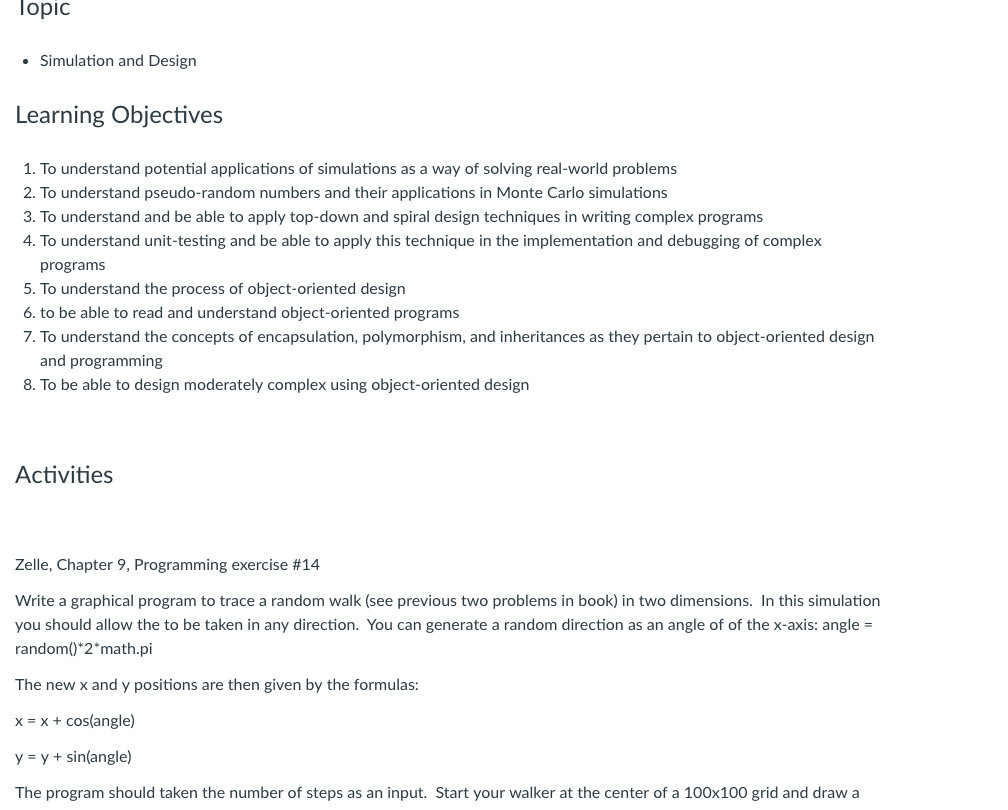

opic Simulation and Design Learning Objective:s 1. To understand potential applications of simulations as a way of solving real-world problems 2. To understand pseudo-random numbers and their applications in Monte Carlo simulations 3. To understand and be able to apply top-down and spiral design techniques in writing complex programs . To understand unit-testing and be able to apply this technique in the implementation and debugging of complex programs 5. To understand the process of object-oriented design 6. to be able to read and understand object-oriented programs 7. To understand the concepts of encapsulation, polymorphism, and inheritances as they pertain to object-oriented design and programming 8. To be able to design moderately complex using object-oriented design Activities lie, Chapter 9, Programming exercise #14 Write a graphical program to trace a random walk (see previous two problems in book) in two dimensions. In this simulation you should allow the to be taken in any direction. You can generate a random direction as an angle of of the x-axis: angle- random) 2 math.pi The new x and y positions are then given by the formulas: x-x cos(angle) y-ysin(angle) The program should taken the number of steps as an input. Start your walker at the center of a 100x100 grid and draw a opic Simulation and Design Learning Objective:s 1. To understand potential applications of simulations as a way of solving real-world problems 2. To understand pseudo-random numbers and their applications in Monte Carlo simulations 3. To understand and be able to apply top-down and spiral design techniques in writing complex programs . To understand unit-testing and be able to apply this technique in the implementation and debugging of complex programs 5. To understand the process of object-oriented design 6. to be able to read and understand object-oriented programs 7. To understand the concepts of encapsulation, polymorphism, and inheritances as they pertain to object-oriented design and programming 8. To be able to design moderately complex using object-oriented design Activities lie, Chapter 9, Programming exercise #14 Write a graphical program to trace a random walk (see previous two problems in book) in two dimensions. In this simulation you should allow the to be taken in any direction. You can generate a random direction as an angle of of the x-axis: angle- random) 2 math.pi The new x and y positions are then given by the formulas: x-x cos(angle) y-ysin(angle) The program should taken the number of steps as an input. Start your walker at the center of a 100x100 grid and draw a
Step by Step Solution
There are 3 Steps involved in it

Get step-by-step solutions from verified subject matter experts
 Study Help