







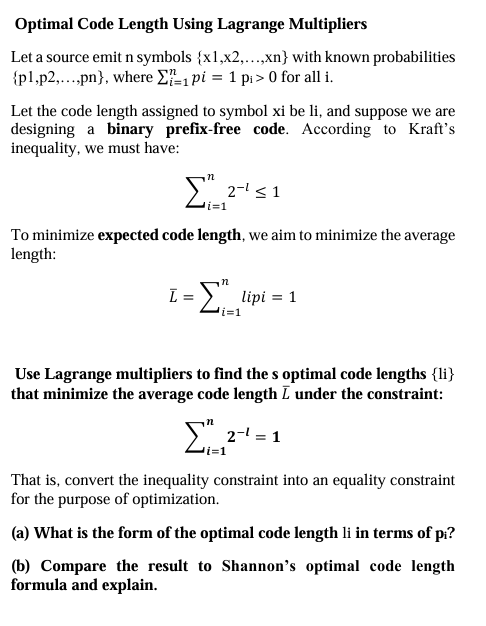
Question: Optimal Code Length Using Lagrange Multipliers Let a source emit n symbols { x 1 , x 2 , dots, x n } with known
Optimal Code Length Using Lagrange Multipliers
Let a source emit symbols dots, with known probabilities
dots, where for all
Let the code length assigned symbol and suppose are
designing a binary prefixfree code. According Kraft's
inequality, must have:
minimize expected code length, aim minimize the average
length:
Use Lagrange multipliers find the soptimal code lengths
that minimize the average code length under the constraint:
That convert the inequality constraint into equality constraint
for the purpose optimization.
What the form the optimal code length terms
Compare the result Shannon's optimal code length
formula and explain.
Step by Step Solution
There are 3 Steps involved in it
1 Expert Approved Answer
Step: 1 Unlock

Question Has Been Solved by an Expert!
Get step-by-step solutions from verified subject matter experts
Step: 2 Unlock
Step: 3 Unlock
 Study Help