







Question: optimization Let V = {1,...,n} be vertices, which we can think of as n cities. We think of 1 V as the source of some
optimization 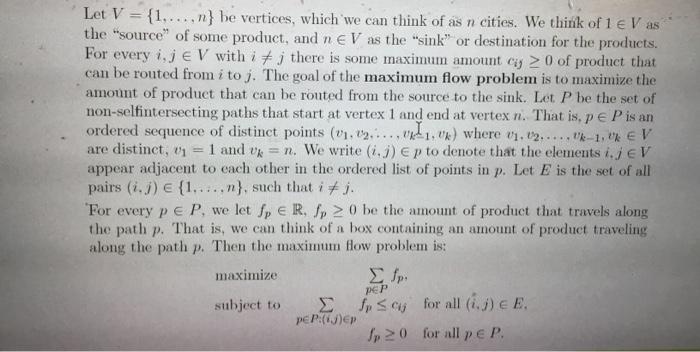
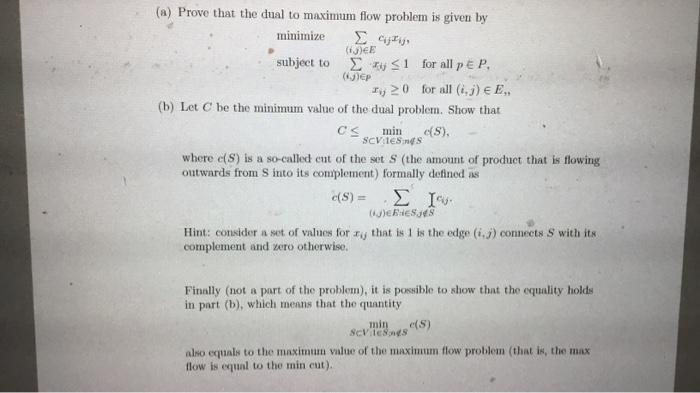
Let V = {1,...,n} be vertices, which we can think of as n cities. We think of 1 V as the "source" of some product, and n eV as the "sink" or destination for the products. For every ij V with i j there is some maximum amount cy> 0 of product that can be routed from i toj. The goal of the maximum flow problem is to maximize the amount of product that can be routed from the source to the sink. Lot P be the set of non-selfintersecting paths that start at vertex 1 and end at vertex n. That is, p e P is an ordered sequence of distinct points (01.02.......) where 01.02..... 12-1. * EV are distinct, 0 = 1 and ux = n. We write (3) ep to denote that the elements ij eV appear adjacent to each other in the ordered list of points in p. Let E is the set of all pairs () {1.....n}, such that i tj. For every pe P, we let fpe R, Jp o be the amount of product that travels along the path p. That is, we can think of a box containing an amount of product traveling along the path p. Then the maximum flow problem is: maximize subject to fps for all (1) E. . (1) 1p 20 for all p e P. PEP (a) Prove that the dual to maximum flow problem is given by minimize (JEE subject to 131 for all p E P. (EP 120 for all (3) E E, (b) Let C be the minimum value of the dual problem. Show that CS min ofS). SCV Lens where c(S) is a so-called out of the sot S (the amount of product that is flowing outwards from Sinto its complement) formally defined i (S) = . JEEHESJES Hint: consider a set of values for so that is 1 is the edge (1.7) connects with its complement and to otherwise. Finally (not a part of the problem), it is possible to show that the equality holds in part (b), which means that the quantity min ScVitens also equals to the maximum value of the maximum flow problem (that is, the max flow is equal to the min cut). (5) Let V = {1,...,n} be vertices, which we can think of as n cities. We think of 1 V as the "source" of some product, and n eV as the "sink" or destination for the products. For every ij V with i j there is some maximum amount cy> 0 of product that can be routed from i toj. The goal of the maximum flow problem is to maximize the amount of product that can be routed from the source to the sink. Lot P be the set of non-selfintersecting paths that start at vertex 1 and end at vertex n. That is, p e P is an ordered sequence of distinct points (01.02.......) where 01.02..... 12-1. * EV are distinct, 0 = 1 and ux = n. We write (3) ep to denote that the elements ij eV appear adjacent to each other in the ordered list of points in p. Let E is the set of all pairs () {1.....n}, such that i tj. For every pe P, we let fpe R, Jp o be the amount of product that travels along the path p. That is, we can think of a box containing an amount of product traveling along the path p. Then the maximum flow problem is: maximize subject to fps for all (1) E. . (1) 1p 20 for all p e P. PEP (a) Prove that the dual to maximum flow problem is given by minimize (JEE subject to 131 for all p E P. (EP 120 for all (3) E E, (b) Let C be the minimum value of the dual problem. Show that CS min ofS). SCV Lens where c(S) is a so-called out of the sot S (the amount of product that is flowing outwards from Sinto its complement) formally defined i (S) = . JEEHESJES Hint: consider a set of values for so that is 1 is the edge (1.7) connects with its complement and to otherwise. Finally (not a part of the problem), it is possible to show that the equality holds in part (b), which means that the quantity min ScVitens also equals to the maximum value of the maximum flow problem (that is, the max flow is equal to the min cut) Step by Step Solution
There are 3 Steps involved in it
1 Expert Approved Answer
Step: 1 Unlock

Question Has Been Solved by an Expert!
Get step-by-step solutions from verified subject matter experts
Step: 2 Unlock
Step: 3 Unlock
 Study Help