







Question: OPTIONS 1. active, passive or real 2. decrease, increase or neutralize 3. decrease, increase or neutralize 4. decrease, increase or neutralize DCF analysis doesn't always
OPTIONS
1. active, passive or real
2. decrease, increase or neutralize
3. decrease, increase or neutralize
4. decrease, increase or neutralize
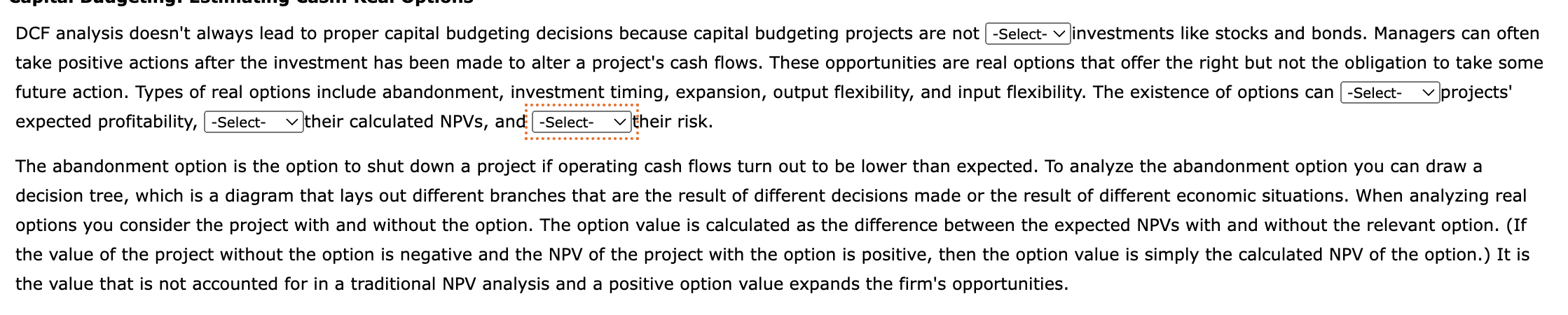
DCF analysis doesn't always lead to proper capital budgeting decisions because capital budgeting projects are not investments like stocks and bonds. Managers can often take positive actions after the investment has been made to alter a project's cash flows. These opportunities are real options that offer the right but not the obligation to take some future action. Types of real options include abandonment, investment timing, expansion, output flexibility, and input flexibility. The existence of options can projects' expected profitability, their calculated NPVs, and hheir risk. The abandonment option is the option to shut down a project if operating cash flows turn out to be lower than expected. To analyze the abandonment option you can draw a decision tree, which is a diagram that lays out different branches that are the result of different decisions made or the result of different economic situations. When analyzing real options you consider the project with and without the option. The option value is calculated as the difference between the expected NPVs with and without the relevant option. (If the value of the project without the option is negative and the NPV of the project with the option is positive, then the option value is simply the it is the value that is not accounted for in a traditional NPV analysis and a positive option value expands the firm's opportunities
Step by Step Solution
There are 3 Steps involved in it

Get step-by-step solutions from verified subject matter experts
 Study Help