







Question: or the next question, recall that the C language represents strings as arrays of characters with the end of the string represented by then null
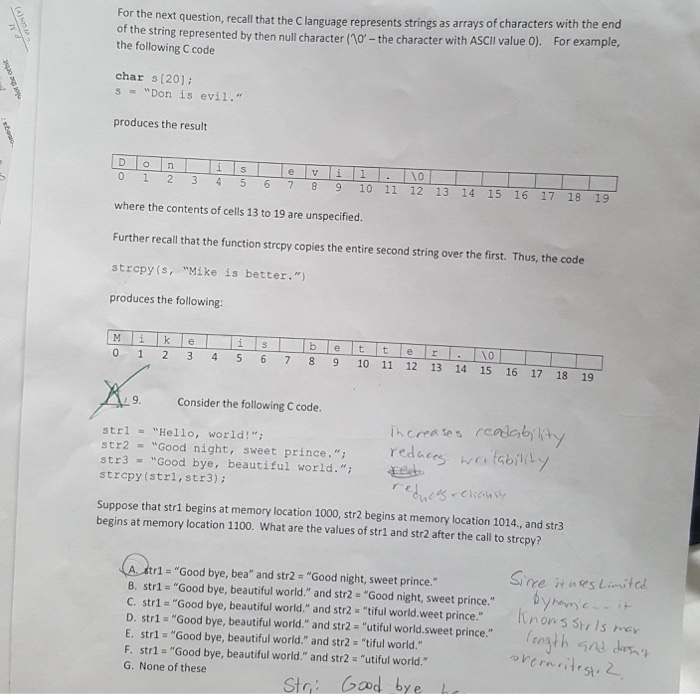
or the next question, recall that the C language represents strings as arrays of characters with the end of the string represented by then null character (10'-the character with ASCIl value O). For example the following C code char s (20]: s"Don is evi1." produces the result 0 1 2 34 5 6 7 8 9 10 11 12 13 14 15 16 17 18 where the contents of cells 13 to 19 are unspecified. Further recall that the function strcpy copies the entire second string over the first. Thus, the code strcpy(s,"Mike is better.") produces the following: 19 0 1 2 3 45 6 7 89 10 11 12 13 14 15 16 17 18 19 9. Consider the following C code. ih creases readabik Good night, sweet prince" redoers westabity strl"Hello, world!" st eb str3 = "Good bye, beautiful world."; strcpy(strl,str3) Suppose that str1 begins at memory location 1000, str2 begins at memory location 1014., and str begins at memory location 1100. What are the values of str1 and str2 after the call to strcpy? Sime it nses Limitcd tr1 "Good bye, bea" and str2 "Good night, sweet prince." B. stri "Good bye, beautiful world." and str2 "Good night, sweet prince."Dyhemc C. str1 "Good bye, beautiful world." and str2 "tiful world.weet prince."nons s D. str1 - "Good bye, beautiful world." and str2 - "utiful world.sweet prince." leath gal r E. str1 "Good bye, beautiful world." and str2 "tiful world." F. stri - "Good bye, beautiful world." and str2 "utiful world." G. None of these Str: God bye
Step by Step Solution
There are 3 Steps involved in it

Get step-by-step solutions from verified subject matter experts
 Study Help