







Question: (Organization behaviour ) Please read the case DELTA from Chapter 6Motivation Page: - 186 given in your textbook - Organizational behaviour: Improving performance and commitment
(Organization behaviour )
Please read
the
case "DELTA" from Chapter 6"Motivation" Page:
- 186 given in your textbook - Organizational behaviour: Improving performance and
commitment in the workplace (7th ed). by Colquitt,
J. A., LePine, J. A., & Wesson, M. J. (2021) and Answer the following Questions:
Question(s):
- Which motivational theories does Delta appear to be leveraging in its approach to motivation?
- Picture being an employee of Delta during the period where the company transitioned into and
out of-_bankruptcy.
What motivational
implications would that experience have, and how long would they last?
3. Which do you think is most motivational for Delta's employees? Their high base pay, their generous profit sharing, or a CEO who is so accessible and communicative?
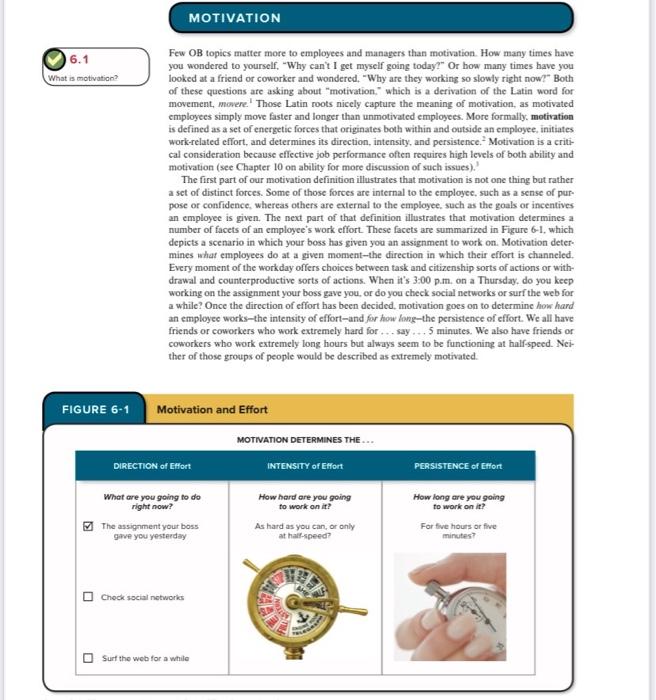
Few OB topics matter more to employees and managers than motivation. How many times have you wondered to yourself, "Why can't I get myself going today?" Or how many times have you looked at a friend or coworker and wondered. "Why are they working so slowly right now?" Both of these questions are asking about "motivation," which is a derivation of the Latin word for movement, mowere. Those Latin roots nicely capture the meaning of motivation, as motivated employees simply move faster and longer than unmotivated employees. More formally. motivation is def ined as a set of energetic forces that originates both within and outside an employee, initiates work-related effort, and determines its direction, intensity, and persistence. 2 Motivation is a critical consideration because effective job performance often requires high levels of both ability and motivation (see Chapter 10 on ability for more discussion of such issues).. The first part of our motivation definition illustrates that motivation is not one thing but rather a set of distinct forces. Some of those forces are internal to the employec, such as a sense of purpose or confidence, whereas others are external to the employee, such as the goals or incentives an employee is given. The next part of that definition illustrates that motivation determines a number of facets of an employee's work effort. These facets are summarized in Figure 6-1, which depicts a scenario in which your boss has given you an assignment to work on. Motivation determines what employees do at a given moment-the direction in which their effort is channeled. Every moment of the workday offers choices between task and citizenship sorts of actions or withdrawal and counterproductive sorts of actions. When it's 3.00 p.m. on a Thursday. do you keep working on the assignment your boss gave you, or do you check social networks or surf the web for a while? Once the direction of effort has been decided, motivation goes on to determine how hand an employec works-the intensity of effort-and for how fong-the persistence of cffort. We all have friends or coworkers who work extremely hard for .... say ... 5 minutes. We also have friends or coworkers who work extremely long hours but alwuys seem to be functioning at half-specd. Neither of those groups of people would be described as extremely motivated. Motivation and Effort
Step by Step Solution
There are 3 Steps involved in it

Get step-by-step solutions from verified subject matter experts
 Study Help