







Question: oruur-Plex Theater Leo's Four-Plex Theater was a single-location, four- screen theater located in a small town in west Texas. Leo Antonelli bought the theater a
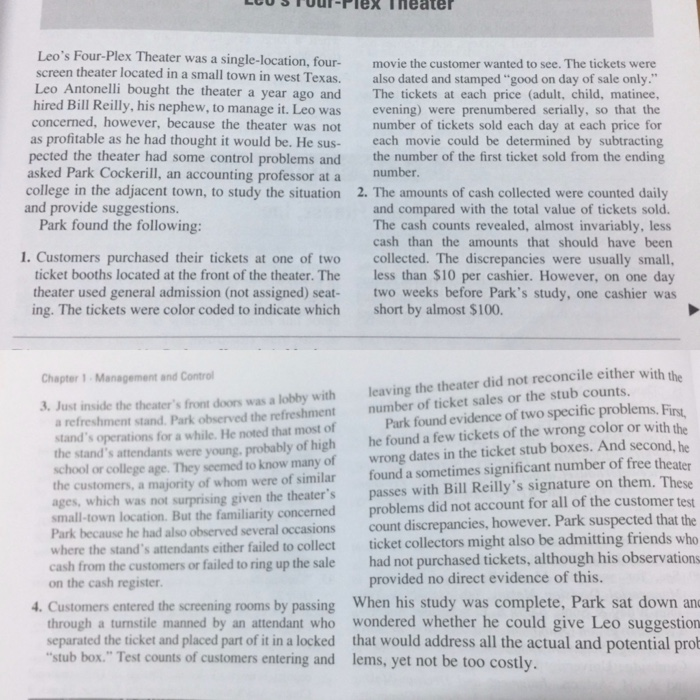
oruur-Plex Theater Leo's Four-Plex Theater was a single-location, four- screen theater located in a small town in west Texas. Leo Antonelli bought the theater a year ago and hired Bill Reilly, his nephew, to manage it. Leo was concerned, however, because the theater was not as profitable as he had thought it would be. He sus- pected the theater had some control problems and asked Park Cockerill, an accounting professor at a college in the adjacent town, to study the situation and provide suggestions. Park found the following: movie the customer wanted to see. The tickets were also dated and stamped "good on day of sale only." The tickets at each price (adult, child, matinee, evening) were prenumbered serially, so that the number of tickets sold each day at each price for each movie could be determined by subtracting the number of the first ticket sold from the ending number 2. The amounts of cash collected were counted daily and compared with the total value of tickets sold. The cash counts revealed, almost invariably, less cash than the amounts that should have been collected. The discrepancies were usually small, less than $10 per cashier. However, on one day two weeks before Park's study, one cashier was short by almost $100. 1. Customers purchased their tickets at one of two ticket booths located at the front of the theater. The theater used general admission (not assigned) seat- ing. The tickets were color coded to indicate which Chapter 1 Management and Control leaving the theater did not reconcile either with the 3. Just inside the theater's front doors was a lobby with number of ticket sales or the stub counts. a refreshment stand. Park observed the refreshment Park found evidence of two specific problems. Firs stand's operations for a while. He noted that most of he found a few tickets of the wrong color or with the the stand's attendants were young, probably of high school or college age. They seemed to know many of wrong dates in the ticket stub boxes. And second, he the customers, a majority of whom were of similar found a sometimes significant number of free theater ages, which was not surprising given the theater's passes with Bill Reilly's signature on them. These small town location. But the familiarity concerned problems did not account for all of the customer test Park because he had also observed several occasions count discrepancies, however. Park suspected that the where the stand's attendants either failed to collect ticket collectors might also be admitting friends who cash from the customers or failed to ring up the sale had not purchased tickets, although his observations on the cash register provided no direct evidence of this. 4. Customers entered the screening rooms by passing When his study was complete, Park sat down anu through a turnstile manned by an attendant who wondered whether he could give Leo suggestion separated the ticket and placed part of it in a locked that would address all the actual and potential prob "stub box." Test counts of customers entering and lems, yet not be too costly. oruur-Plex Theater Leo's Four-Plex Theater was a single-location, four- screen theater located in a small town in west Texas. Leo Antonelli bought the theater a year ago and hired Bill Reilly, his nephew, to manage it. Leo was concerned, however, because the theater was not as profitable as he had thought it would be. He sus- pected the theater had some control problems and asked Park Cockerill, an accounting professor at a college in the adjacent town, to study the situation and provide suggestions. Park found the following: movie the customer wanted to see. The tickets were also dated and stamped "good on day of sale only." The tickets at each price (adult, child, matinee, evening) were prenumbered serially, so that the number of tickets sold each day at each price for each movie could be determined by subtracting the number of the first ticket sold from the ending number 2. The amounts of cash collected were counted daily and compared with the total value of tickets sold. The cash counts revealed, almost invariably, less cash than the amounts that should have been collected. The discrepancies were usually small, less than $10 per cashier. However, on one day two weeks before Park's study, one cashier was short by almost $100. 1. Customers purchased their tickets at one of two ticket booths located at the front of the theater. The theater used general admission (not assigned) seat- ing. The tickets were color coded to indicate which Chapter 1 Management and Control leaving the theater did not reconcile either with the 3. Just inside the theater's front doors was a lobby with number of ticket sales or the stub counts. a refreshment stand. Park observed the refreshment Park found evidence of two specific problems. Firs stand's operations for a while. He noted that most of he found a few tickets of the wrong color or with the the stand's attendants were young, probably of high school or college age. They seemed to know many of wrong dates in the ticket stub boxes. And second, he the customers, a majority of whom were of similar found a sometimes significant number of free theater ages, which was not surprising given the theater's passes with Bill Reilly's signature on them. These small town location. But the familiarity concerned problems did not account for all of the customer test Park because he had also observed several occasions count discrepancies, however. Park suspected that the where the stand's attendants either failed to collect ticket collectors might also be admitting friends who cash from the customers or failed to ring up the sale had not purchased tickets, although his observations on the cash register provided no direct evidence of this. 4. Customers entered the screening rooms by passing When his study was complete, Park sat down anu through a turnstile manned by an attendant who wondered whether he could give Leo suggestion separated the ticket and placed part of it in a locked that would address all the actual and potential prob "stub box." Test counts of customers entering and lems, yet not be too costly
Step by Step Solution
There are 3 Steps involved in it

Get step-by-step solutions from verified subject matter experts
 Study Help