







Question: other hand, Prab is less likely to run going back home. On any given day, he runs down hill only with probability 1 [9; he
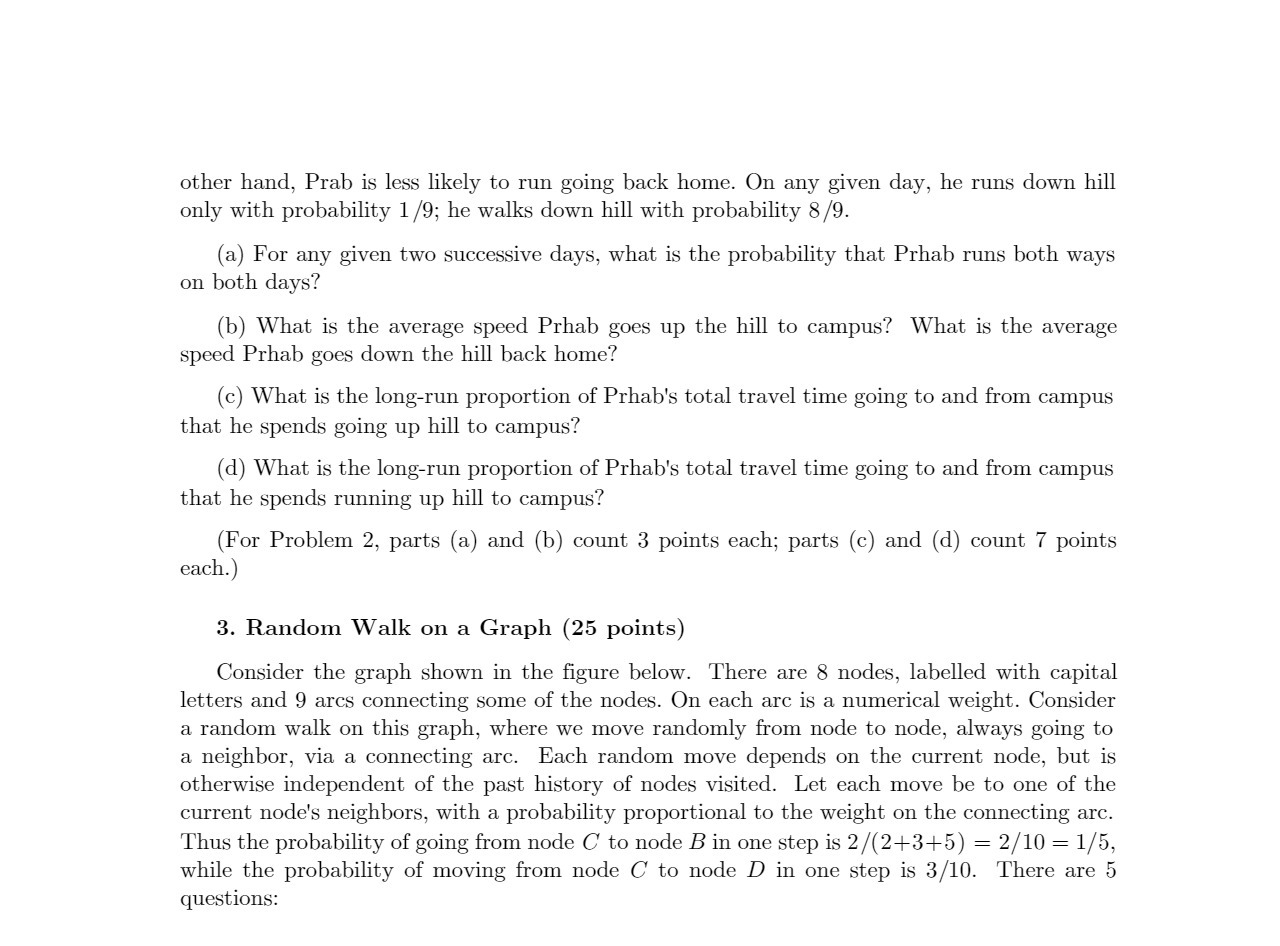
other hand, Prab is less likely to run going back home. On any given day, he runs down hill only with probability 1 [9; he walks down hill with probability 8/9. (a) For any given two succeSsive days, what is the probability that Prhab runs both ways on both days? (b) What is the average speed Prhab goes up the hill to campus? What is the average speed Prhab goes down the hill back home? (c) What is the long-run proportion of Prhab's total travel time going to and from campus that he spends going up hill to campus? (d) What is the longrun proportion of Prhab's total travel time going to and from campus that he spends rlmning up hill to campus? (For Problem 2, parts (a) and (b) count 3 points each; parts (c) and ((1) count 7 points each.) 3. Random Walk on a Graph (25 points) Consider the graph shown in the gure below. There are 8 nodes, labelled with capital letters and 9 arcs connecting some of the nodes. On each arc is a numerical weight. Consider a random walk on this graph, where we move randomly from node to node1 always going to a neighbor, via a connecting arc. Each random move depends on the current node1 but is otherwise independent of the past history of nodes visited. Let each move be to one of the current node's neighbors1 with a probability proportional to the weight on the connecting arc. Thus the probability of going from node C to node B in one step is 2/(2+3+5) = 2/10 = 1/5, while the probability of moving from node 0 to node D in one step is 3/10. There are 5 questions
Step by Step Solution
There are 3 Steps involved in it

Get step-by-step solutions from verified subject matter experts
 Study Help