







Question: Our first theorem formalizes the intuition given above that learning from sta - tistical queries implies learning in the noise - free Valiant model. The
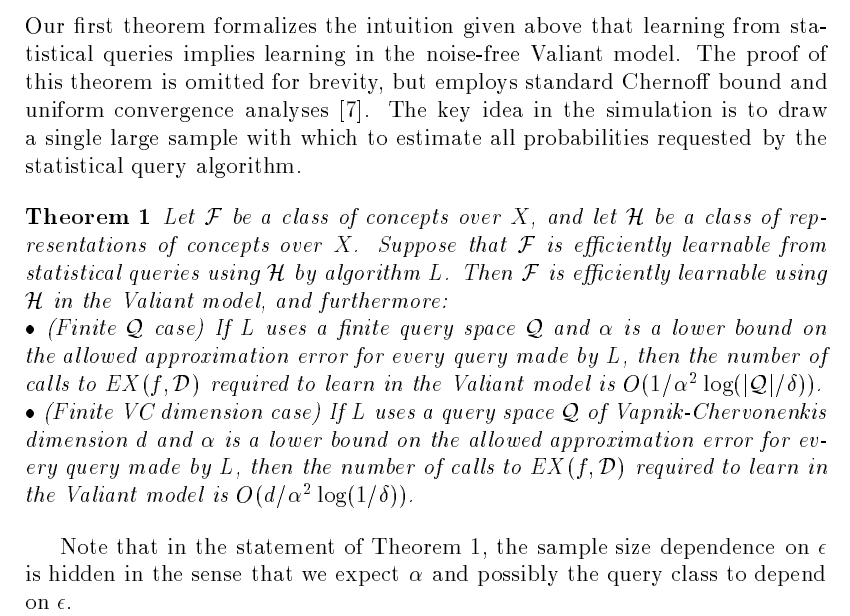
Our first theorem formalizes the intuition given above that learning from sta
tistical queries implies learning in the noisefree Valiant model. The proof of
this theorem is omitted for brevity, but employs standard Chernoff bound and
uniform convergence analyses The key idea in the simulation is to draw
a single large sample with which to estimate all probabilities requested by the
statistical query algorithm.
Theorem Let be a class of concepts over and let be a class of rep
resentations of concepts over Suppose that is efficiently learnable from
statistical queries using by algorithm Then is efficiently learnable using
in the Valiant model, and furthermore:
Finite case If uses a finite query space and is a lower bound on
the allowed approximation error for every query made by then the number of
calls to required to learn in the Valiant model is
Finite VC dimension case If L uses a query space of VapnikChervonenkis
dimension and is a lower bound on the allowed approximation error for ev
ery query made by then the number of calls to required to learn in
the Valiant model is
Note that in the statement of Theorem the sample size dependence on
is hidden in the sense that we expect and possibly the query class to depend
on
Step by Step Solution
There are 3 Steps involved in it
1 Expert Approved Answer
Step: 1 Unlock

Question Has Been Solved by an Expert!
Get step-by-step solutions from verified subject matter experts
Step: 2 Unlock
Step: 3 Unlock
 Study Help