







Question: Over applied factory overhead always will result when a predetermined factory overhead rate is employed and a. Production is greater than defined capacity b. Actual
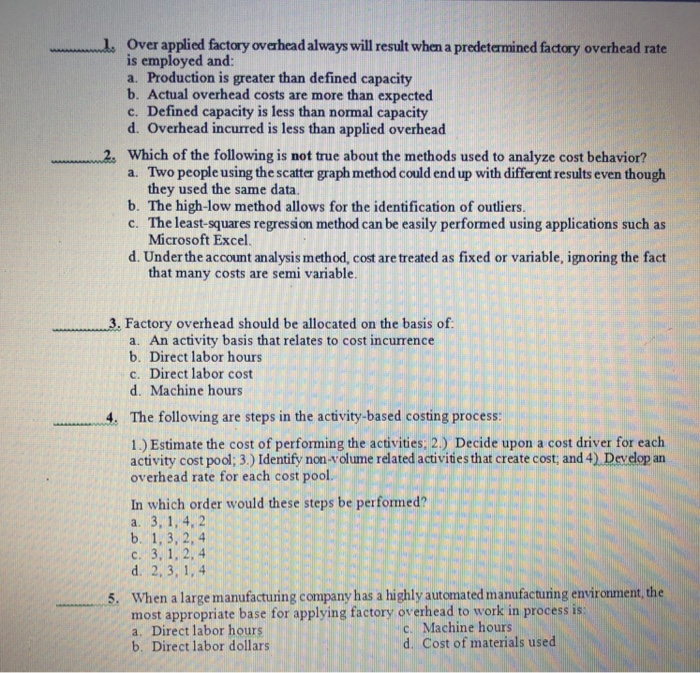
Over applied factory overhead always will result when a predetermined factory overhead rate is employed and a. Production is greater than defined capacity b. Actual overhead costs are more than expected c. Defined capacity is less than normal capacity d. Overhead incurred is less than applied overhead Which of the following is not true about the methods used to analyze cost behavior? Two people using the scatter graph method could end up with different results even though they used the same data a. b. The high-low method allows for the identification of outliers. c. The least-squares regression method can be easily performed using applications such as Microsoft Excel d. Under the account analysis method, cost are treated as fixed or variable, ignoring the fact that many costs are semi variable. 3. Factory overhead should be allocated on the basis of a. An activity basis that relates to cost incurrence b. Direct labor hours c. Direct labor cost d. Machine hours 4. The following are steps in the activity-based costing process: 1.) Estimate the cost of performing the activities, 2.) Decide upon a cost driver for each activity cost pool; 3.) Identify non-volume related activities that create cost, and 4) Develop an overhead rate for each cost pool. In which order would these steps be performed? a. 3, 1, 4, 2 b. 1, 3, 2, 4 c. 3, 1, 2, 4 d. 2, 3, 1,4 When a large manufacturing company has a highly automated manufacturing environment, the most appropriate base for applying factory overhead to work in process is: a. Direct labor hours b. Direct labor dollars 5. c. Machine hours d. Cost of materials used
Step by Step Solution
There are 3 Steps involved in it

Get step-by-step solutions from verified subject matter experts
 Study Help