







Question: Overview Maria has asked you to create a program that prompts the user to enter the lower bound and the upper bound. You have decided
Overview
Maria has asked you to create a program that prompts the user to enter the lower bound and the upper
bound. You have decided to write pseudocode to design the program before actually developing the
code. When run, the program should ask the user to guess a number. If the number guessed is lower
than the random number, the program should print out a message like "Nope, too low." If the number
guessed is higher than the random number, print out a message like "Nope, too high." If the number
guessed is the same as the random number, print out a message like "You got it
Note: The output messages you include in your pseudocode may differ slightly from these samples.
Sample Output
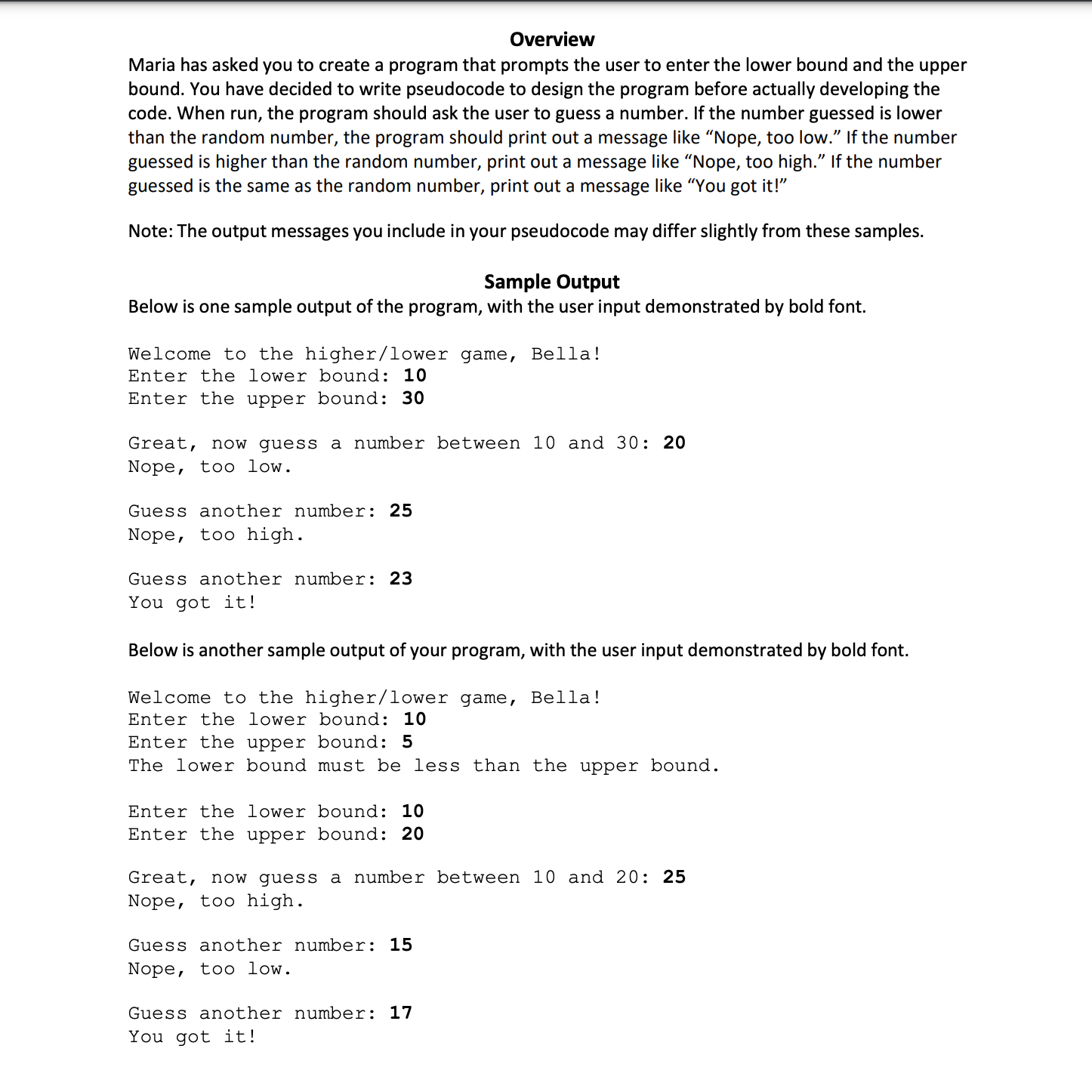
Below is one sample output of the program, with the user input demonstrated by bold font.
Welcome to the higherlower game, Bella!
Enter the lower bound:
Enter the upper bound:
Great, now guess a number between and :
Nope, too low.
Guess another number:
Nope, too high.
Guess another number:
You got it
Below is another sample output of your program, with the user input demonstrated by bold font.
Welcome to the higherlower game, Bella!
Enter the lower bound:
Enter the upper bound:
The lower bound must be less than the upper bound.
Enter the lower bound:
Enter the upper bound:
Great, now guess a number between and :
Nope, too high.
Guess another number:
Nope, too low.
Guess another number:
YouPrompt
For this assignment, you will be designing pseudocode for a higherlower game program. The higherlower game program uses similar constructs to the game you will design and develop in Projects One and Two.
Review the HigherLower Game Sample Output PDF for more detailed examples of this game. As you read, consider the following questions:
What are the different steps needed in this program? How can you break them down in a way that a computer can understand?
What information would you need from the user at each point inputs What information would you output to the user at each point?
When might it be a good idea to use IF and IF ELSE statements?
When might it be a good idea to use loops?
Create pseudocode that logically outlines each step of the game program so that it meets the following functionality:
Prompts the user to input the lower bound and upper bound. Include input validation to ensure that the lower bound is less than the upper bound.
Generates a random number between the lower and upper bounds
Prompts the user to input a guess between the lower and upper bounds. Include input validation to ensure that the user only enters values between the lower and upper bound.
Prints an output statement based on the guessed number. Be sure to account for each of the following situations through the use of decision branching:
What should the computer output if the user guesses a number that is too low?
What should the computer output if the user guesses a number that is too high?
What should the computer output if the user guesses the right number?
Loops so that the game continues prompting the user for a new number until the user guesses the correct number.
Step by Step Solution
There are 3 Steps involved in it
1 Expert Approved Answer
Step: 1 Unlock

Question Has Been Solved by an Expert!
Get step-by-step solutions from verified subject matter experts
Step: 2 Unlock
Step: 3 Unlock
 Study Help