







Question: P 1 . ( 2 0 marks ) The Magnetic Levitation ( Maglev ) train ( see the figure to the left ) uses a
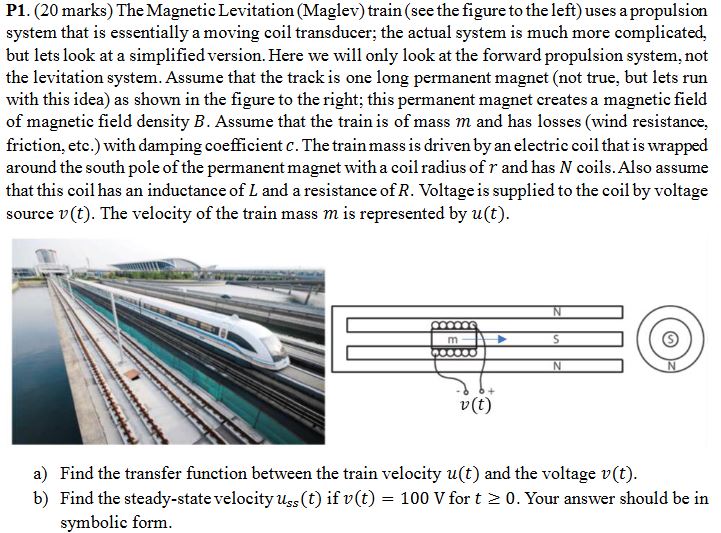
P marks The Magnetic Levitation Maglev train see the figure to the left uses a propulsion system that is essentially a moving coil transducer; the actual system is much more complicated, but lets look at a simplified version. Here we will only look at the forward propulsion system, not the levitation system. Assume that the track is one long permanent magnet not true, but lets run with this idea as shown in the figure to the right; this permanent magnet creates a magnetic field of magnetic field density B Assume that the train is of mass m and has losses wind resistance, friction, etc. with damping coefficient c The train mass is driven by an electric coil that is wrapped around the south pole of the permanent magnet with a coil radius of r and has N coils. Also assume that this coil has an inductance of L and a resistance of R Voltage is supplied to the coil by voltage source vt The velocity of the train mass m is represented by ut
a Find the transfer function between the train velocity ut and the voltage vt
b Find the steadystate velocity us st if vtmathrm~V for t geq Your answer should be in symbolic form.
Step by Step Solution
There are 3 Steps involved in it
1 Expert Approved Answer
Step: 1 Unlock

Question Has Been Solved by an Expert!
Get step-by-step solutions from verified subject matter experts
Step: 2 Unlock
Step: 3 Unlock
 Study Help