







Question: P . 5 Laser Amplifier Gain and Population Difference. A 1 5 - c m long N d 3 + : glass rod used as
P Laser Amplifier Gain and Population Difference. A long : glass rod used as a laser amplifier has a total small signal gain of at Use the data provided in Table to determine the population difference ions per required to achieve this gain. points
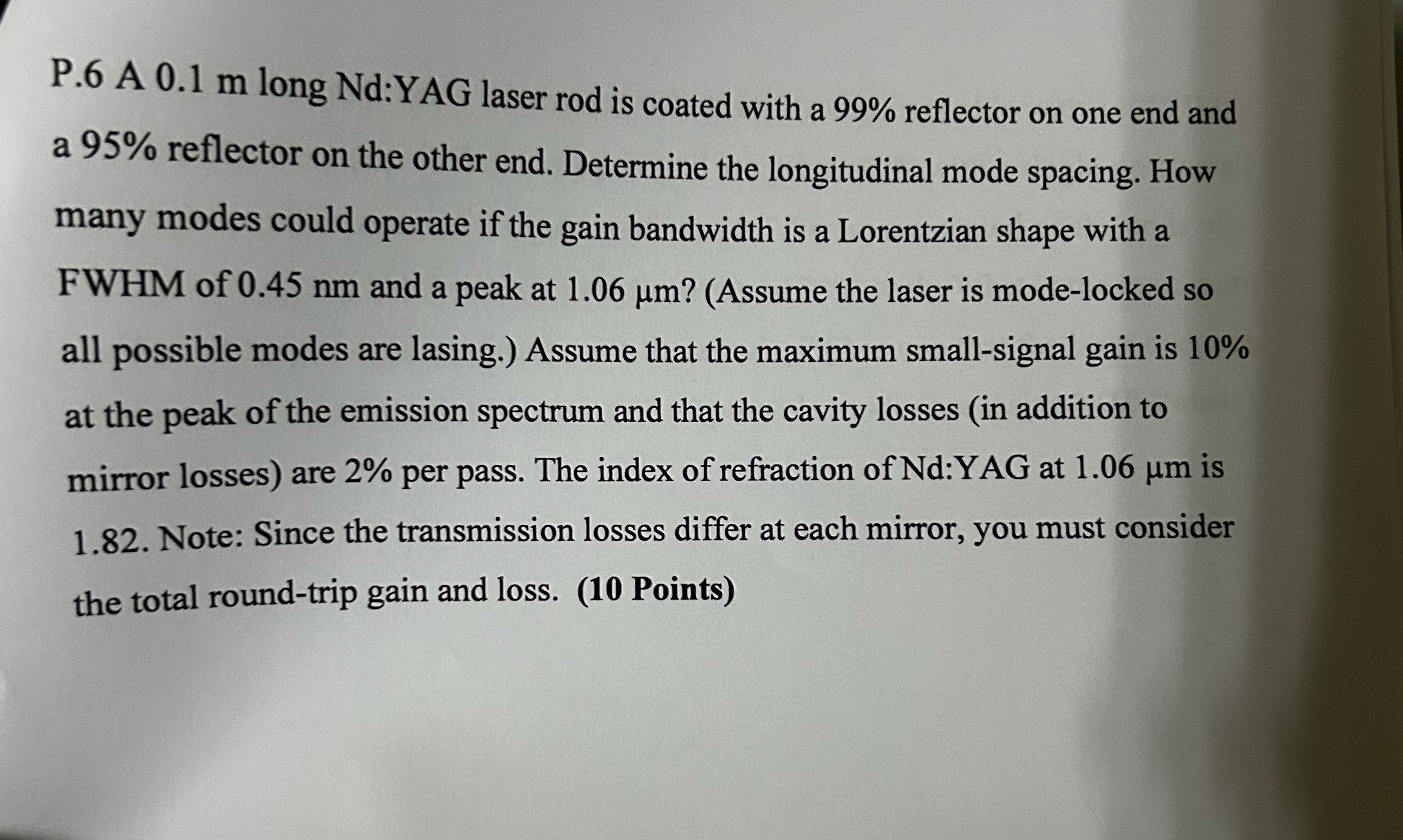
P A m long Nd:YAG laser rod is coated with a reflector on one end and a reflector on the other end. Determine the longitudinal mode spacing. How many modes could operate if the gain bandwidth is a Lorentzian shape with a FWHM of nm and a peak at Assume the laser is modelocked so all possible modes are lasing. Assume that the maximum smallsignal gain is at the peak of the emission spectrum and that the cavity losses in addition to mirror losses are per pass. The index of refraction of Nd:YAG at is Note: Since the transmission losses differ at each mirror, you must consider the total roundtrip gain and loss. Points
Step by Step Solution
There are 3 Steps involved in it
1 Expert Approved Answer
Step: 1 Unlock

Question Has Been Solved by an Expert!
Get step-by-step solutions from verified subject matter experts
Step: 2 Unlock
Step: 3 Unlock
 Study Help