



Question: P 6 - 1 ( Algo ) Reporting Net Sales and Expenses with Discounts, Returns, and Bad Debts LO 6 - 1 , 6 -
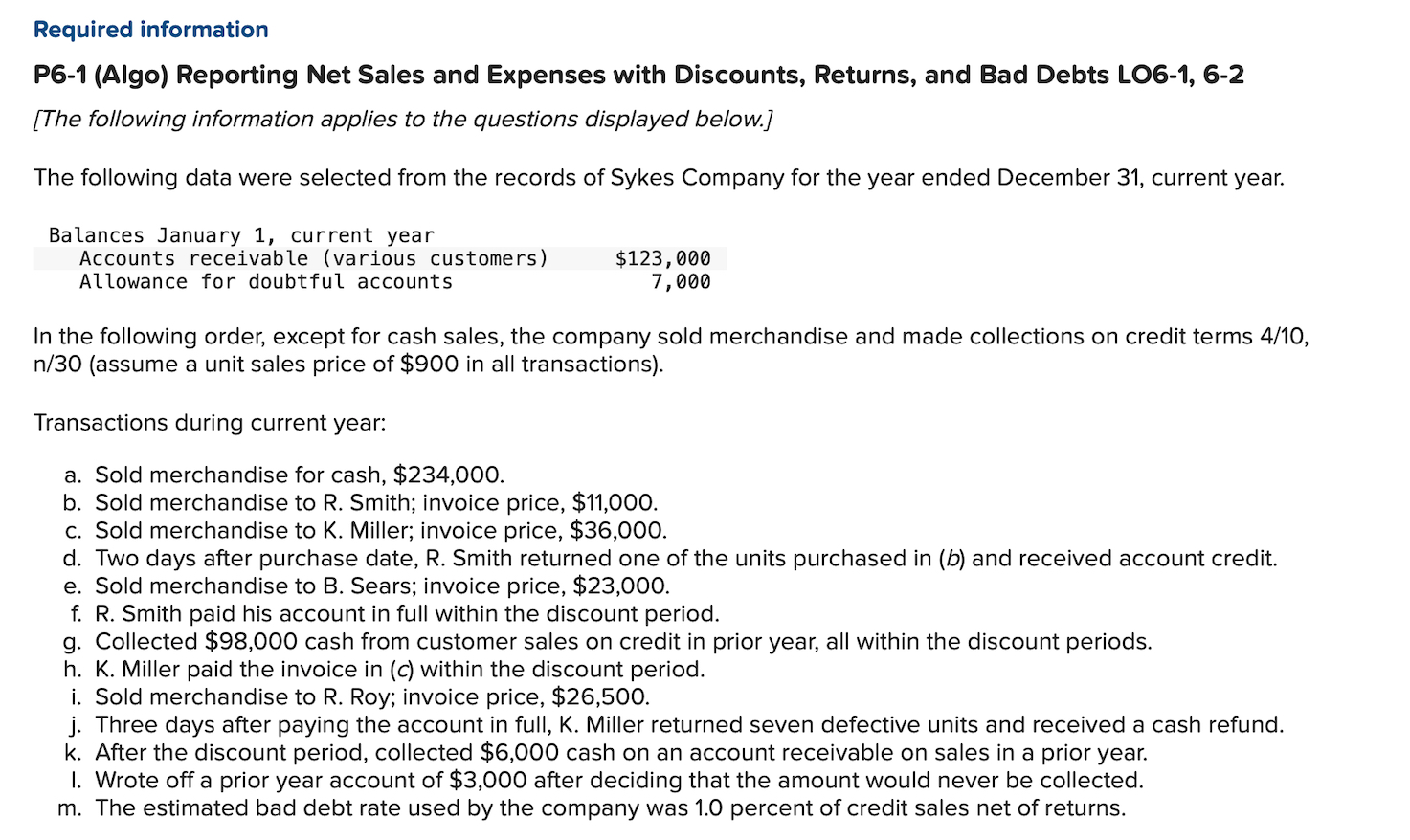
PAlgo Reporting Net Sales and Expenses with Discounts, Returns, and Bad Debts LOSkip to questionThe following information applies to the questions displayed below.The following data were selected from the records of Sykes Company for the year ended December current year.Balances January current year Accounts receivable various customers$Allowance for doubtful accountsIn the following order, except for cash sales, the company sold merchandise and made collections on credit terms nassume a unit sales price of $ in all transactionsTransactions during current year:Sold merchandise for cash, $Sold merchandise to R Smith; invoice price, $Sold merchandise to K Miller; invoice price, $Two days after purchase date, R Smith returned one of the units purchased in b and received account credit.Sold merchandise to B Sears; invoice price, $R Smith paid his account in full within the discount period.Collected $ cash from customer sales on credit in prior year, all within the discount periods.K Miller paid the invoice in c within the discount period.Sold merchandise to R Roy; invoice price, $Three days after paying the account in full, K Miller returned seven defective units and received a cash refund.After the discount period, collected $ cash on an account receivable on sales in a prior year.Wrote off a prior year account of $ after deciding that the amount would never be collected.The estimated bad debt rate used by the company was percent of credit sales net of returns.
Required information
PAlgo Reporting Net Sales and Expenses with Discounts, Returns, and Bad Debts LO
The following information applies to the questions displayed below.
The following data were selected from the records of Sykes Company for the year ended December current year.
Balances January current year
Accounts receivable various customers $
Allowance for doubtful accounts
In the following order, except for cash sales, the company sold merchandise and made collections on credit terms assume a unit sales price of $ in all transactions
Transactions during current year:
a Sold merchandise for cash, $
b Sold merchandise to R Smith; invoice price, $
c Sold merchandise to K Miller; invoice price, $
d Two days after purchase date, R Smith returned one of the units purchased in and received account credit.
e Sold merchandise to B Sears; invoice price, $
f R Smith paid his account in full within the discount period.
g Collected $ cash from customer sales on credit in prior year, all within the discount periods.
h K Miller paid the invoice in c within the discount period.
i Sold merchandise to R Roy; invoice price, $
j Three days after paying the account in full, K Miller returned seven defective units and received a cash refund.
k After the discount period, collected $ cash on an account receivable on sales in a prior year.
I. Wrote off a prior year account of $ after deciding that the amount would never be collected.
m The estimated bad debt rate used by the company was percent of credit sales net of returns.
Required:
Using the following categories, indicate the effect of each listed transaction, including the writeoff of the uncollectible account and the adjusting entry for estimated bad debts ignore cost of goods sold The first transaction is used as an example.
Note: Round your answers to the nearest whole dollar amount. Any decrease in account balances should be indicated by a minus sign.
Answer is complete but not entirely correct.
tableTransactionSales Revenue,Sales Discounts takentableSalesReturns and AllowancesBad Debt Expensea$ bc Odefg hijkm VTotal$ $ $ $
P Part
Show how the accounts related to the preceding sale and collection activities should be reported on the current year income statement.
Note: Round your answers to the nearest whole dollar amount.
Answer is complete but not entirely correct.
Step by Step Solution
There are 3 Steps involved in it
1 Expert Approved Answer
Step: 1 Unlock

Question Has Been Solved by an Expert!
Get step-by-step solutions from verified subject matter experts
Step: 2 Unlock
Step: 3 Unlock