







Question: P Please post MATLAB script. m m Background Modelling the trajectory of a rocket is critical for NASA to successfully achieve mission objectives. Typically, rockets
P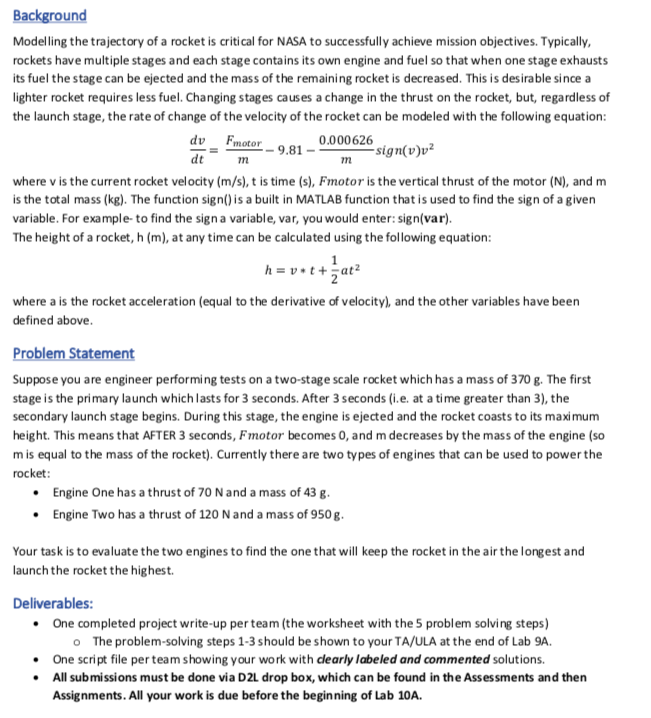
Please post MATLAB script.
m m Background Modelling the trajectory of a rocket is critical for NASA to successfully achieve mission objectives. Typically, rockets have multiple stages and each stage contains its own engine and fuel so that when one stage exhausts its fuel the stage can be ejected and the mass of the remaining rocket is decreased. This is desirable since a lighter rocket requires less fuel. Changing stages causes a change in the thrust on the rocket, but, regardless of the launch stage, the rate of change of the velocity of the rocket can be modeled with the following equation: dv Fmotor 0.000626 9.81 dt -sign(v)v2 where v is the current rocket velocity (m/s), t is time (s), Fmotor is the vertical thrust of the motor (N), and m is the total mass (kg). The function sign() is a built in MATLAB function that is used to find the sign of a given variable. For example-to find the sign a variable, var, you would enter: sign(var). The height of a rocket, h (m), at any time can be calculated using the following equation: 1 h = v*t +-at? where a is the rocket acceleration (equal to the derivative of velocity), and the other variables have been defined above. Problem Statement Suppose you are engineer performing tests on a two-stage scale rocket which has a mass of 370 g. The first stage is the primary launch which lasts for 3 seconds. After 3 seconds (i.e. at a time greater than 3), the secondary launch stage begins. During this stage, the engine is ejected and the rocket coasts to its maximum height. This means that AFTER 3 seconds, Fmotor becomes 0, and m decreases by the mass of the engine (so mis equal to the mass of the rocket). Currently there are two types of engines that can be used to power the rocket: Engine One has a thrust of 70 N and a mass of 43 g. Engine Two has a thrust of 120 N and a mass of 950g. Your task is to evaluate the two engines to find the one that will keep the rocket in the air the longest and launch the rocket the highest. Deliverables: One completed project write-up per team (the worksheet with the 5 problem solving steps) The problem-solving steps 1-3 should be shown to your TA/ULA at the end of Lab 9A. One script file per team showing your work with clearly labeled and commented solutions. All submissions must be done via D2L drop box, which can be found in the Assessments and then Assignments. All your work is due before the beginning of Lab 10A. m m Background Modelling the trajectory of a rocket is critical for NASA to successfully achieve mission objectives. Typically, rockets have multiple stages and each stage contains its own engine and fuel so that when one stage exhausts its fuel the stage can be ejected and the mass of the remaining rocket is decreased. This is desirable since a lighter rocket requires less fuel. Changing stages causes a change in the thrust on the rocket, but, regardless of the launch stage, the rate of change of the velocity of the rocket can be modeled with the following equation: dv Fmotor 0.000626 9.81 dt -sign(v)v2 where v is the current rocket velocity (m/s), t is time (s), Fmotor is the vertical thrust of the motor (N), and m is the total mass (kg). The function sign() is a built in MATLAB function that is used to find the sign of a given variable. For example-to find the sign a variable, var, you would enter: sign(var). The height of a rocket, h (m), at any time can be calculated using the following equation: 1 h = v*t +-at? where a is the rocket acceleration (equal to the derivative of velocity), and the other variables have been defined above. Problem Statement Suppose you are engineer performing tests on a two-stage scale rocket which has a mass of 370 g. The first stage is the primary launch which lasts for 3 seconds. After 3 seconds (i.e. at a time greater than 3), the secondary launch stage begins. During this stage, the engine is ejected and the rocket coasts to its maximum height. This means that AFTER 3 seconds, Fmotor becomes 0, and m decreases by the mass of the engine (so mis equal to the mass of the rocket). Currently there are two types of engines that can be used to power the rocket: Engine One has a thrust of 70 N and a mass of 43 g. Engine Two has a thrust of 120 N and a mass of 950g. Your task is to evaluate the two engines to find the one that will keep the rocket in the air the longest and launch the rocket the highest. Deliverables: One completed project write-up per team (the worksheet with the 5 problem solving steps) The problem-solving steps 1-3 should be shown to your TA/ULA at the end of Lab 9A. One script file per team showing your work with clearly labeled and commented solutions. All submissions must be done via D2L drop box, which can be found in the Assessments and then Assignments. All your work is due before the beginning of Lab 10A
Step by Step Solution
There are 3 Steps involved in it

Get step-by-step solutions from verified subject matter experts
 Study Help