Question: =P(1-2) h, Consider a population model dp p =p dt where p(t) represents the population of lobsters in millions, t represents positive years since 2016,
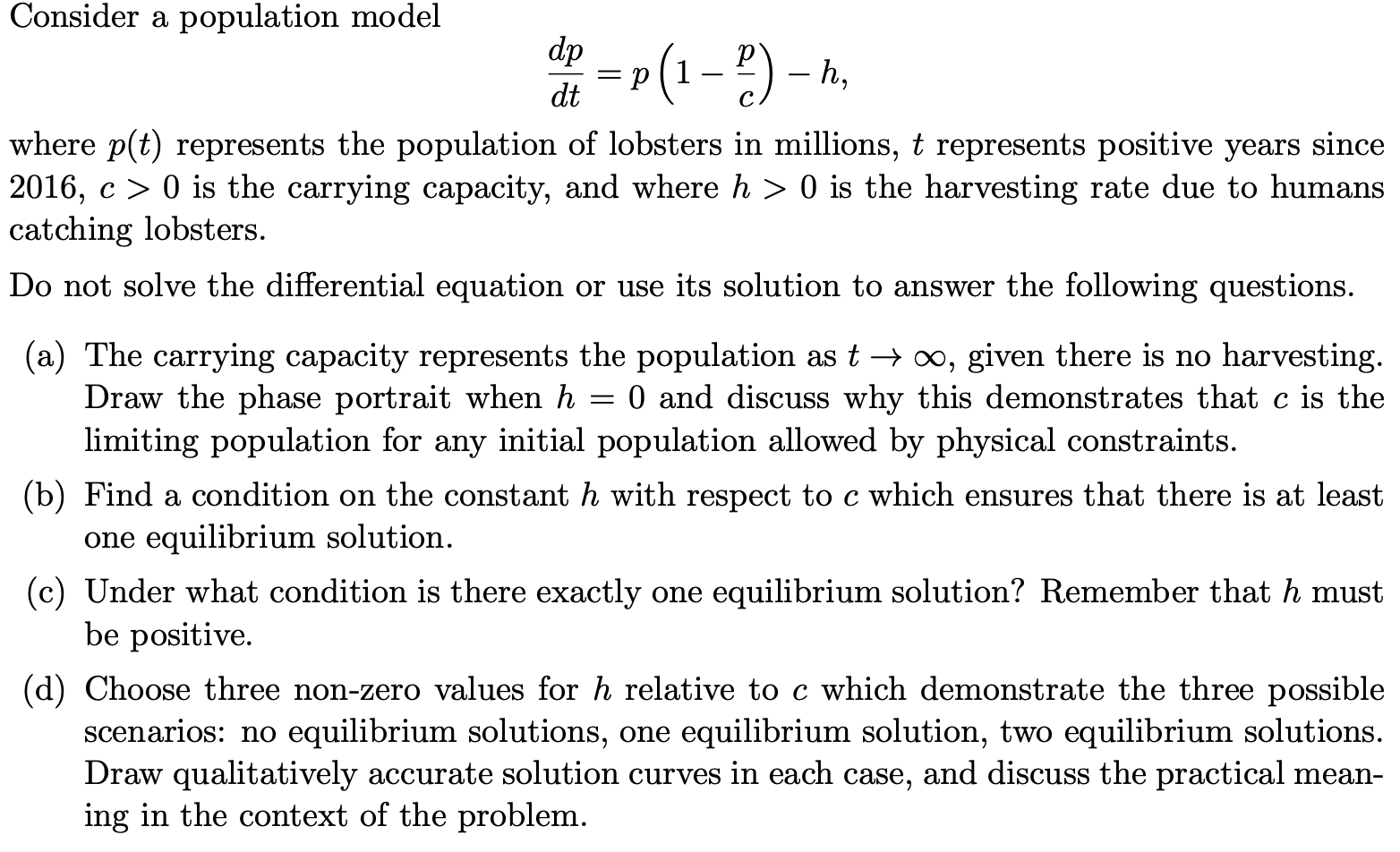
=P(1-2) h, Consider a population model dp p =p dt where p(t) represents the population of lobsters in millions, t represents positive years since 2016, c> 0 is the carrying capacity, and where h > 0 is the harvesting rate due to humans catching lobsters. Do not solve the differential equation or use its solution to answer the following questions. = (a) The carrying capacity represents the population as t+00, given there is no harvesting. Draw the phase portrait when h = 0 and discuss why this demonstrates that c is the limiting population for any initial population allowed by physical constraints. (b) Find a condition on the constant h with respect to c which ensures that there is at least one equilibrium solution. (c) Under what condition is there exactly one equilibrium solution? Remember that h must be positive. (d) Choose three non-zero values for h relative to c which demonstrate the three possible scenarios: no equilibrium solutions, one equilibrium solution, two equilibrium solutions. Draw qualitatively accurate solution curves in each case, and discuss the practical mean- ing in the context of the problem. =P(1-2) h, Consider a population model dp p =p dt where p(t) represents the population of lobsters in millions, t represents positive years since 2016, c> 0 is the carrying capacity, and where h > 0 is the harvesting rate due to humans catching lobsters. Do not solve the differential equation or use its solution to answer the following questions. = (a) The carrying capacity represents the population as t+00, given there is no harvesting. Draw the phase portrait when h = 0 and discuss why this demonstrates that c is the limiting population for any initial population allowed by physical constraints. (b) Find a condition on the constant h with respect to c which ensures that there is at least one equilibrium solution. (c) Under what condition is there exactly one equilibrium solution? Remember that h must be positive. (d) Choose three non-zero values for h relative to c which demonstrate the three possible scenarios: no equilibrium solutions, one equilibrium solution, two equilibrium solutions. Draw qualitatively accurate solution curves in each case, and discuss the practical mean- ing in the context of the




