



Question: P7.3. Would you expect to be able to detect the increase in cancer deaths due to the extra radiation dose received due to cosmic rays
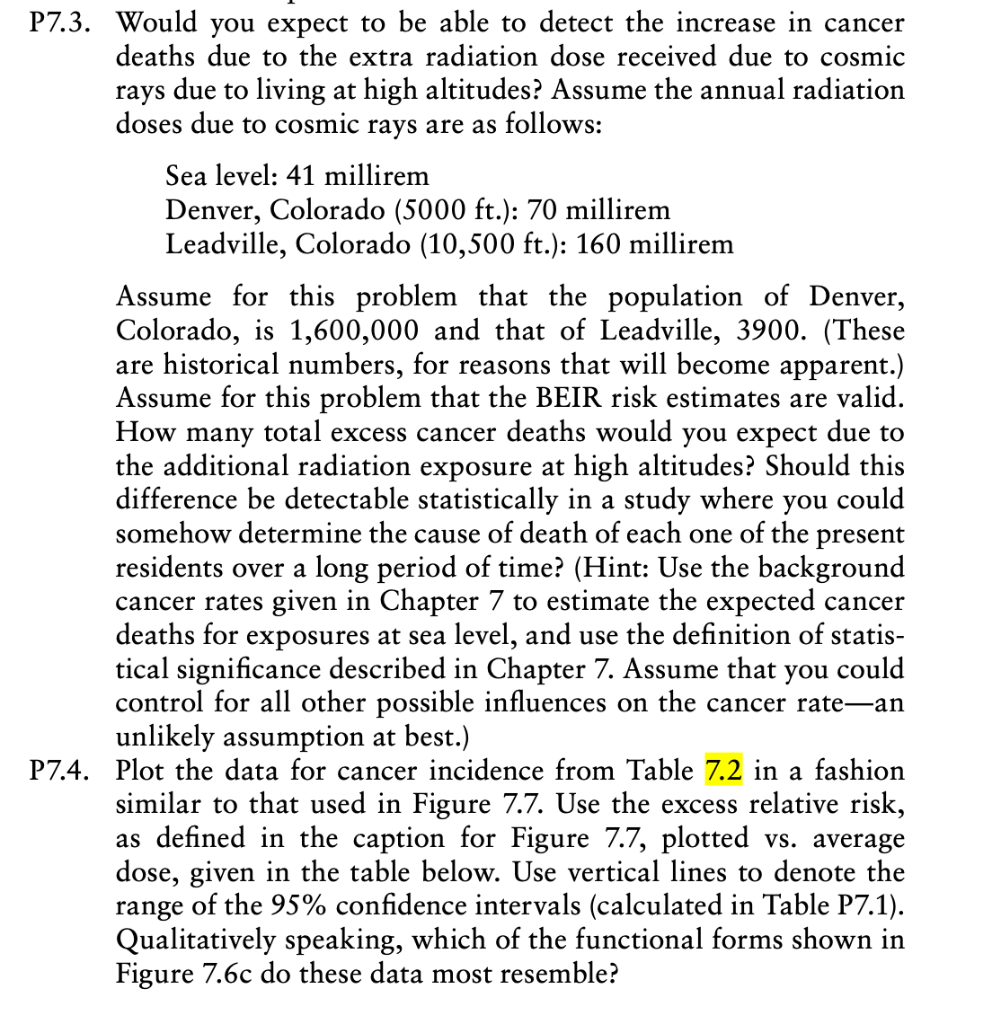
P7.3. Would you expect to be able to detect the increase in cancer deaths due to the extra radiation dose received due to cosmic rays due to living at high altitudes? Assume the annual radiation doses due to cosmic rays are as follows:
Sea level: 41 millirem Denver, Colorado (5000 ft.): 70 millirem Leadville, Colorado (10,500 ft.): 160 millirem
Assume for this problem that the population of Denver, Colorado, is 1,600,000 and that of Leadville, 3900. (These are historical numbers, for reasons that will become apparent.) Assume for this problem that the BEIR risk estimates are valid. How many total excess cancer deaths would you expect due to the additional radiation exposure at high altitudes? Should this difference be detectable statistically in a study where you could somehow determine the cause of death of each one of the present residents over a long period of time? (Hint: Use the background cancer rates given in Chapter 7 to estimate the expected cancer deaths for exposures at sea level, and use the definition of statistical significance described in Chapter 7. Assume that you could control for all other possible influences on the cancer ratean unlikely assumption at best.)
P7.4. Plot the data for cancer incidence from Table 7.2 in a fashion similar to that used in Figure 7.7. Use the excess relative risk, as defined in the caption for Figure 7.7, plotted vs. average dose, given in the table below. Use vertical lines to denote the range of the 95% confidence intervals (calculated in Table P7.1). Qualitatively speaking, which of the functional forms shown in Figure 7.6c do these data most resemble?
P7.3. Would you expect to be able to detect the increase in cancer deaths due to the extra radiation dose received due to cosmic rays due to living at high altitudes? Assume the annual radiation doses due to cosmic rays are as follows: Sea level: 41 millirem Denver, Colorado (5000 ft.): 70 millirem Leadville, Colorado (10,500 ft.): 160 millirem Assume for this problem that the population of Denver, Colorado, is 1,600,000 and that of Leadville, 3900. (These are historical numbers, for reasons that will become apparent.) Assume for this problem that the BEIR risk estimates are valid. How many total excess cancer deaths would you expect due to the additional radiation exposure at high altitudes? Should this difference be detectable statistically in a study where you could somehow determine the cause of death of each one of the present residents over a long period of time? (Hint: Use the background cancer rates given in Chapter 7 to estimate the expected cancer deaths for exposures at sea level, and use the definition of statis- tical significance described in Chapter 7. Assume that you could control for all other possible influences on the cancer ratean unlikely assumption at best.) P7.4. Plot the data for cancer incidence from Table 7.2 in a fashion similar to that used in Figure 7.7. Use the excess relative risk, as defined in the caption for Figure 7.7, plotted vs. average dose, given in the table below. Use vertical lines to denote the range of the 95% confidence intervals (calculated in Table P7.1). Qualitatively speaking, which of the functional forms shown in Figure 7.6c do these data most resemble? P7.3. Would you expect to be able to detect the increase in cancer deaths due to the extra radiation dose received due to cosmic rays due to living at high altitudes? Assume the annual radiation doses due to cosmic rays are as follows: Sea level: 41 millirem Denver, Colorado (5000 ft.): 70 millirem Leadville, Colorado (10,500 ft.): 160 millirem Assume for this problem that the population of Denver, Colorado, is 1,600,000 and that of Leadville, 3900. (These are historical numbers, for reasons that will become apparent.) Assume for this problem that the BEIR risk estimates are valid. How many total excess cancer deaths would you expect due to the additional radiation exposure at high altitudes? Should this difference be detectable statistically in a study where you could somehow determine the cause of death of each one of the present residents over a long period of time? (Hint: Use the background cancer rates given in Chapter 7 to estimate the expected cancer deaths for exposures at sea level, and use the definition of statis- tical significance described in Chapter 7. Assume that you could control for all other possible influences on the cancer ratean unlikely assumption at best.) P7.4. Plot the data for cancer incidence from Table 7.2 in a fashion similar to that used in Figure 7.7. Use the excess relative risk, as defined in the caption for Figure 7.7, plotted vs. average dose, given in the table below. Use vertical lines to denote the range of the 95% confidence intervals (calculated in Table P7.1). Qualitatively speaking, which of the functional forms shown in Figure 7.6c do these data most resemble
Step by Step Solution
There are 3 Steps involved in it

Get step-by-step solutions from verified subject matter experts