







Question: Packets are scheduled using FIFO policy Packets are scheduled using Highest Priority First policy. Assume even-numbered packets are high priority and odd-numbered packets are
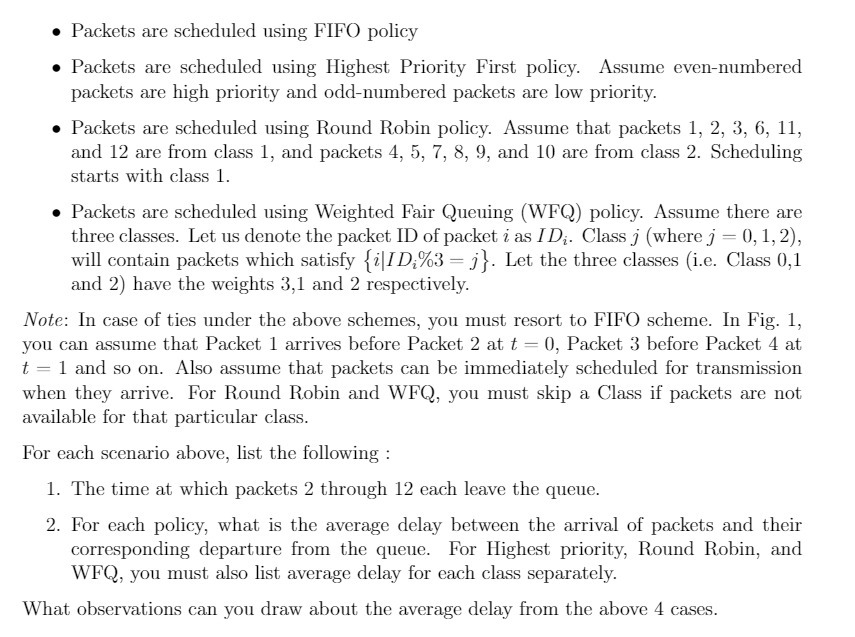
Packets are scheduled using FIFO policy Packets are scheduled using Highest Priority First policy. Assume even-numbered packets are high priority and odd-numbered packets are low priority. Packets are scheduled using Round Robin policy. Assume that packets 1, 2, 3, 6, 11, and 12 are from class 1, and packets 4, 5, 7, 8, 9, and 10 are from class 2. Scheduling starts with class 1. Packets are scheduled using Weighted Fair Queuing (WFQ) policy. Assume there are three classes. Let us denote the packet ID of packet i as ID. Class j (where j = 0, 1, 2), will contain packets which satisfy {i|ID;%3 = j}. Let the three classes (i.e. Class 0,1 and 2) have the weights 3,1 and 2 respectively. Note: In case of ties under the above schemes, you must resort to FIFO scheme. In Fig. 1, you can assume that Packet 1 arrives before Packet 2 at t = 0, Packet 3 before Packet 4 at t = 1 and so on. Also assume that packets can be immediately scheduled for transmission when they arrive. For Round Robin and WFQ, you must skip a Class if packets are not available for that particular class. For each scenario above, list the following: 1. The time at which packets 2 through 12 each leave the queue. 2. For each policy, what is the average delay between the arrival of packets and their corresponding departure from the queue. For Highest priority, Round Robin, and WFQ, you must also list average delay for each class separately. What observations can you draw about the average delay from the above 4 cases.
Step by Step Solution
There are 3 Steps involved in it

Get step-by-step solutions from verified subject matter experts
 Study Help