



Question: $ Par value Coupon rate Original maturity Remaining maturity Original flotation costs Call premium 87,000,000 5.5000% 31 17 9,000,000 6.9400% 30% $ Tax rate Refunding
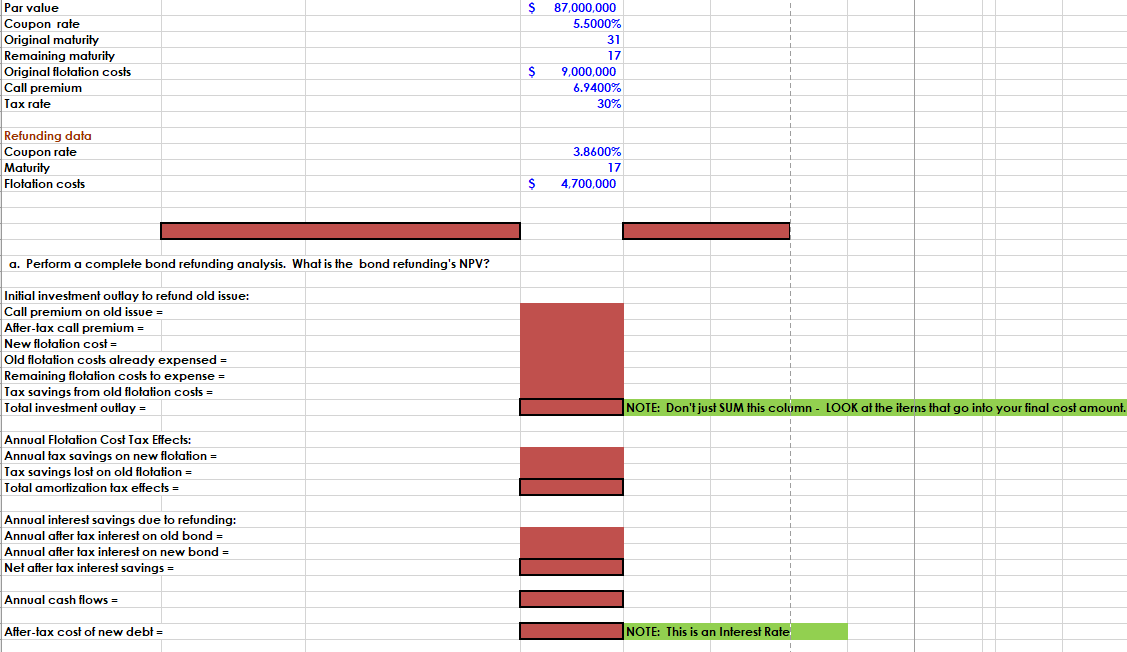
$ Par value Coupon rate Original maturity Remaining maturity Original flotation costs Call premium 87,000,000 5.5000% 31 17 9,000,000 6.9400% 30% $ Tax rate Refunding data Coupon rate Maturity Flotation costs 3.8600% 17 4.700.000 S a. Perform a complete bond refunding analysis. What is the bond refunding's NPV? Initial investment outlay to refund old issue: Call premium on old issue = After-tax call premium = New flotation cost - Old flotation costs already expensed = Remaining flotation costs to expense = Tax savings from old flotation costs = Total investment outlay = NOTE: Don't just SUM this column - LOOK at the iterns that go into your final cost amount. Annual Flotation Cost Tax Effects: Annual tax savings on new flotation = Tax savings lost on old flotation - Total amortization tax effects = Annual interest savings due to refunding: Annual after tax interest on old bond = Annual after tax interest on new bond = Net after tax interest savings = Annual cash flows = After-tax cost of new debt = NOTE: This is an Interest Rate $ Par value Coupon rate Original maturity Remaining maturity Original flotation costs Call premium 87,000,000 5.5000% 31 17 9,000,000 6.9400% 30% $ Tax rate Refunding data Coupon rate Maturity Flotation costs 3.8600% 17 4.700.000 S a. Perform a complete bond refunding analysis. What is the bond refunding's NPV? Initial investment outlay to refund old issue: Call premium on old issue = After-tax call premium = New flotation cost - Old flotation costs already expensed = Remaining flotation costs to expense = Tax savings from old flotation costs = Total investment outlay = NOTE: Don't just SUM this column - LOOK at the iterns that go into your final cost amount. Annual Flotation Cost Tax Effects: Annual tax savings on new flotation = Tax savings lost on old flotation - Total amortization tax effects = Annual interest savings due to refunding: Annual after tax interest on old bond = Annual after tax interest on new bond = Net after tax interest savings = Annual cash flows = After-tax cost of new debt = NOTE: This is an Interest Rate
Step by Step Solution
There are 3 Steps involved in it

Get step-by-step solutions from verified subject matter experts