







Question: Part 1 ( 1 point ) Consider a market with a demand curve given ( in inverse form ) by ( P ( Q
Part point
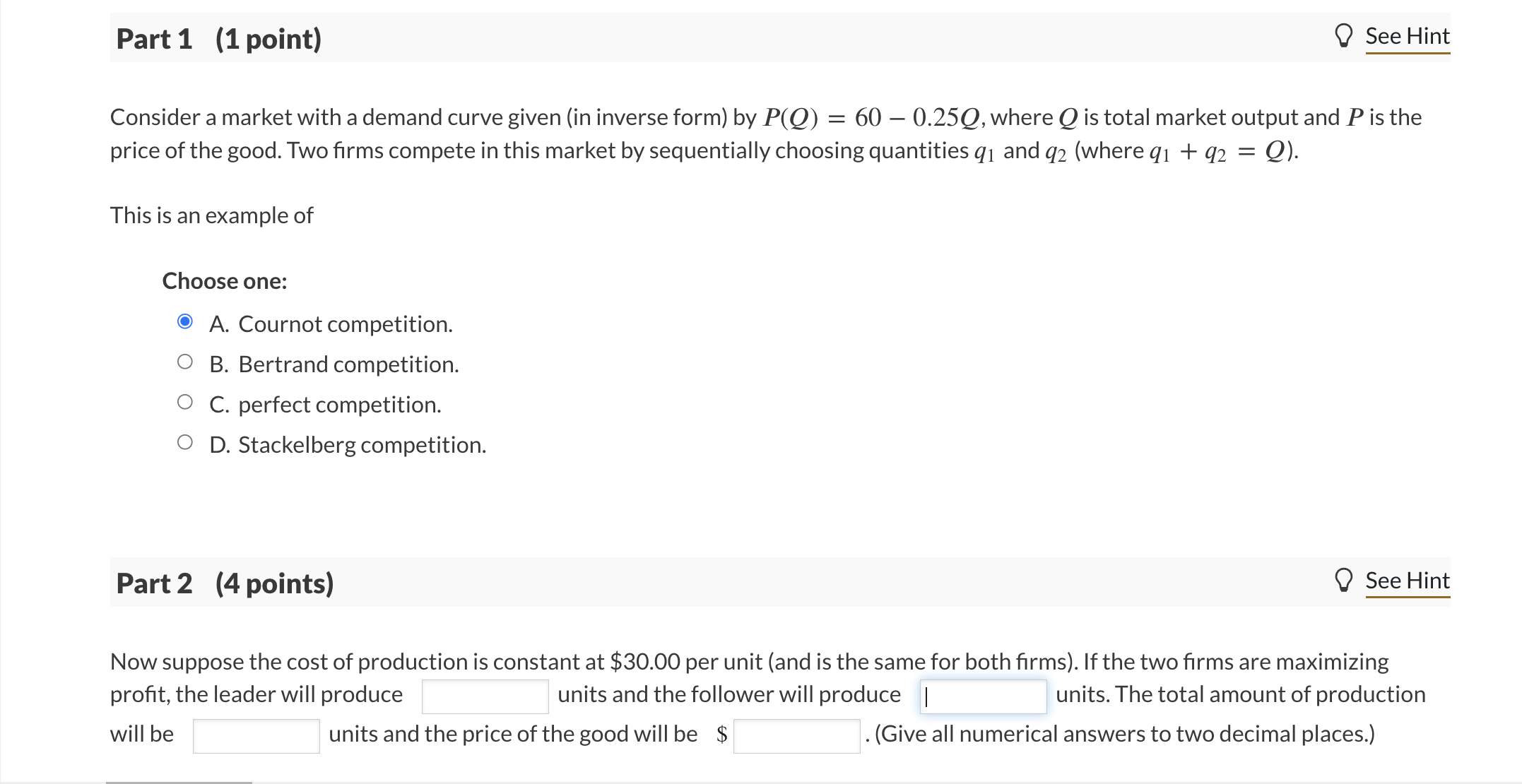
Consider a market with a demand curve given in inverse form by PQ Q where Q is total market output and P is the price of the good. Two firms compete in this market by sequentially choosing quantities q and qwhere qqQ
This is an example of
Choose one:
A Cournot competition.
B Bertrand competition.
C perfect competition.
D Stackelberg competition.
Part points
Now suppose the cost of production is constant at $ per unit and is the same for both firms If the two firms are maximizing profit, the leader will produce units and the follower will produce units. The total amount of production will be units and the price of the good will be $
Give all numerical answers to two decimal places.
Step by Step Solution
There are 3 Steps involved in it
1 Expert Approved Answer
Step: 1 Unlock

Question Has Been Solved by an Expert!
Get step-by-step solutions from verified subject matter experts
Step: 2 Unlock
Step: 3 Unlock
 Study Help