







Question: Part 1 1. Send a pulse down your wave machine by gently lifting a jelly baby up and pushing it down. *What moves through the
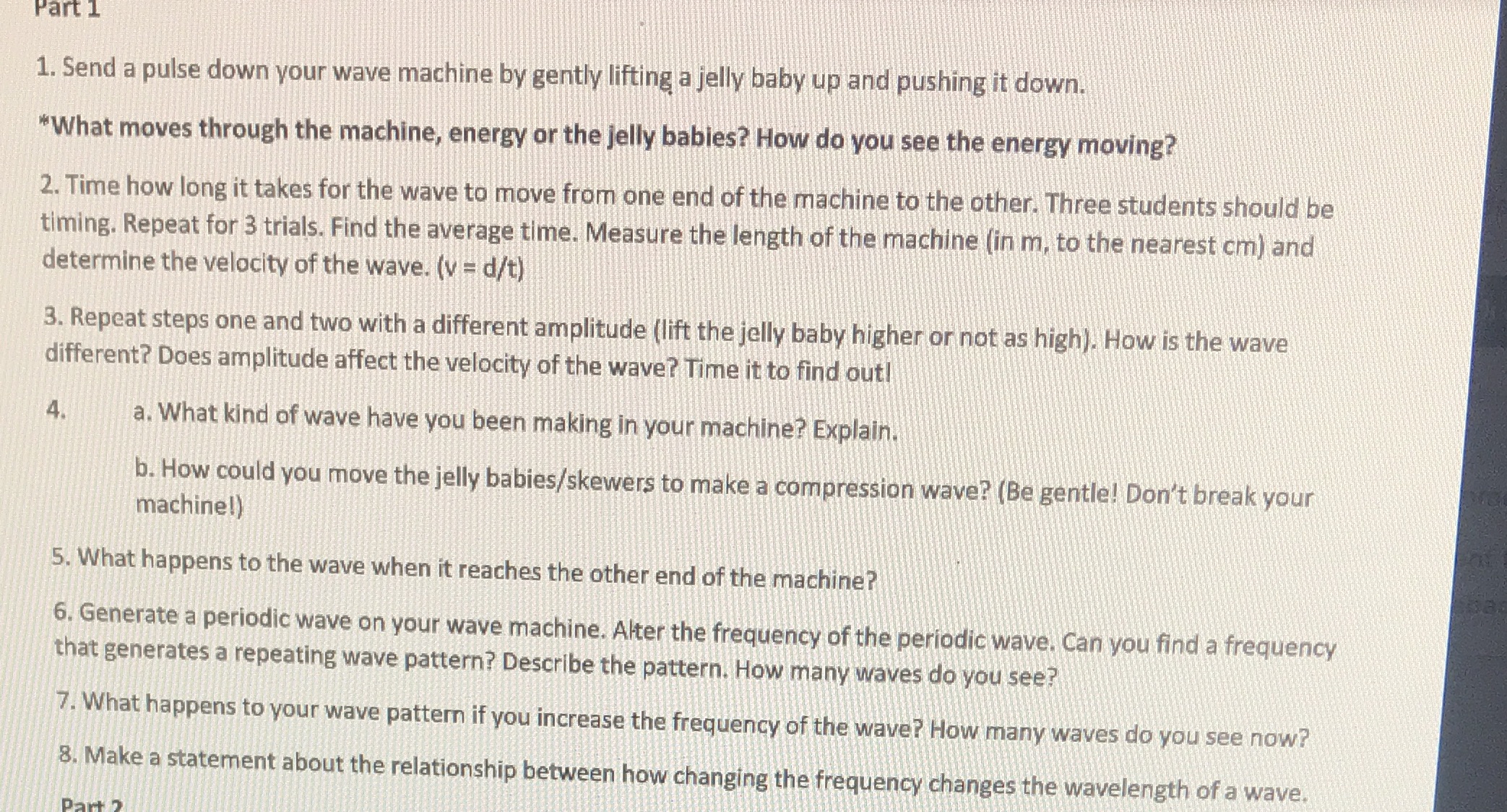
Part 1 1. Send a pulse down your wave machine by gently lifting a jelly baby up and pushing it down. *What moves through the machine, energy or the jelly babies? How do you see the energy moving? 2. Time how long it takes for the wave to move from one end of the machine to the other. Three students should be timing. Repeat for 3 trials. Find the average time. Measure the length of the machine (in m, to the nearest cm) and determine the velocity of the wave. (v = d/t) 3. Repeat steps one and two with a different amplitude (lift the jelly baby higher or not as high). How is the wave different? Does amplitude affect the velocity of the wave? Time it to find out! 4. a. What kind of wave have you been making in your machine? Explain. b. How could you move the jelly babies/skewers to make a compression wave? (Be gentle! Don't break your machine!) 5. What happens to the wave when it reaches the other end of the machine? 6. Generate a periodic wave on your wave machine. Alter the frequency of the periodic wave. Can you find a frequency that generates a repeating wave pattern? Describe the pattern. How many waves do you see? 7. What happens to your wave pattern if you increase the frequency of the wave? How many waves do you see now? 8. Make a statement about the relationship between how changing the frequency changes the wavelength of a wave
Step by Step Solution
There are 3 Steps involved in it

Get step-by-step solutions from verified subject matter experts
 Study Help