



Question: Part 1 (5 marks): Please refer to application 5.2 entitled as Top Management Team at Ortiv Glass Corporation . available in your textbook and answer
Part 1 (5 marks):
Please refer to application 5.2 entitled as Top Management Team at Ortiv Glass Corporation. available in your textbook and answer the following:
1. Discuss why strategic orientation is fundamental to diagnosis in OD. Demonstrate your answer using two examples from this application.
2. Describe and evaluate each of the Ortivs team design components:
- Goal clarity
- Task structure
- Team functioning
- Group composition
- Group norms
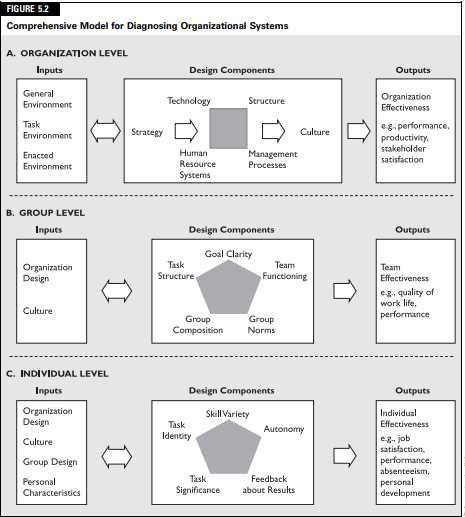
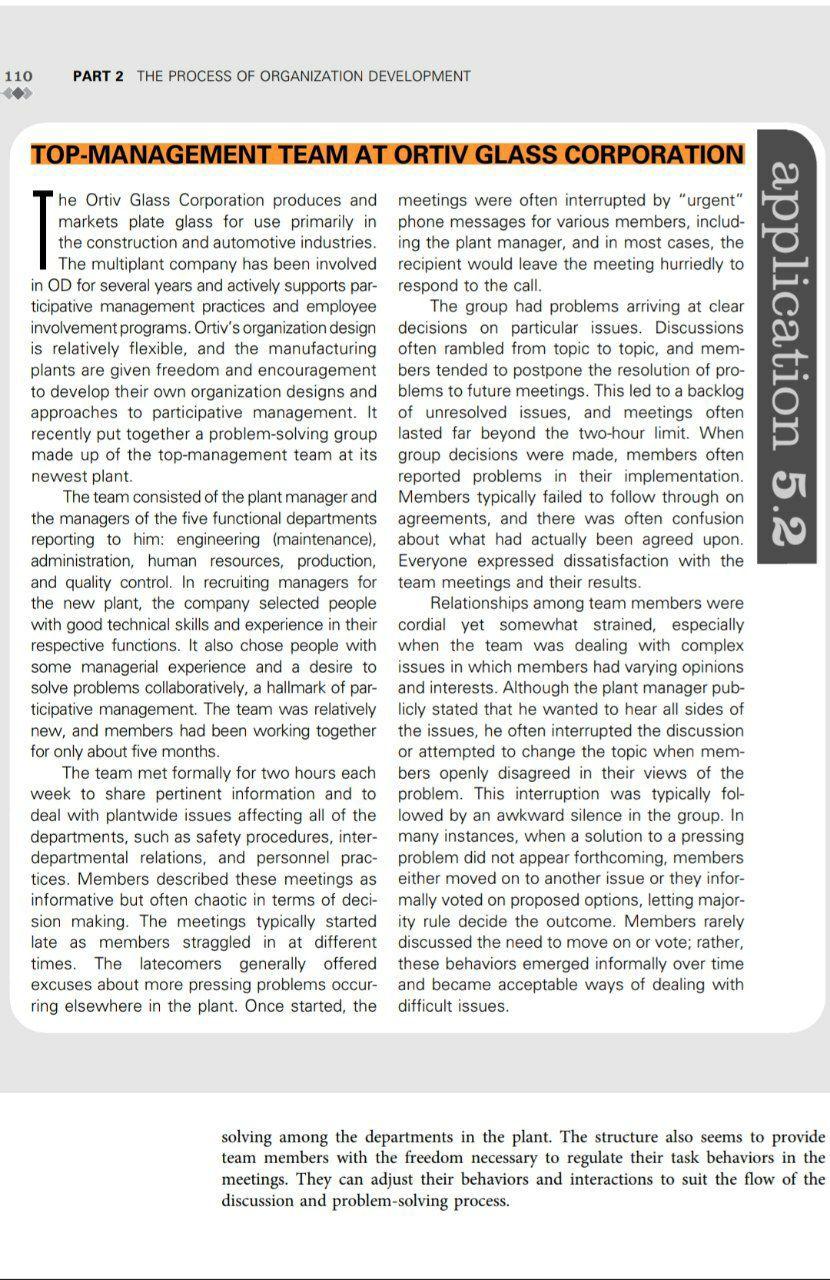
FIGURE 5.2 Comprehensive Model for Diagnosing Organizational Systems A. ORGANIZATION LEVEL Inputs Design Components Outputs General Environment Technology Structure Task Environment Strategy Culture Organization Effectiveness eg., performance productivity stakeholder satisfaction Enacted Environment Human Resource Systems Management Processes B. GROUP LEVEL Inputs Design Components Outputs Goal Clarity Organization Design Task Structure Team Functioning Team Effectiveness eg, quality of work life, performance Culture Group Composition Group Norms C. INDIVIDUAL LEVEL Inputs Outputs Organization Design Culture Design Components Skill Variety Task Autonomy Identity Individual Effectiveness egjob satisfaction, performance, absenteeism, personal development Group Design Personal Characteristics Task Significance Feedback about Results 110 PART 2 THE PROCESS OF ORGANIZATION DEVELOPMENT TOP-MANAGEMENT TEAM AT ORTIV GLASS CORPORATION application 5.2 'he Ortiv Glass Corporation produces and meetings were often interrupted by "urgent" markets plate glass for use primarily in phone messages for various members, includ- the construction and automotive industries. ing the plant manager, and in most cases, the The multiplant company has been involved recipient would leave the meeting hurriedly to in OD for several years and actively supports par-respond to the call. ticipative management practices and employee The group had problems arriving at clear involvement programs. Ortiv's organization design decisions on particular issues. Discussions is relatively flexible, and the manufacturing often rambled from topic to topic, and mem- plants are given freedom and encouragement bers tended to postpone the resolution of pro- to develop their own organization designs and blems to future meetings. This led to a backlog approaches to participative management. It of unresolved issues, and meetings often recently put together a problem-solving group lasted far beyond the two-hour limit. When made up of the top-management team at its group decisions were made, members often newest plant reported problems in their implementation. The team consisted of the plant manager and Members typically failed to follow through on the managers of the five functional departments agreements, and there was often confusion reporting to him: engineering (maintenance), about what had actually been agreed upon. administration, human resources, production, Everyone expressed dissatisfaction with the and quality control. In recruiting managers for team meetings and their results. the new plant, the company selected people Relationships among team members were with good technical skills and experience in their cordial yet somewhat strained, especially respective functions. It also chose people with when the team was dealing with complex some managerial experience and a desire to issues in which members had varying opinions solve problems collaboratively, a hallmark of par- and interests. Although the plant manager pub- ticipative management. The team was relatively licly stated that he wanted to hear all sides of new, and members had been working together the issues, he often interrupted the discussion for only about five months. or attempted to change the topic when mem- The team met formally for two hours each bers openly disagreed in their views of the week to share pertinent information and to problem. This interruption was typically fol- deal with plantwide issues affecting all of the lowed by an awkward silence in the group. In departments, such as safety procedures, inter- many instances, when a solution to a pressing departmental relations, and personnel prac- problem did not appear forthcoming, members tices. Members described these meetings as either moved on to another issue or they infor- informative but often chaotic in terms of deci-mally voted on proposed options, letting major- sion making. The meetings typically started ity rule decide the outcome. Members rarely late as members straggled in at different discussed the need to move on or vote; rather, times. The latecomers generally offered these behaviors emerged informally over time excuses about more pressing problems occur- and became acceptable ways of dealing with ring elsewhere in the plant. Once started, the difficult issues. solving among the departments in the plant. The structure also seems to provide team members with the freedom necessary to regulate their task behaviors in the meetings. They can adjust their behaviors and interactions to suit the flow of the discussion and problem-solving processStep by Step Solution
There are 3 Steps involved in it
1 Expert Approved Answer
Step: 1 Unlock

Question Has Been Solved by an Expert!
Get step-by-step solutions from verified subject matter experts
Step: 2 Unlock
Step: 3 Unlock