







Question: Part 1 : Dynamic Modeling A jacketed stirred tank is used to cool a process by causing cooling water to flow trhough the jackes as
Part : Dynamic Modeling
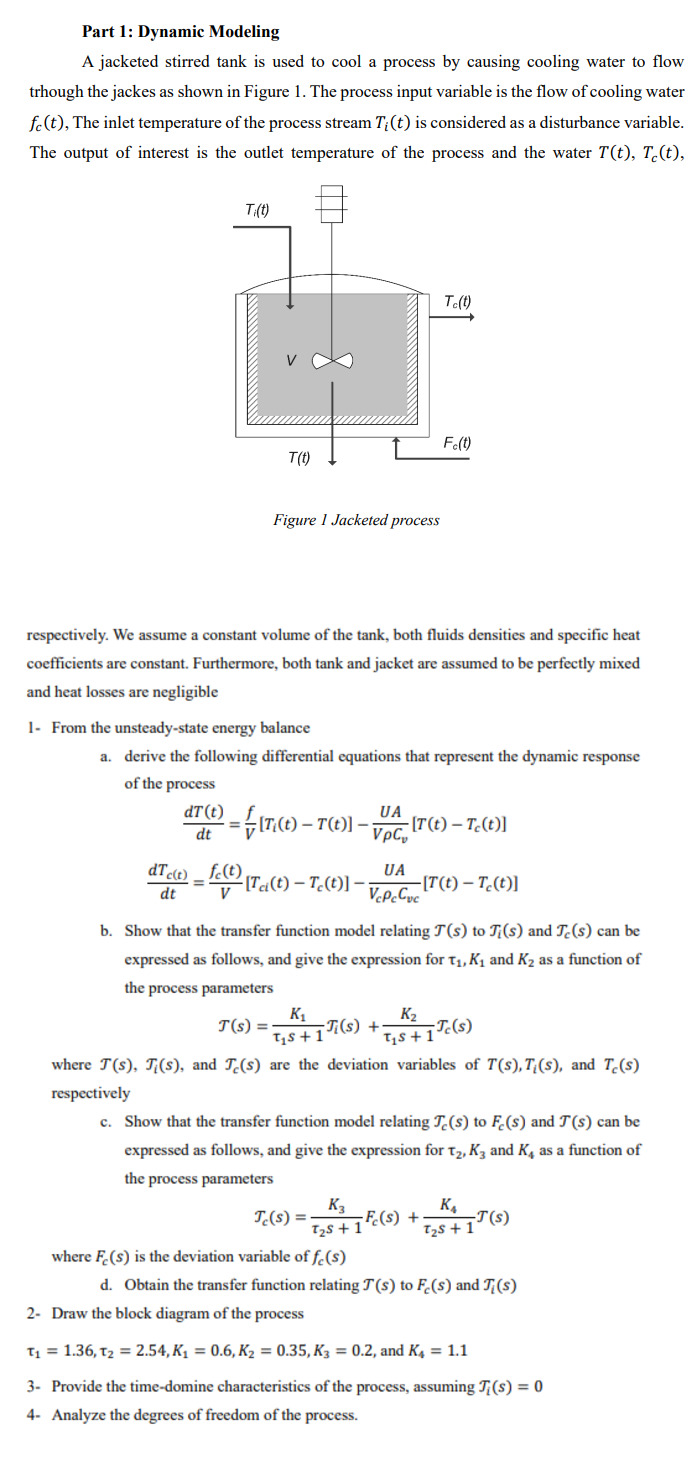
A jacketed stirred tank is used to cool a process by causing cooling water to flow
trhough the jackes as shown in Figure The process input variable is the flow of cooling water
The inlet temperature of the process stream is considered as a disturbance variable.
The output of interest is the outlet temperature of the process and the water
Figure Jacketed process
respectively. We assume a constant volume of the tank, both fluids densities and specific heat
coefficients are constant. Furthermore, both tank and jacket are assumed to be perfectly mixed
and heat losses are negligible
From the unsteadystate energy balance
a derive the following differential equations that represent the dynamic response
of the process
b Show that the transfer function model relating to and can be
expressed as follows, and give the expression for and as a function of
the process parameters
where and are the deviation variables of and
respectively
c Show that the transfer function model relating to and can be
expressed as follows, and give the expression for and as a function of
the process parameters
where is the deviation variable of
d Obtain the transfer function relating to and
Draw the block diagram of the process
and
Provide the timedomine characteristics of the process, assuming
Analyze the degrees of freedom of the process.
Step by Step Solution
There are 3 Steps involved in it
1 Expert Approved Answer
Step: 1 Unlock

Question Has Been Solved by an Expert!
Get step-by-step solutions from verified subject matter experts
Step: 2 Unlock
Step: 3 Unlock
 Study Help