







Question: > Part 1: Making the Position vs Time Graph Let's start by making a graph of the position vs time for one of the objects.
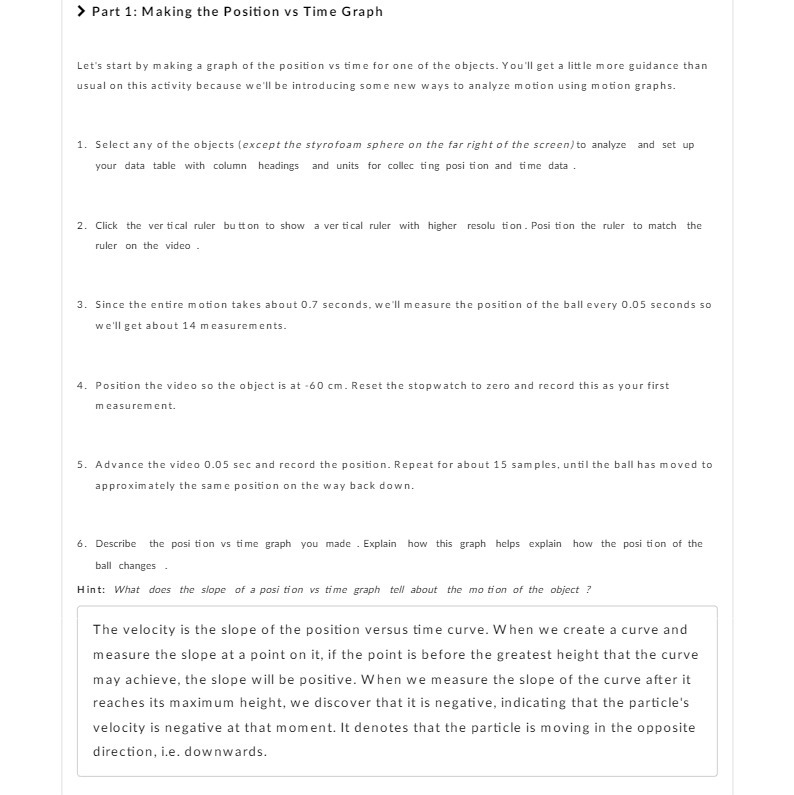
> Part 1: Making the Position vs Time Graph Let's start by making a graph of the position vs time for one of the objects. You'll get a little more guidance than usual on this activity because we'll be introducing some new ways to analyze motion using motion graphs. 1. Select any of the objects (except the styrofoam sphere on the far right of the screen) to analyze and set up your data table with column headings and units for collecting position and time data . 2. Click the ver tical ruler button to show a vertical ruler with higher resolu tion . Position the ruler to match the ruler on the video . Since the entire motion takes about 0.7 seconds. we'll measure the position of the ball every 0.05 seconds so we'll get about 14 measurements- 4. Position the video so the object is at -60 cm. Reset the stopwatch to zero and record this as your first measurement. 5. Advance the video 0.05 sec and record the position. Repeat for about 15 samples, until the ball has moved to approximately the same position on the way back down. 6. Describe the position vs time graph you made . Explain how this graph helps explain how the position of the ball changes Hint: What does the slope of a position vs time graph tell about the motion of the object ? The velocity is the slope of the position versus time curve. When we create a curve and measure the slope at a point on it, if the point is before the greatest height that the curve may achieve, the slope will be positive. When we measure the slope of the curve after it reaches its maximum height, we discover that it is negative, indicating that the particle's velocity is negative at that moment. It denotes that the particle is moving in the opposite direction, i.e. downwards
Step by Step Solution
There are 3 Steps involved in it

Get step-by-step solutions from verified subject matter experts
 Study Help