







Question: Part 1 : Outline 10 items that can be used to evaluate the performance of students (e.g. always attends class on time ). Evaluate your
Part 1: Outline 10 items that can be used to evaluate the performance of students (e.g. always attends class on time). Evaluate your own behaviour for each of these dimensions (do not share your ratings - we will do something with them in Part 3).
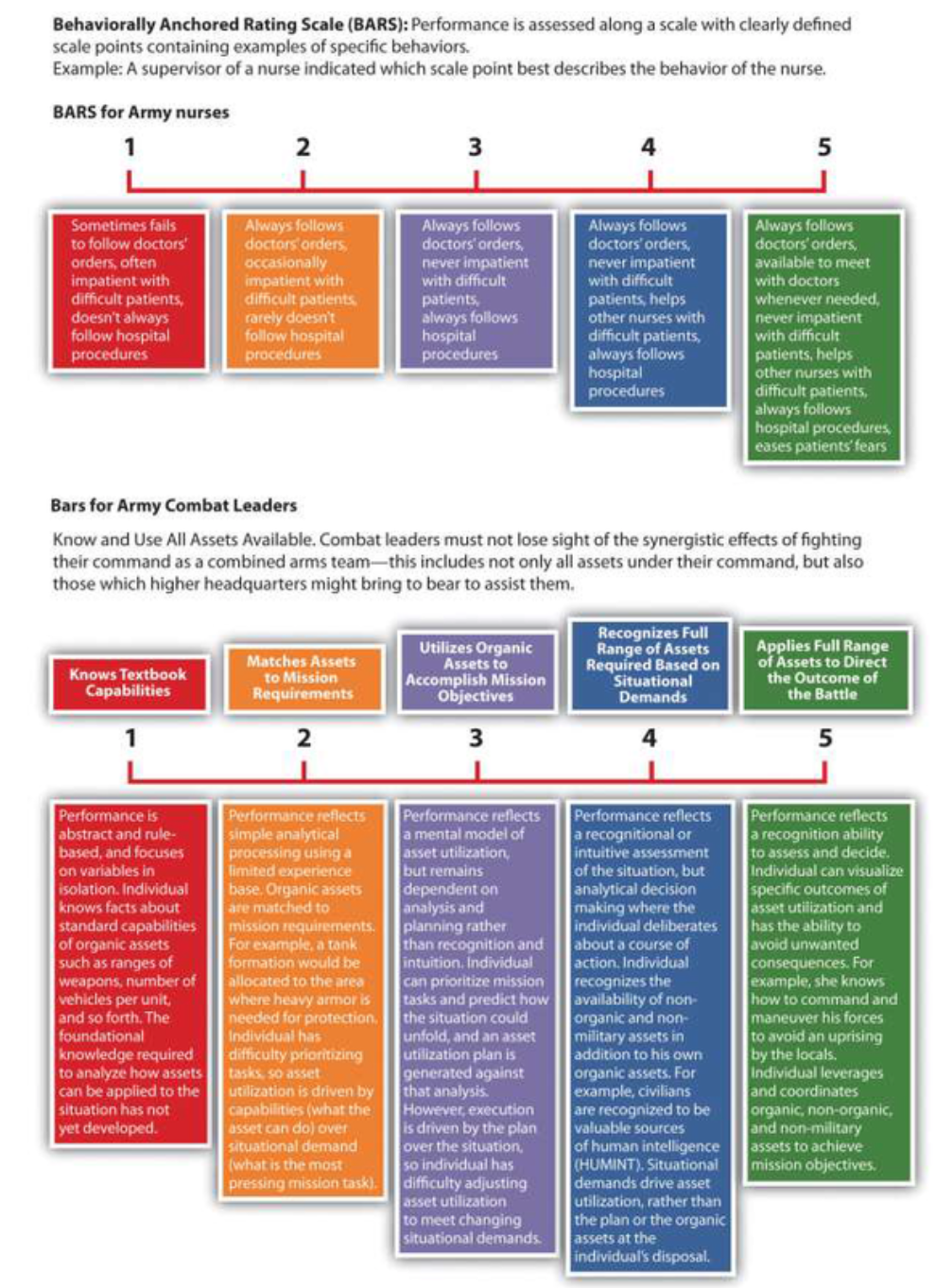
Part 2: Take 2 of the items from your list above, and develop a 5-point BARS scale for both items. Once again, please evaluate your own behaviour (but do not share your ratings - we will do something with them in Part 3). Check out the textbook for more information about BARS scales. This is an example of what a 5-point BARS scale looks like:
Part 3: Did your ratings change in Part 1 and Part 2? Why or why not? (you don't have to share your ratings).
Part 4: Think of a friend or family member whose behaviour you want to change. Using the problem-solving interview and suggestions for conducting effective appraisals in interviews, explain how you would provide feedback to your friend.
Behaviorally Anchored Rating Scale (BARS): Performance is assessed along a scale with clearly defined scale points containing examples of specific behaviors. Example: A supervisor of a nurse indicated which scale point best describes the behavior of the nurse. BARS for Army nurses 1 2 3 4 5 2 Sometimes fails to follow doctors orders, often impatient with difficult patients, doesn't always follow hospital procedures Always follows doctors orders occasionally impatient with difficult patients rarely doesn't follow hospital procedures Always follows doctors orders never impatient with difficult patients always follows hospital procedures Always follows doctors' orders. never impatient with difficult patients helps other nurses with difficult patients always follows hospital procedures Always follows doctors' orders, available to meet with doctors whenever needed, never impatient with difficult patients, helps other nurses with difficult patients always follows hospital procedures eases patients' fears Bars for Army Combat Leaders Know and Use All Assets Available. Combat leaders must not lose sight of the synergistic effects of fighting their command as a combined arms team-this includes not only all assets under their command, but also those which higher headquarters might bring to bear to assist them. Knows Textbook Capabilities Matches Assets to Mission Requirements Utilizes Organic Assets to Accomplish Mission Objectives Recognizes Full Range of Assets Required Based on Situational Demands Applies Full Range of Assets to Direct the Outcome of the Battle 1 2 3 5 Performance is abstract and rule- based, and focuses on variables in isolation. Individual knows facts about standard capabilities of organic assets such as ranges of weapons, number of vehicles per unit and so forth. The foundational knowledge required to analyze how assets can be applied to the situation has not yet developed Performance reflects Performance reflects simple analytical a mental model of processing using a asset utilization limited experience but remains base. Organic assets dependent on are matched to analysis and mission requirements. planning rather For example, a tank than recognition and formation would be intuition. Individual allocated to the area can prioritize mission where heavy armoris tasks and predict how needed for protection the situation could Individual has unfold, and an asset difficulty prioritizing utilization plan is tasks. so asset generated against utilization is driven by that analysis. capabilities what the However, execution asset can do) over is driven by the plan situational demand over the situation, (what is the most so individual has pressing mission task). difficulty adjusting asset utilization to meet changing situational demands Performance reflects a recognitional or intuitive assessment of the situation, but analytical decision making where the individual deliberates about a course of action. Individual recognizes the availability of non organic and non- military assets in addition to his own organic assets. For example, civilians are recognized to be valuable sources of human intelligence (HUMINT). Situational demands drive asset utilization, rather than the plan or the organic assets at the individual's disposal. Performance reflects a recognition ability to assess and decide. Individual can visualize specific outcomes of asset utilization and has the ability to avoid unwanted consequences. For example, she knows how to command and maneuver his forces to avoid an uprising by the locals. Individual leverages and coordinates organic, non-organic, and non-military assets to achieve mission objectivesStep by Step Solution
There are 3 Steps involved in it

Get step-by-step solutions from verified subject matter experts
 Study Help