







Question: Part 1 : Please choose TRUE or FALSE for the statement. In the newsvendor problem, safety stock reduction from aggregating customer demand from different locations
Part : Please choose TRUE or FALSE for the statement.
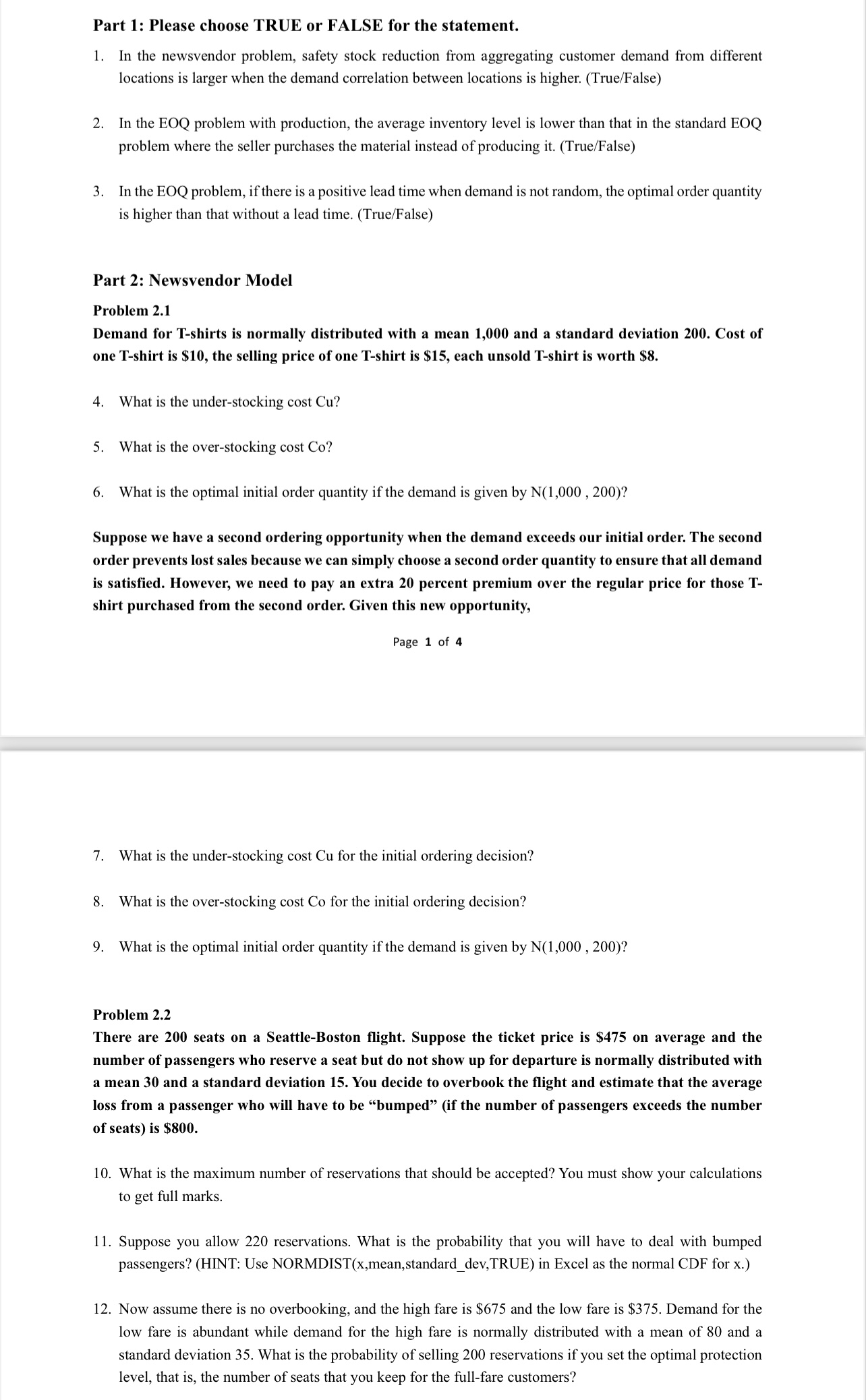
In the newsvendor problem, safety stock reduction from aggregating customer demand from different locations is larger when the demand correlation between locations is higher. TrueFalse
In the EOQ problem with production, the average inventory level is lower than that in the standard EOQ problem where the seller purchases the material instead of producing itTrueFalse
In the EOQ problem, if there is a positive lead time when demand is not random, the optimal order quantity is higher than that without a lead time. TrueFalse
Part : Newsvendor Model
Problem
Demand for Tshirts is normally distributed with a mean and a standard deviation Cost of one Tshirt is $ the selling price of one Tshirt is $ each unsold Tshirt is worth $
What is the understocking cost
What is the overstocking cost Co
What is the optimal initial order quantity if the demand is given by
Suppose we have a second ordering opportunity when the demand exceeds our initial order. The second order prevents lost sales because we can simply choose a second order quantity to ensure that all demand is satisfied. However, we need to pay an extra percent premium over the regular price for those shirt purchased from the second order. Given this new opportunity,
Page of
What is the understocking cost for the initial ordering decision?
What is the overstocking cost Co for the initial ordering decision?
What is the optimal initial order quantity if the demand is given by
Problem
There are seats on a SeattleBoston flight. Suppose the ticket price is $ on average and the number of passengers who reserve a seat but do not show up for departure is normally distributed with a mean and a standard deviation You decide to overbook the flight and estimate that the average loss from a passenger who will have to be "bumped" if the number of passengers exceeds the number of seats is $
What is the maximum number of reservations that should be accepted? You must show your calculations to get full marks.
Suppose you allow reservations. What is the probability that you will have to deal with bumped passengers? HINT: Use NORMDISTxmean,standarddev,TRUE in Excel as the normal CDF for x
Now assume there is no overbooking, and the high fare is $ and the low fare is $ Demand for the low fare is abundant while demand for the high fare is normally distributed with a mean of and a standard deviation What is the probability of selling reservations if you set the optimal protection level, that is the number of seats that you keep for the fullfare customers?
Step by Step Solution
There are 3 Steps involved in it
1 Expert Approved Answer
Step: 1 Unlock

Question Has Been Solved by an Expert!
Get step-by-step solutions from verified subject matter experts
Step: 2 Unlock
Step: 3 Unlock
 Study Help