





Question: PART 1 Question 1 Question 2 Question 3 Question 4 Question 5 Question 6 Question 7 Choose FOUR questions from this section, illustrating your answer
PART 1 Question 1 Question 2 Question 3 Question

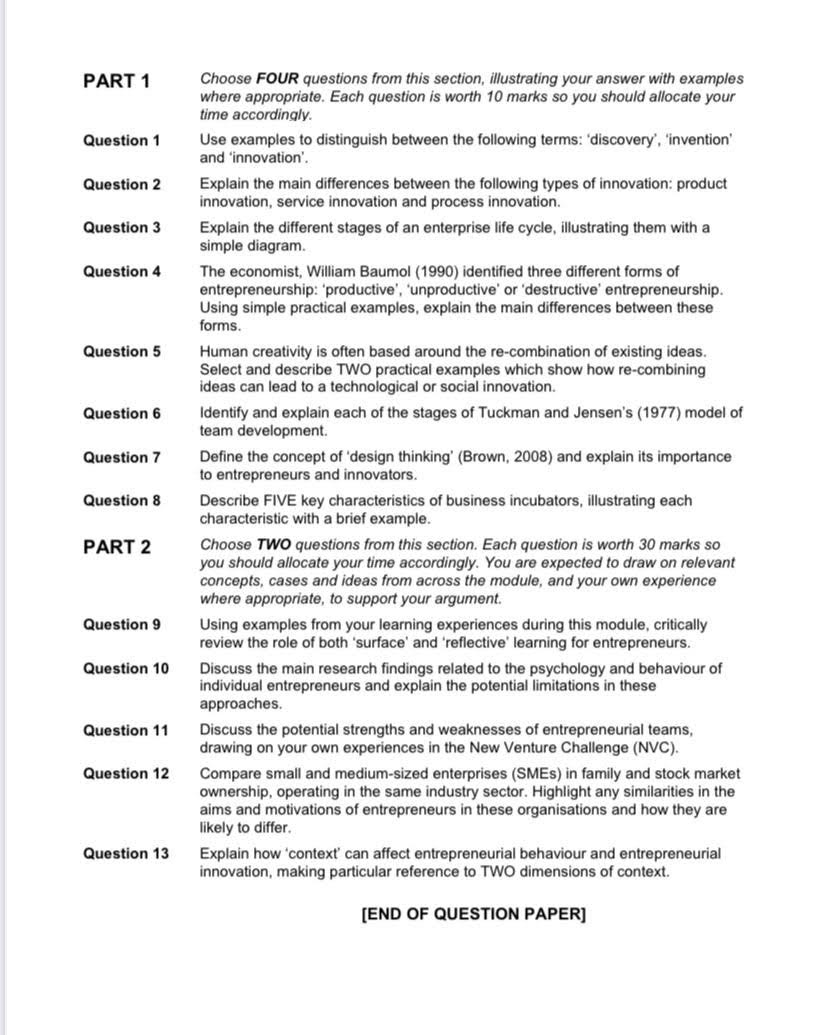
PART 1 Question 1 Question 2 Question 3 Question 4 Question 5 Question 6 Question 7 Choose FOUR questions from this section, illustrating your answer with examples where appropriate. Each question is worth 10 marks so you should allocate your time accordingly. Use examples to distinguish between the following terms: 'discovery', 'invention and 'innovation' Explain the main differences between the following types of innovation: product innovation, service innovation and process innovation. Explain the different stages of an enterprise life cycle, illustrating them with a simple diagram The economist, William Baumol (1990) identified three different forms of entrepreneurship: 'productive', 'unproductive' or 'destructive' entrepreneurship. Using simple practical examples, explain the main differences between these forms. Human creativity is often based around the re-combination of existing ideas. Select and describe TWO practical examples which show how re-combining ideas can lead to a technological or social innovation Identify and explain each of the stages of Tuckman and Jensen's (1977) model of team development. Define the concept of design thinking' (Brown, 2008) and explain its importance to entrepreneurs and innovators, Describe FIVE key characteristics of business incubators, illustrating each characteristic with a brief example. Choose TWO questions from this section. Each question is worth 30 marks so you should allocate your time accordingly. You are expected to draw on relevant concepts, cases and ideas from across the module, and your own experience where appropriate, to support your argument. Using examples from your learning experiences during this module, critically review the role of both 'surface' and 'reflective learning for entrepreneurs. Discuss the main research findings related to the psychology and behaviour of individual entrepreneurs and explain the potential limitations in these approaches. Discuss the potential strengths and weaknesses of entrepreneurial teams, drawing on your own experiences in the New Venture Challenge (NVC). Compare small and medium-sized enterprises (SMEs) in family and stock market ownership, operating in the same industry sector. Highlight any similarities in the aims and motivations of entrepreneurs in these organisations and how they are likely to differ Explain how 'context can affect entrepreneurial behaviour and entrepreneurial innovation, making particular reference to TWO dimensions of context. Question 8 PART 2 Question 9 Question 10 Question 11 Question 12 Question 13 [END OF QUESTION PAPER]

Step by Step Solution

There are 3 Steps involved in it

1 Expert Approved Answer
Step: 1 Unlock blur-text-image

Question Has Been Solved by an Expert!

Get step-by-step solutions from verified subject matter experts

Step: 2 Unlock
Step: 3 Unlock

Students Have Also Explored These Related General Management Questions!