







Question: Part 1 Reference: https://phet.colorado.edu/en/simulation/blackbody-spectrumPart 2 Reference: https://phet.colorado.edu/en/simulation/legacy/photoelectric h = 6.626E-34 J's Ap T= 2.90E-3 m.K c=Af E=hf KEmax = hf-Wo Wo= hfo KE = 1/am
Part 1 Reference: https://phet.colorado.edu/en/simulation/blackbody-spectrumPart 2 Reference: https://phet.colorado.edu/en/simulation/legacy/photoelectric
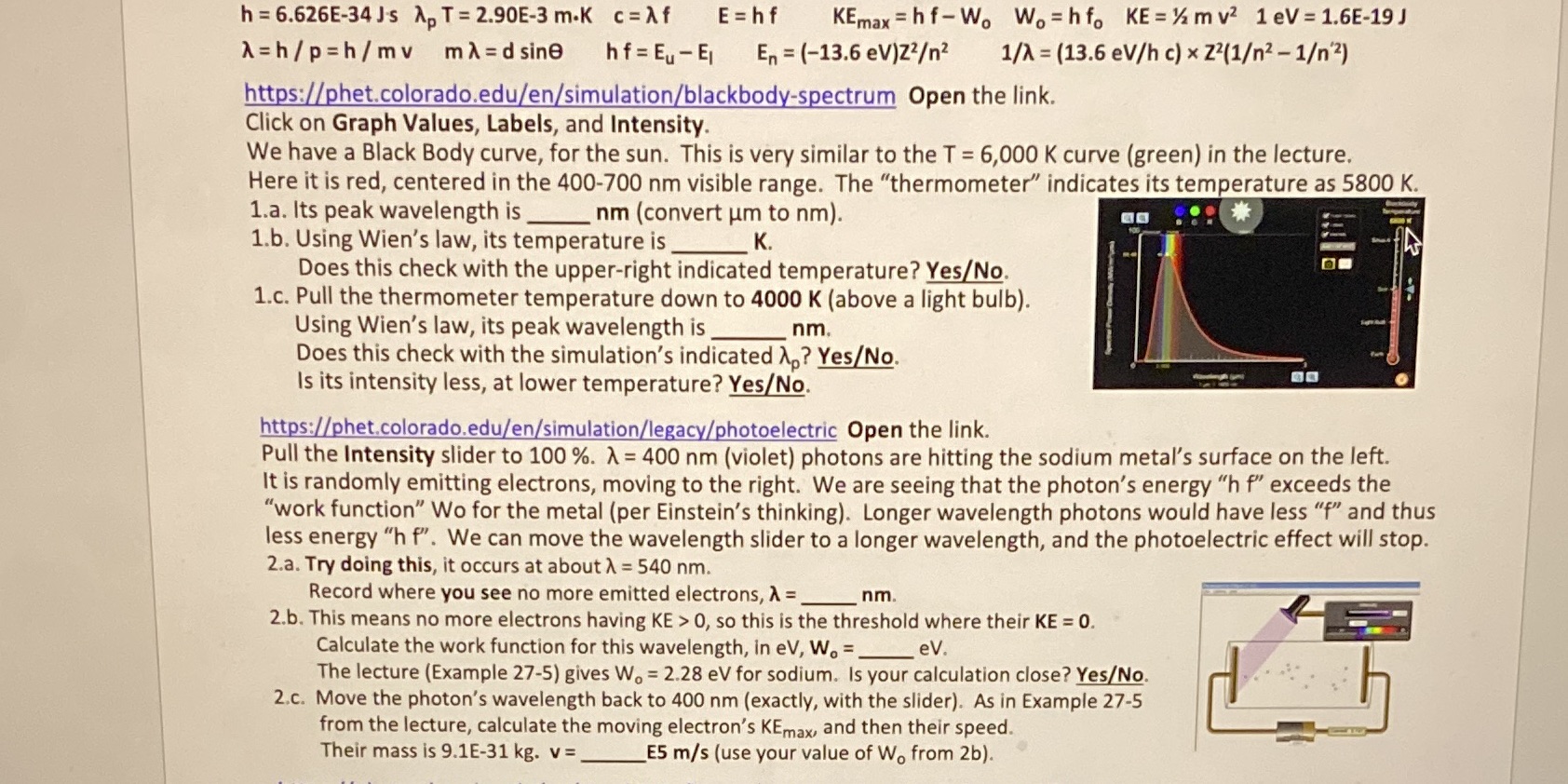
h = 6.626E-34 J's Ap T= 2.90E-3 m.K c=Af E=hf KEmax = hf-Wo Wo= hfo KE = 1/am v2 1 eV =1.6E-19 J A=h/p=h/mv ma= dsine hf= Eu -E En=(-13.6 eV)Z2? 1/1 = (13.6 eV/h c) x Z2(12 -1'?) https://phet.colorado.edu/en/simulation/blackbody-spectrum Open the link. Click on Graph Values, Labels, and Intensity. We have a Black Body curve, for the sun. This is very similar to the T = 6,000 K curve (green) in the lecture. Here it is red, centered in the 400-700 nm visible range. The "thermometer" indicates its temperature as 5800 K. 1.a. Its peak wavelength is _nm (convert um to nm). 1.b. Using Wien's law, its temperature is K. Does this check with the upper-right indicated temperature? Yes/No. 1.c. Pull the thermometer temperature down to 4000 K (above a light bulb). Using Wien's law, its peak wavelength is nm. Does this check with the simulation's indicated ? Yes/No. Is its intensity less, at lower temperature? Yes/No. https://phet.colorado.edu/en/simulation/legacy/photoelectric Open the link. Pull the Intensity slider to 100%. 1 = 400 nm (violet) photons are hitting the sodium metal's surface on the left. It is randomly emitting electrons, moving to the right. We are seeing that the photon's energy "h f" exceeds the "work function" Wo for the metal (per Einstein's thinking). Longer wavelength photons would have less "f" and thus less energy "h f". We can move the wavelength slider to a longer wavelength, and the photoelectric effect will stop. 2.a. Try doing this, it occurs at about ) = 540 nm. Record where you see no more emitted electrons, A = _ _nm. 2.b. This means no more electrons having KE > 0, so this is the threshold where their KE = 0. Calculate the work function for this wavelength, in ev, W. = _ ev. The lecture (Example 27-5) gives W. = 2.28 eV for sodium. Is your calculation close? Yes/No. 2.c. Move the photon's wavelength back to 400 nm (exactly, with the slider). As in Example 27-5 from the lecture, calculate the moving electron's KEmax, and then their speed. Their mass is 9.1E-31 kg. v= E5 m/s (use your value of W. from 2b)
Step by Step Solution
There are 3 Steps involved in it

Get step-by-step solutions from verified subject matter experts
 Study Help