







Question: Part 1 - Your boss is back with a two partial models. The first partial model you boss needs you to look at is for
Part 1 -
Your boss is back with a two partial models. The first partial model you boss needs you to look at is for the stock of Gao Computing sells for $50, and last years dividend was $2.10. A flotation cost of 10% would be required to issue new common stock. Gaospreferred stock pays a dividend of $3.30 per share, and newpreferred stock could be sold at a price to net the company $30 per share. Security analysts are projecting that the common dividend will grow at a rate of 7% a year. The firm can issue additional long-term debt at an interest rate (or a before-tax cost) of 10%, and its marginal tax rate is 35%. The market risk premium is 6%, the risk-free rate is 6.5%, and Gaos beta is 0.83. In its cost-of-capital calculations, Gao uses a target capital structure with 45% debt, 5% preferred stock, and 50% common equity.
- Calculate the cost of each capital componentin other words, the after-tax cost of debt, the cost of preferred stock (including flotation costs), and the cost of equity (ignoring flotation costs). Use both the CAPM method and the dividend growth approach to find the cost of equity.
- Calculate the cost of new stock using the dividend growth approach.
- What is the cost of new common stock based on the CAPM? (Hint: Find the difference between re and rs as determined by the dividend growth approach and then add that difference to the CAPM value for rs.)
- Assuming that Gao will not issue new equity and will continue to use the same target capital structure, what is the companys WACC? e. Suppose Gao is evaluating three projects with the following characteristics.
- Each project has a cost of $1 million. They will all be financed using the target mix of long-term debt, preferred stock, and common equity. The cost of the common equity for each project should be based on the beta estimated for the project. All equity will come from reinvested earnings.
- Equity invested in Project A would have a beta of 0.5 and an expected return of 9.0%.
- Equity invested in Project B would have a beta of 1.0 and an expected return of 10.0%.
- Equity invested in Project C would have a beta of 2.0 and an expected return of 11.0%.
- Analyze the companys situation, and explain why each project should be accepted or rejected
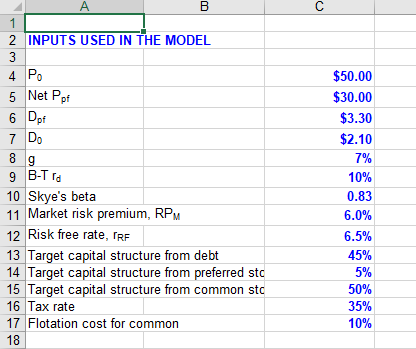
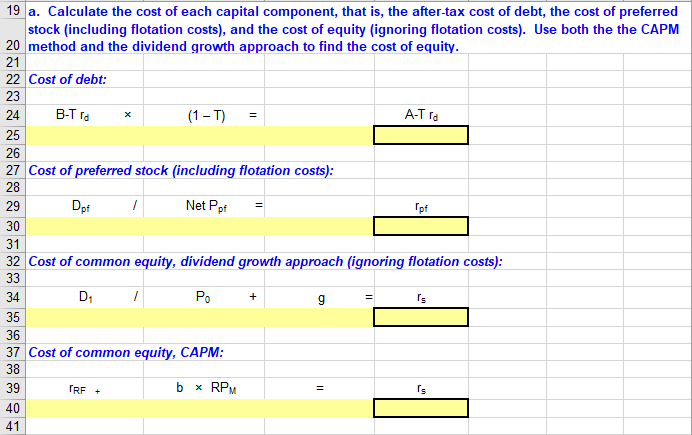
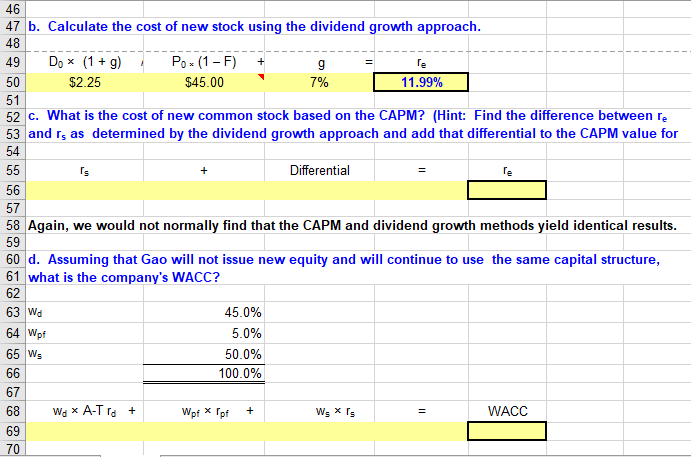
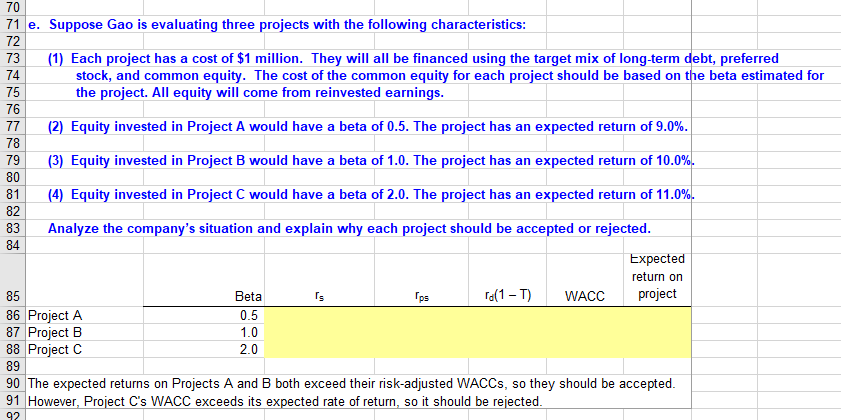
2 INPUTS USED IN THE MODEL 4 P 5 Net Pp 7 Do $50.00 $30.00 $3.30 2.10 9 10 Skye's beta 11 Market risk premium, RPM 12 Risk free rate, TRF 13 Target capital structure from debt 14 Target capital structure from preferred st 15 Target capital structure from common sto 16 Tax rate 17 Flotation cost for common 18 10% 0.83 6.0% 6.5% 45% 5% 50% 35% 10% 19 a. Calculate the cost of each capital component, that is, the after-tax cost of debt, the cost of preferred stock (including flotation costs), and the cost of equity (ignoring flotation costs). Use both the the CAPM 20 method and the dividend growth approach to find the cost of equity 21 22 Cost of debt: 23 24 B-Trdx 25 26 27 Cost of preferred stock (including flotation costs) 28 29 30 31 32 Cost of common equity, dividend growth approach (ignoring flotation costs) A-T rd Net Ppf D1 34 35 36 37 Cost of common equity, CAPM 38 39 40 41 RF+ b x RPM 46 47 b. Calculate the cost of new stock using the dividend growth approach 48Po (1-F) 49 Dox (1+ g) 50 51 52 c. What is the cost of new common stock based on the CAPM? (Hint: Find the difference between re 53 and rs as determined by the dividend growth approach and add that differential to the CAPM value for 54 $2.25 $45.00 7% 11.99% Differential 56 57 58 Again, we would not normally find that the CAPM and dividend growth methods yield identical results 59 60 d. Assuming that Gao will not issue new equity and will continue to use the same capital structure, 61 what is the company's WACC? 62 63 Wd 64 Wpf 45,0% 5,0% 50.0% 100.0% 67 WACC 69 70 71 e. Suppose Gao is evaluating three projects with the following characteristics 72 73 (1) Each project has a cost of $1 million. They will all be financed using the target mix of long-term debt, preferred 74 75 76 77 (2) Equity invested in Project A would have a beta of 0.5. The project has an expected return of 9.0% 78 79 (3) Equity invested in Project B would have a beta of 1.0. The project has an expected return of 10 80 81(4) Equity invested in Project C would have a beta of 2.0. The project has an expected return of 11 82 83 Analyze the company's situation and explain why each project should be accepted or rejected 84 stock, and common equity. The cost of the common equity for each project should be based on the beta estimated for the project. All equity will come from reinvested earnings Expected return on 1-T WACC project 85 86 Proiect A 87 Proiect B 88 ProjectC 89 90 The expected returns on Projects A and B both exceed their risk-adjusted WACCs, so they should be accepted 91 However, Proiect C's WACC exceeds its expected rate of return, so it should be reiected 92 Beta 0.5 1.0
Step by Step Solution
There are 3 Steps involved in it

Get step-by-step solutions from verified subject matter experts
 Study Help